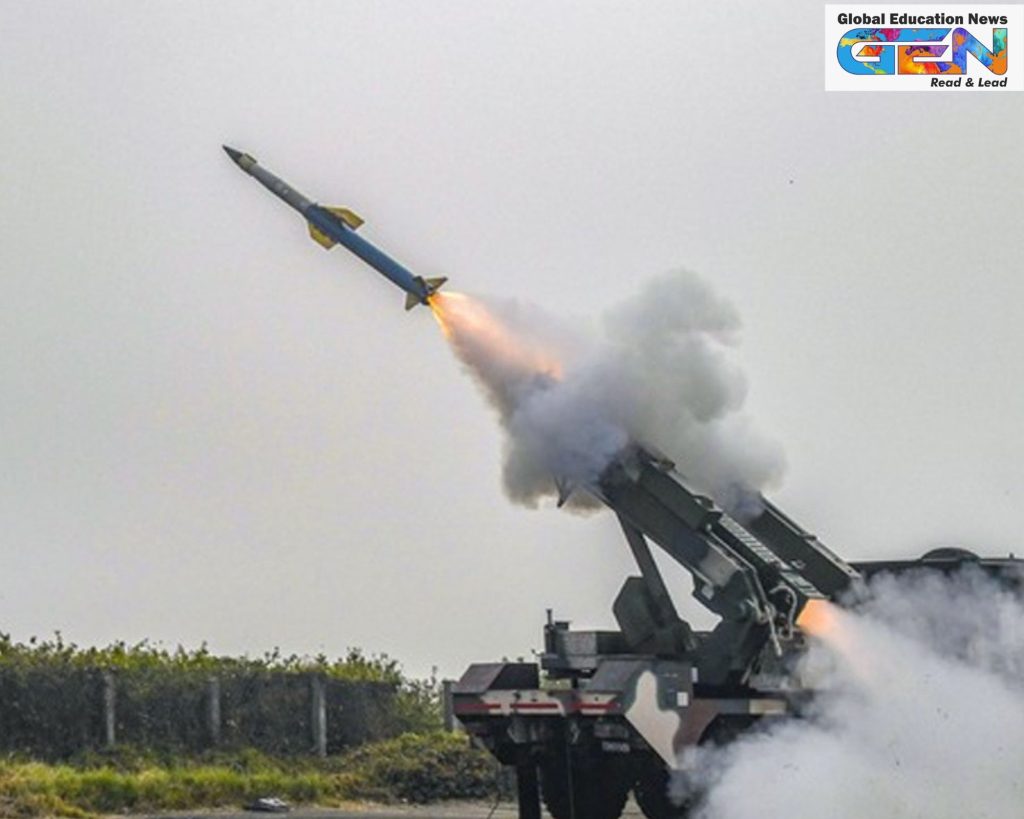
India marked a historic milestone in its defense capabilities with the successful maiden flight tests of the Integrated Air Defence Weapon System (IADWS) on August 23, 2025, off the coast of Odisha. Conducted by the Defence Research and Development Organisation (DRDO), the test showcased a cutting-edge, indigenously developed multi-layered air defense shield, heralding a new era of self-reliance under the Atmanirbhar Bharat initiative. Defense Minister Rajnath Singh praised the DRDO and the Indian Armed Forces, calling the achievement a game-changer for protecting critical infrastructure against aerial threats. Here’s an in-depth look at the IADWS, its components, and its significance for India’s defense landscape.
A Breakthrough in Air Defense: The IADWS Test
The IADWS test, conducted at 12:30 PM IST on August 23, 2025, at the Integrated Test Range (ITR) in Chandipur, Odisha, demonstrated India’s ability to neutralize diverse aerial threats. The system simultaneously engaged and destroyed multiple targets, including two high-speed fixed-wing Unmanned Aerial Vehicles (UAVs) and a multi-copter drone, at varying ranges and altitudes.
Key Points:
- Test Date and Location: August 23, 2025, at 12:30 PM IST, off Odisha’s coast at ITR Chandipur.
- Targets Neutralized: Two high-speed UAVs and a multi-copter drone, showcasing multi-target engagement.
- Performance: Flawless coordination of radar, missile systems, and command-and-control networks, validated by range instruments.
- Official Statement: Rajnath Singh lauded the test as a milestone in strengthening area defense for vital facilities.
Components of the IADWS: A Multi-Layered Shield
The IADWS is India’s first fully indigenous multi-layered air defense system, integrating three advanced technologies to counter a wide spectrum of aerial threats, from drones to high-speed aircraft and missiles. Controlled by a Centralised Command and Control Centre developed by the Defence Research & Development Laboratory, the system is a testament to India’s growing defense innovation.
Key Components:
- Quick Reaction Surface-to-Air Missile (QRSAM): Engages medium-range threats like aircraft and cruise missiles at 30–35 km range and up to 15 km altitude, offering mobile defense for forward bases.
- Advanced Very Short Range Air Defence System (VSHORADS): Targets low-altitude threats, such as helicopters and drones, within 6–7 km, ensuring point defense.
- High-Power Laser-Based Directed Energy Weapon (DEW): A futuristic, cost-efficient laser system for speed-of-light engagement, ideal against drone swarms and saturation attacks.
- Command and Control: Seamlessly integrates all components, with radar and communication systems developed by Research Centre Imarat and Centre for High Energy Systems and Sciences.
Strategic Significance: Aligning with Sudarshan Chakra
The IADWS test aligns with Prime Minister Narendra Modi’s Mission Sudarshan Chakra, announced on Independence Day 2025, which aims to develop a fully indigenous air defense shield by 2035. The system, dubbed Sudarshan Chakra, integrates advanced surveillance, cybersecurity, and physical safeguards to protect critical infrastructure.
Key Points:
- Sudarshan Chakra Vision: A multi-layered framework to counter drones, stealth aircraft, and hypersonic weapons, reducing reliance on imports like Russia’s S-400.
- Strategic Timing: Follows the Agni-5 missile test on August 20, 2025, showcasing India’s dual offensive and defensive capabilities.
- Self-Reliance: Fully indigenous systems highlight India’s growing R&D prowess under Atmanirbhar Bharat.
- Global Standing: Positions India alongside nations like the U.S. (Patriot), Russia (S-400), and Israel (Iron Dome) with advanced air defense systems.
Impact on National Security
The IADWS strengthens India’s defense against 21st-century aerial threats, including drones, cruise missiles, and stealth aircraft. Its multi-layered approach eliminates gaps in traditional single-layered defenses, ensuring robust protection for nuclear installations, air bases, and industrial zones.
Key Points:
- Threat Neutralization: Capable of countering low-flying drones, high-speed aircraft, and precision-guided munitions.
- Operational Readiness: Validated target acquisition, tracking, and engagement protocols, with further trials planned across diverse terrains.
- Cost Efficiency: DEW’s near-unlimited firing cycles reduce reliance on expensive missiles, ideal for drone swarm defense.
- Export Potential: Strengthens India’s “Make in India – Make for the World” vision, with potential for global exports.
Challenges and Next Steps
While the maiden test marks a significant achievement, the IADWS requires extensive field trials to ensure reliability across varied scenarios, including electronic warfare environments and extreme terrains. Integrating complex systems like QRSAM, VSHORADS, and DEW under a unified command structure also poses logistical challenges.
Key Points:
- Future Trials: Live intercepts of cruise missile surrogates and drone swarms planned for 2026.
- Challenges: Coordinating multiple layers and scaling production for nationwide deployment.
- DRDO’s Role: Continued R&D to refine DEW technology and enhance system interoperability.
- Deployment Timeline: Full operationalization expected by 2028, with initial deployments at strategic sites.