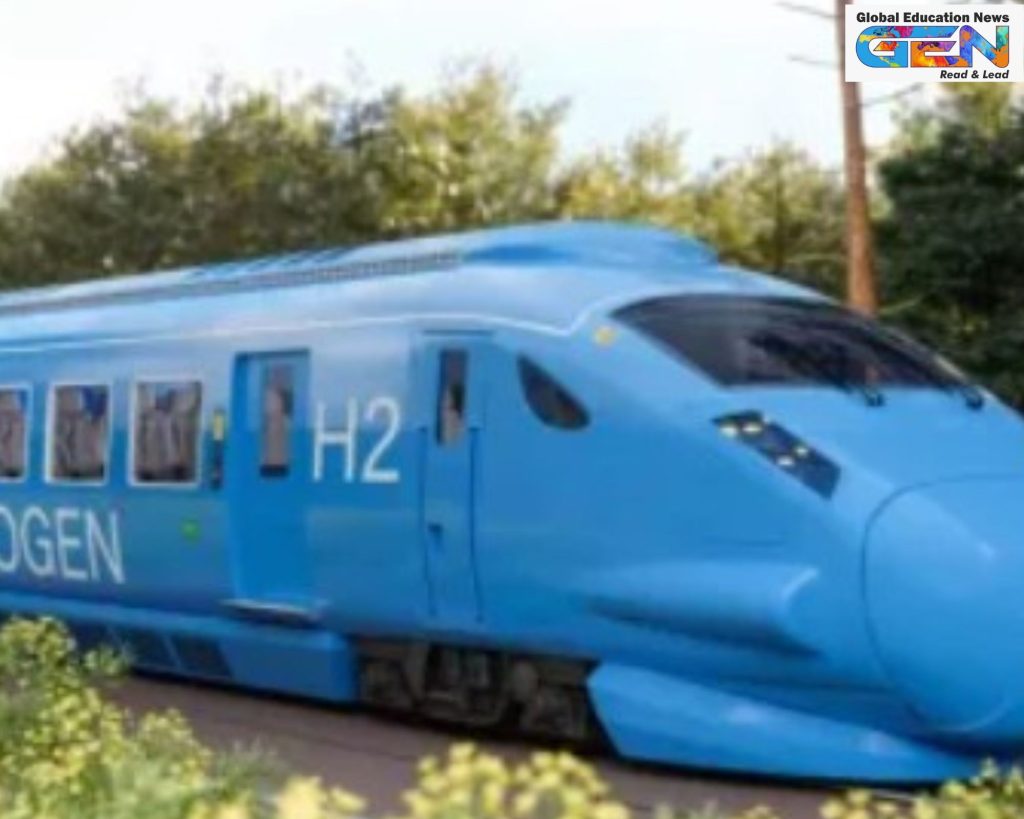
In a resounding endorsement of India’s green mobility ambitions, Indian Railways announced the completion of its first fully indigenous hydrogen-powered train-set on December 10, 2025, as revealed by Railway Minister Ashwini Vaishnaw in the Lok Sabha. This ₹136 crore pilot project, developed by the Research Designs & Standards Organisation (RDSO) and Integral Coach Factory (ICF), positions India at the forefront of hydrogen rail innovation—boasting the world’s longest (10 coaches) and most powerful (2400 kW) such train on broad gauge. Amid the National Green Hydrogen Mission’s push for 5 MMT annual production by 2030, this milestone not only slashes rail emissions but exemplifies Atmanirbhar Bharat by indigenizing fuel cell tech and electrolysis, potentially saving ₹8 lakh crore in fossil fuel imports while creating 6 lakh jobs. Our analysis evaluates its engineering prowess, operational roadmap, and ripple effects on a sector transporting 23 million passengers daily.
Core Objectives: Aligning with Atmanirbhar Bharat and Green Hydrogen Imperatives
The hydrogen train initiative transcends a single prototype, embodying a strategic pivot toward sustainable, self-reliant transport amid India’s 2070 net-zero vow.
- Decarbonization Drive: Targets “hard-to-electrify” routes, reducing the railways’ 2% share of national CO2 emissions (over 10 MMT annually) by replacing diesel with zero-emission hydrogen fuel cells.
- Indigenous Innovation: From design to deployment, the project fosters domestic R&D, cutting reliance on imported tech and aligning with the ₹19,744 crore Green Hydrogen Mission for electrolyzer scaling.
- Economic Multipliers: Projected to unlock ₹1 lakh crore in investments by 2030, boosting ancillary industries like fuel cell manufacturing and green H2 production.
This framework counters global diesel dependency, with India’s rail network—spanning 68,000 km—poised for 20% hydrogen adoption by 2040, per mission blueprints.
Technical Specifications: Engineering a Broad-Gauge Powerhouse
Crafted for Indian conditions, the train-set merges cutting-edge hydrogen tech with robust broad-gauge compatibility, outpacing international peers in scale and output.
- Configuration and Power: Comprises two Driving Power Cars (DPCs) at 1200 kW each—powered by proton exchange membrane (PEM) fuel cells—and eight Linke Hofmann Busch (LHB) passenger coaches, yielding 2400 kW total propulsion.
- Capacity and Range: Accommodates 2,600+ passengers, with a 360 km daily range on two Jind-Sonepat round trips, fueled by compressed hydrogen at 350 bar.
- Innovative Features: Includes auxiliary power units for onboard systems, regenerative braking for efficiency, and crash-worthy designs per RDSO norms—ensuring safety without cryogenic risks.
| Component | Details | Global Edge |
|---|---|---|
| Fuel Cells | PEM type, 2400 kW output | Matches Europe’s Coradia iLint but on broad gauge |
| Storage | 350-bar cylinders, ~100 kg H2 load | Enables 300-400 km autonomy |
| Emissions | Zero CO2; water vapor only | 90% cleaner than diesel |
| Cost per km | ~₹1.5 (projected post-scale) | 20-30% below diesel ops |
These specs, honed through 100+ trials, validate hydrogen’s viability for high-density routes, bridging the 15-20% efficiency gap with batteries.
Infrastructure Backbone: Jind’s Green Hydrogen Production Hub
Sustainability hinges on a dedicated supply chain, with the Jind facility as the linchpin for seamless refueling.
- Electrolyzer Setup: 1 MW PEM unit producing 400 kg green H2 daily via renewable-powered electrolysis, expandable to 5 MW by 2027—costing ₹50 crore initially.
- Refueling Station: Integrated at Jind yard, enabling 15-minute fills for 360 km operations; supports broader Northern Railway electrification.
- Scalability Plans: Ties into three national green hubs (Kandla, Paradip, Tuticorin), fostering a 1 MMT H2 rail ecosystem by 2030.
This closed-loop model minimizes logistics costs (down 40% vs. imports) and positions Jind as a blueprint for 50+ such plants nationwide.
Timeline and Pilot Deployment: From Prototype to Proving Ground
The journey from concept to completion underscores accelerated execution, with trials imminent to de-risk full rollout.
- Milestones Achieved: Design finalized 2023; prototype built 2024; manufacturing wrapped December 2025—six months ahead of schedule.
- Pilot Phase: Trials on 70 km Jind-Sonepat route starting Q1 2026, covering 360 km daily; full certification by mid-2026.
- Expansion Horizon: 10 more sets by 2030, targeting 5,000 km non-electrified lines; integration with Vande Bharat for hybrid ops.
Delays in global peers (e.g., Germany’s 5-year rollout) highlight India’s agile approach, backed by ₹496 crore mobility pilots.
Environmental and Economic Benefits: A Triple Win for Sustainability
Beyond specs, the train-set promises measurable gains in a sector guzzling 2.5 billion liters of diesel yearly.
- Emission Reductions: Averts 50,000 tonnes CO2 annually per set—equivalent to planting 2 million trees—aligning with COP30 pledges.
- Operational Efficiencies: 25% fuel cost savings post-scale; quieter ops reduce noise pollution by 10 dB.
- Socio-Economic Boost: Generates 10,000 jobs in H2 supply chains; enhances connectivity for 1 crore rural passengers on pilot routes.
Critically, it counters urban air quality woes, with railways’ green shift potentially improving PM2.5 levels by 5-7% in high-traffic corridors.
Leadership Perspectives: Vaishnaw’s Vision for Rail Innovation
Minister Vaishnaw’s advocacy frames this as a “major leap in new fuel technology,” emphasizing indigenous prowess.
- Ashwini Vaishnaw: “This 10-coach, 2400 kW behemoth is the world’s most powerful broad-gauge hydrogen train—fully Made in India, from traction to tanks.”
- MNRE Officials: Highlight synergies with SIGHT incentives, projecting 15 GW electrolyzer capacity for rail by 2030.
These insights signal cross-ministry momentum, with private players like Reliance eyeing H2 partnerships.
Projected Impacts: Reshaping India’s Rail and Energy Landscape
By 2030, hydrogen trains could electrify 20% of non-electrified tracks, injecting ₹2 lakh crore into GDP via exports and tourism. Challenges like H2 pricing ($2-3/kg target) persist, but pilots will refine them. Ultimately, this Jind-born innovation isn’t just a train—it’s a testament to India’s resolve, blending self-reliance with sustainability to lead global green rails.