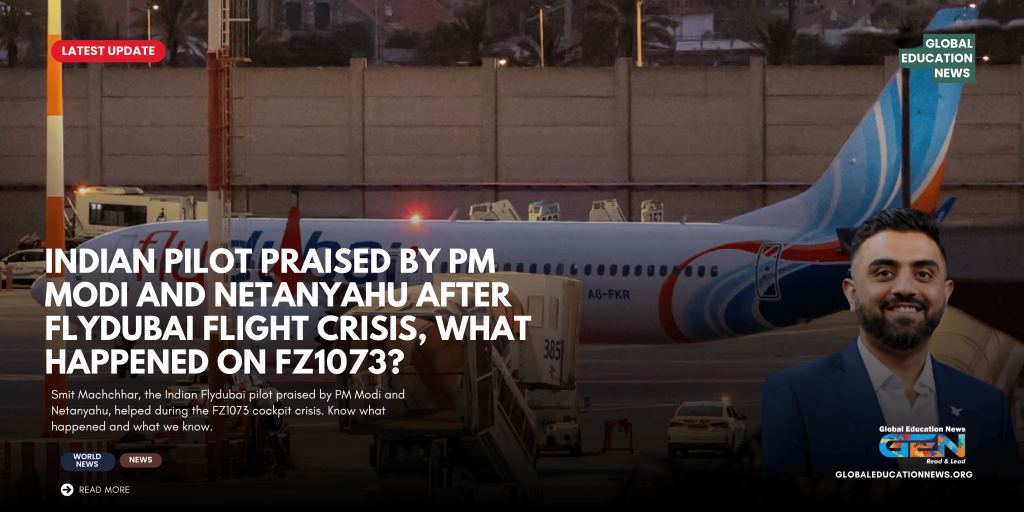
New Delhi, India — Captain Smit Machchhar, the Indian pilot at the centre of the Flydubai Flight FZ1073 incident, has received international recognition after a serious mid-air cockpit confrontation put 174 passengers at risk on a flight from Dubai to Tel Aviv.
Prime Minister Narendra Modi praised Machchhar on October 1, calling him a hero and saying his actions helped protect the lives of passengers and avert a major tragedy. Israeli Prime Minister Benjamin Netanyahu had also publicly praised the captain.
The aircraft eventually landed safely in Tabuk, Saudi Arabia, after passengers and crew intervened and additional pilots helped stabilise the aircraft.
Machchhar, who was seriously injured during the incident, is receiving treatment in Saudi Arabia and has been reported to be in stable condition.
The episode has since raised questions about cockpit security, aviation safety and how a passenger aircraft can be brought under control when an emergency unfolds inside the flight deck.
What Happened on Flydubai Flight FZ1073?
Flydubai flight FZ1073 was travelling from Dubai to Tel Aviv on September 30, 2026, carrying 174 passengers.
According to Israeli officials and multiple international reports, a confrontation developed between the two pilots in the cockpit. The co-pilot allegedly attacked Captain Machchhar and attempted to take control of the aircraft.
The plane then underwent a rapid descent, triggering emergency procedures.
Reuters reported that the aircraft dropped by nearly 14,000 feet in less than 30 seconds during the crisis.
The precise motive behind the alleged attack remains under investigation. Authorities have not established a final explanation for why the confrontation began.
That distinction is important: early reports have raised different possibilities, but investigators have yet to establish a definitive motive.
How Did the Flydubai Plane Reach Safety?
The sequence of events involved more than one person.
Machchhar’s actions helped create an opportunity for people outside the cockpit to intervene. Passengers and crew members entered the flight deck and helped restrain the co-pilot, according to accounts reported by Reuters, AP and The Guardian.
Two Flydubai pilots who were travelling as passengers also became involved in helping stabilise the aircraft and bring it to the ground, according to Reuters.
The aircraft was ultimately diverted to Tabuk in north-western Saudi Arabia, where passengers and crew were able to leave the aircraft safely.
The passengers were later transported onward, while the investigation continued.
Who Is Smit Machchhar?
The incident has also brought sudden international attention to the professional career of the Indian captain.
Machchhar is from Mumbai and previously worked for Indian airline SpiceJet. He joined Flydubai in 2022 as a captain and has accumulated more than 9,750 hours of flying experience on Boeing 737 aircraft, according to his professional profile and reporting based on it.
His aviation career was not something he had originally planned.
Reuters reported that Machchhar had been associated with his family’s textile business before discovering aviation at the age of 19 while studying management in Mumbai. He subsequently trained in New Zealand and built a career in commercial aviation.
Before joining Flydubai, he spent about 11 years with SpiceJet, where he eventually became a senior commander and line-training captain.
That experience has become an important part of the story because the incident demanded not only technical flying skills but also decision-making under extraordinary pressure.
Why PM Modi Praised Captain Smit Machchhar
Prime Minister Narendra Modi publicly praised Machchhar on October 1.
In his message, Modi described the captain as a “HERO” and said that despite being seriously injured, Machchhar demonstrated courage and a determination to protect other people.
Modi also wished him a speedy recovery.
The wording matters because the Prime Minister’s statement was a public expression of recognition, rather than an independent finding about the investigation.
The available reporting indicates that Machchhar’s actions were central to the sequence that allowed passengers and crew to intervene, but investigators are still examining the complete circumstances surrounding the cockpit confrontation.
Netanyahu Also Recognised the Indian Pilot
Modi was not the only national leader to praise Machchhar.
Israeli Prime Minister Benjamin Netanyahu publicly credited the Indian captain for his actions during the emergency and described him as a hero.
Netanyahu also praised passengers and others who intervened during the crisis.
The recognition has given the incident an international dimension involving India, the United Arab Emirates, Israel and Saudi Arabia.
But the central story remains aviation safety: a commercial aircraft carrying 174 people encountered an extraordinary emergency and was ultimately brought safely to the ground.
What Is Known About the Co-Pilot and the Investigation?
Authorities have reported that the co-pilot was taken into custody in Saudi Arabia following the incident.
The co-pilot has been described in reports as an Omani national, while the motive behind the confrontation remains unclear.
Some early accounts raised the possibility of a security or terrorism-related incident, but that should not be treated as an established conclusion while investigations are continuing. AP reported that authorities were investigating the motive and that there was no confirmed explanation at the time of its report.
This is one area where the developing story needs caution.
Aviation incidents often produce competing accounts in their first hours. Investigators must establish the sequence through cockpit evidence, communications, passenger testimony, aircraft data and other records before drawing final conclusions.
Flydubai Flight Incident: Why the Cockpit Matters
The incident has also focused attention on one of the most protected areas of a commercial aircraft: the cockpit.
Modern commercial aviation relies heavily on procedures designed to prevent unauthorised access and protect the flight deck. But the FZ1073 episode demonstrated how quickly an internal emergency can become an aviation crisis.
The aircraft’s rapid descent, the struggle inside the cockpit and the intervention of passengers and additional pilots created a highly unusual chain of events.
Aviation experts cited by international media have emphasised how remarkable it was that the aircraft could recover from such a rapid loss of altitude and continue safely toward an emergency landing.
The incident will therefore be closely examined not only for what happened inside the cockpit but also for how the aircraft’s systems, crew procedures and emergency responses performed under pressure.
Smit Machchhar’s Career Before the Flydubai Incident
Machchhar’s professional journey has emerged as another significant part of the story.
From Mumbai to commercial aviation
He initially had links to his family’s textile business before turning toward aviation during his late teens.
SpiceJet years
He spent more than a decade at SpiceJet, accumulating substantial experience on Boeing 737 aircraft and eventually serving in training and command roles.
Joining Flydubai
Machchhar moved to Flydubai in 2022, becoming a direct-entry captain on the airline’s Boeing 737 fleet. His professional profile records thousands of hours of flight experience.
That background is now being examined alongside the decisions he made during the September 30 emergency.
What Happens Next?
The immediate priority is Machchhar’s recovery and the formal investigation into the flight.
Authorities will need to reconstruct the incident using aircraft data, communications, witness accounts and other evidence.
Several questions remain open:
- What triggered the cockpit confrontation?
- What was the co-pilot’s motive?
- How did the aircraft respond during the rapid descent?
- Which emergency procedures were activated?
- How did passengers and additional pilots assist?
- What aviation-security lessons will emerge from the investigation?
Those answers will take time.
For now, the clearest established fact is that Flydubai FZ1073 reached safety in Tabuk after an extraordinary in-flight emergency, while Captain Smit Machchhar remains under medical care.
The Indian pilot’s name has travelled far beyond the cockpit in the space of a day—from Mumbai and Dubai to Tel Aviv, Riyadh and New Delhi.
But as investigators work through what happened, the story is bigger than the praise surrounding one pilot. It is also a test of the systems, training, procedures and human decisions that stand between an aviation emergency and a catastrophe.