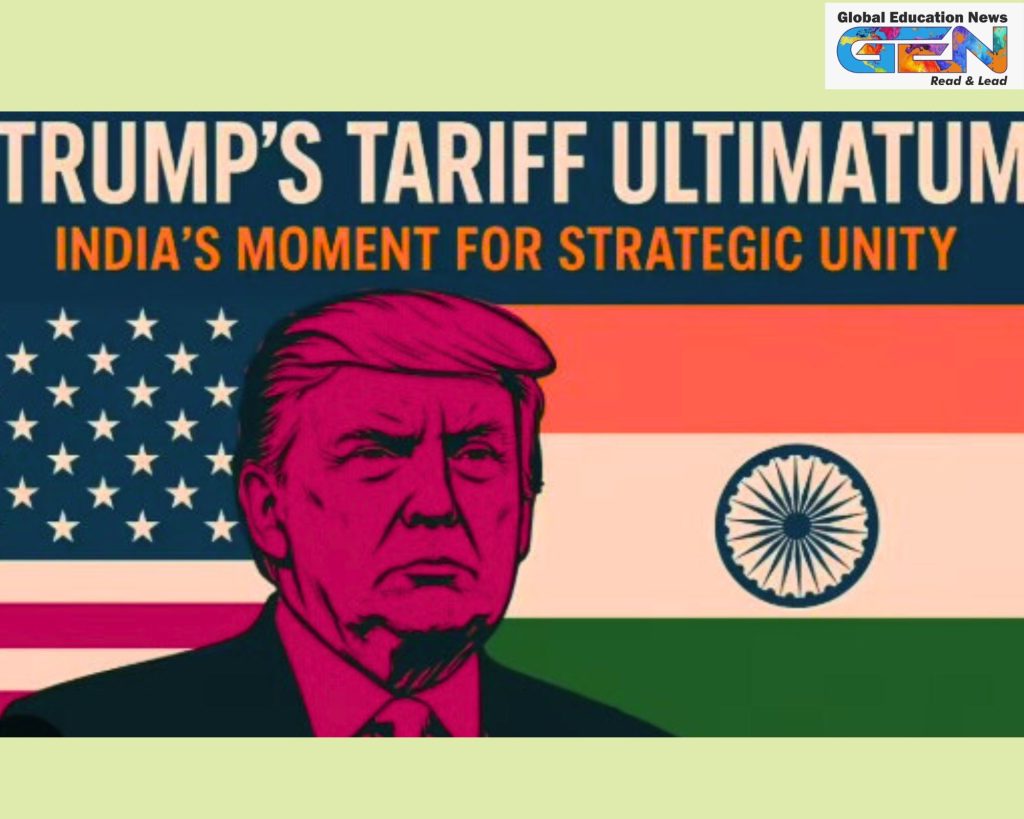
India’s e-commerce export sector, currently valued at $5 billion, faces a critical juncture as 50% US tariffs threaten key industries like textiles, leather, and gems. In response, the Commerce and Industry Ministry is exploring bold reforms, including allowing foreign direct investment (FDI) in inventory-based e-commerce models, to boost exports through the E-Commerce Export Hubs (ECEHs) initiative. With consultations involving giants like Amazon and Flipkart alongside MSMEs, the government aims to ease compliance burdens and tap into a $350 billion export potential by 2030. This article dives into the proposed changes, stakeholder debates, and their implications for India’s small businesses.
Key Points:
- India explores FDI in inventory-based e-commerce to counter 50% US tariffs.
- E-Commerce Export Hubs aim to simplify logistics and compliance for MSMEs.
- Current e-commerce exports at $5 billion could reach $350 billion by 2030.
The US Tariff Shock: A Catalyst for Change
The US imposed a 50% tariff on Indian goods effective August 7, 2025, citing India’s continued purchase of Russian oil. This impacts 55% of India’s $86.5 billion annual exports to the US, particularly MSME-led sectors like textiles, leather, and jewelry. The Federation of Indian Export Organisations (FIEO) warns that the tariffs place Indian exporters at a 30-35% cost disadvantage compared to competitors like Vietnam (20% tariff) or China (30%). With orders on hold and margins thinning, the government is under pressure to act swiftly.
The Commerce Ministry’s response includes the ₹25,000 crore Export Promotion Mission (EPM) and the ECEHs model, announced in the 2025-26 Union Budget. These initiatives aim to diversify markets, enhance digital infrastructure, and streamline compliance, with a focus on empowering MSMEs, which dominate e-commerce exports of low-value goods ($25-$1,000) like handicrafts and garments.
Key Points:
- 50% US tariffs hit 55% of India’s $86.5 billion exports, affecting MSMEs most.
- ₹25,000 crore EPM and ECEHs target market diversification and compliance relief.
- MSMEs export low-value goods like handicrafts, facing high compliance burdens.
Inventory-Based E-Commerce: A Game-Changer for MSMEs?
India’s e-commerce policy currently allows 100% FDI in the marketplace model, where platforms like Amazon and Flipkart act as intermediaries without owning inventory. However, FDI is prohibited in the inventory-based model, where platforms own and sell goods directly. MSMEs argue that allowing FDI in this model could reduce compliance burdens by enabling platforms to handle logistics, customs, and inventory management, thus freeing small businesses to focus on production.
The Global Trade Research Initiative (GTRI) highlights that India’s e-commerce export provisions, designed for traditional B2B trade, burden MSMEs with complex customs procedures and payment repatriation challenges. A separate e-commerce export policy, as seen in China ($300 billion in e-commerce exports), could streamline processes and boost India’s exports to $350 billion by 2030. However, retailers oppose FDI relaxation, fearing it could harm small traders by empowering large platforms.
Key Points:
- 100% FDI is allowed in marketplace models, but banned in inventory-based models.
- MSMEs seek FDI to ease compliance; retailers fear harm to small traders.
- GTRI suggests a dedicated e-commerce export policy to reach $350 billion by 2030.
E-Commerce Export Hubs: A Lifeline for Small Exporters
The ECEHs, announced in the 2025-26 Union Budget, aim to create integrated zones offering customs clearance, packaging, warehousing, and quality certification under one roof. Five pilot projects are set to launch soon, complementing the Districts as Export Hubs (DEH) initiative, which has prepared export plans for 590 districts. These hubs align with the Foreign Trade Policy (FTP) 2023, which extends benefits like RoDTEP and Duty Drawback to courier-mode exports and supports over 1,000 Dak Ghar Niryat Kendras for small-scale exporters.
Partnerships with logistics providers and platforms like Shiprocket, formalized through MoUs, aim to enhance MSME export readiness. The government’s ₹25,000 crore EPM also includes collateral-free loans and brand-building campaigns to position India as a “value-for-money” alternative to China.
Key Points:
- ECEHs offer integrated logistics and compliance support for MSMEs.
- Five pilot hubs to launch soon, alongside 590 district export plans.
- MoUs with platforms like Shiprocket boost MSME export capabilities.
Stakeholder Consultations: A Divided Landscape
The Commerce Ministry, via the DPIIT, has held one round of consultations with stakeholders, including Amazon, Flipkart, MSMEs, and retailers, with a second round scheduled for next week. MSMEs advocate for FDI in inventory-based models to simplify exports, while retailers argue it could disrupt local trade by favoring large platforms. Amazon, which has facilitated $13 billion in Indian exports since 2015, and Flipkart are pushing for relaxed FDI norms for exports, aligning with PM Modi’s vision of a $200-300 billion e-commerce export market by 2030.
The EY-ASSOCHAM report recommends allowing FDI-funded platforms to hold inventory for international sales, raising courier consignment limits, and streamlining reverse logistics to reduce costs. However, opposition from retailers highlights the tension between empowering MSMEs and protecting small traders.
Key Points:
- DPIIT consultations involve Amazon, Flipkart, MSMEs, and retailers.
- MSMEs support FDI in inventory models; retailers oppose it.
- Amazon and Flipkart aim for $80 billion and $200-300 billion export targets by 2030.
Challenges and Opportunities: Navigating the Tariff Storm
The 50% US tariffs exacerbate existing challenges for MSMEs, including complex customs, payment delays, and limited credit access. Banks often hesitate to write off returned goods or platform fees, hurting exporters’ credit ratings. The GTRI and EY-ASSOCHAM reports call for a self-declaration model, quarterly reconciliation, and fintech-driven export credit to ease these frictions.
Opportunities lie in India’s exemption from the US de minimis rule withdrawal, which ended duty-free treatment for Chinese low-value imports ($64.6 billion in 2024). This gives Indian MSMEs a cost advantage in the US market for goods under $800. Additionally, FTAs with the UK and EU could unlock $10 billion in new export opportunities for textiles and chemicals.
Key Points:
- Complex customs and payment issues burden MSME exporters.
- India’s de minimis exemption offers a US market advantage over China.
- FTAs with UK and EU could add $10 billion in export opportunities.
How MSMEs Can Prepare: Actionable Steps
To leverage the proposed reforms, MSMEs should:
- Engage in Consultations: Participate in DPIIT discussions to advocate for FDI and policy reforms.
- Leverage ECEHs: Utilize upcoming Export Hubs for streamlined logistics and compliance support.
- Partner with Platforms: Collaborate with Amazon, Flipkart, or Shiprocket for global market access.
- Explore FTAs: Target markets like the UK and EU to offset US tariff impacts.
- Adopt Digital Tools: Use fintech solutions for export credit and compliance to reduce costs.
Key Points:
- Join DPIIT consultations to shape e-commerce export policies.
- Use ECEHs and platform partnerships to simplify exports.
- Target FTA markets and adopt fintech for cost efficiency.