September 15, 2026
Delhi, India
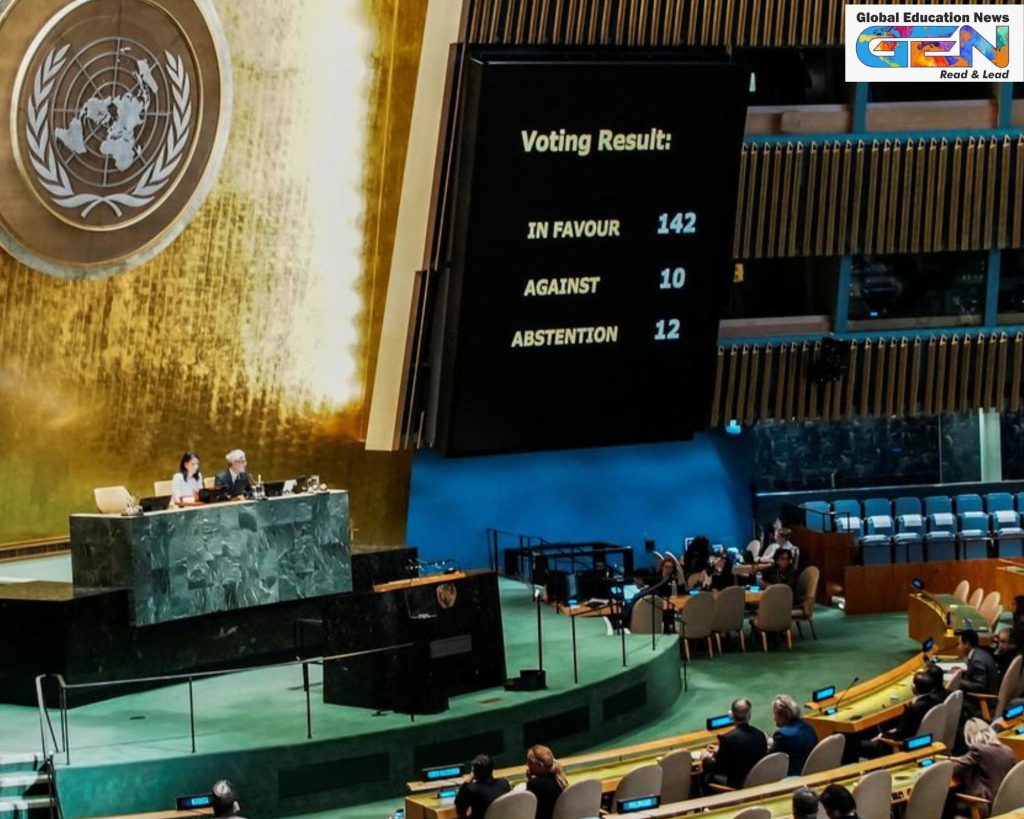
In a significant diplomatic move, India voted in favor of a United Nations General Assembly (UNGA) resolution on September 12, 2025, endorsing the “New York Declaration” for the peaceful settlement of the Israeli-Palestinian conflict through a two-state solution. This resolution, adopted with overwhelming support from 142 countries—including India—against 10 opposing votes and 12 abstentions, marks a renewed global push for ending the war in Gaza and establishing a sovereign Palestinian state alongside Israel. The declaration, emerging from a July 2025 UN conference co-chaired by France and Saudi Arabia, emphasizes immediate ceasefire, hostage release, and irreversible steps toward peace. India’s affirmative vote reflects its balanced foreign policy, prioritizing dialogue, self-determination, and regional stability, while breaking from recent abstentions on Gaza-related resolutions.
Key Points:
- Resolution titled: “Endorsement of the New York Declaration on the Peaceful Settlement of the Question of Palestine and the Implementation of the Two-State Solution.”
- Vote breakdown: 142 in favor (including India, France, Saudi Arabia, Brazil, Canada), 10 against (Israel, USA, Argentina, Hungary), 12 abstentions.
- Aligns with India’s longstanding support for Palestinian rights and a negotiated settlement, as seen in historical UN positions since 1947.
Background: The New York Declaration’s Origins
The New York Declaration stems from a high-level international conference held at UN Headquarters from July 28-30, 2025, organized by France and Saudi Arabia. This event, authorized by a December 2024 UNGA resolution, aimed to revive the stalled two-state solution amid the escalating Gaza conflict. Boycotted by the US and Israel, the conference gathered leaders to outline a 15-month phased plan for a demilitarized, sovereign Palestine, including Palestinian Authority governance over Gaza and the West Bank, hostage release, and a temporary UN peacekeeping mission. The declaration was presented as a comprehensive framework to end violence, counter illegal settlements, and foster international guarantees for peace, with follow-up actions planned for the UNGA high-level week in September 2025.
Key Points:
- Conference focus: End the Gaza war, achieve a just settlement based on UN resolutions and the July 19, 2024, ICJ advisory opinion on self-determination.
- Key commitments: Palestinian President Mahmoud Abbas’s June 9, 2025, letter rejecting violence and terrorism; opposition to Hamas rule in Gaza.
- Broader context: Builds on the Global Alliance for the Two-State Solution launched by Saudi Arabia in September 2024, amid ongoing Israeli settlements and Gaza bombardment.
Key Provisions: A Roadmap for Resolution
The seven-page New York Declaration outlines “tangible, timebound, and irreversible steps” to implement the two-state solution. It demands an immediate end to the Gaza war, unification of Gaza with the West Bank under Palestinian Authority control, and the disarmament of Hamas, which must hand over weapons and cease governance. The document urges Israel to publicly renounce annexation plans, halt all settlement activities in occupied territories (including East Jerusalem), and stop violence and incitement against Palestinians. It reaffirms Palestinian self-determination rights, calls for international action against illegal land grabs, and proposes a sovereign, viable Palestinian state living in peace with Israel. Additionally, it condemns the October 7, 2023, Hamas attacks and seeks hostage release, while mobilizing global leaders for commitments during the 80th UNGA session.
Key Points:
- Immediate actions: Ceasefire in Gaza, release of all hostages, end to Israeli settlements and annexation.
- Long-term framework: Establish a demilitarized Palestinian state; temporary UN security mission during transition.
- Hamas-specific: Cease authority in Gaza, hand over weapons to Palestinian Authority with international support.
- International role: Concrete measures per UN resolutions and ICJ opinion to counter displacement and ensure viability.
India’s Support: Reaffirming Diplomatic Stance
India’s vote in favor of the resolution underscores its consistent advocacy for a two-state solution based on pre-1967 borders, with East Jerusalem as Palestine’s capital—a position rooted in its founding UN support for Palestinian rights in 1947. This marks a departure from India’s abstentions on four Gaza ceasefire resolutions in recent years, signaling a stronger push for Palestinian statehood through dialogue. External Affairs Minister S. Jaishankar has historically emphasized India’s balanced approach, supporting both Israeli security and Palestinian aspirations. The vote aligns with India’s Act East Policy and growing ties with Arab nations, while reinforcing its role as a moral compass in global politics. It also comes amid India’s recognition of Palestine in 1988 and ongoing humanitarian aid to Gaza.
Key Points:
- Shift from abstentions: Previous votes on Gaza ceasefires (2023-2025) saw India abstain; this endorsement breaks the trend.
- Policy alignment: Supports UNSC Resolution 242 (1967) and Quartet Roadmap; India urges direct negotiations without preconditions.
- Diplomatic implications: Boosts India’s credibility in the Global South; potential for enhanced Middle East engagement, including with Saudi Arabia and France.
- Domestic reactions: Welcomed by opposition leaders like Pawan Khera as a return to ethical foreign policy legacy.
Opposition and Abstentions: Voices of Dissent
Ten countries opposed the resolution, led by Israel and the United States, which viewed it as a “misguided publicity stunt” undermining direct negotiations and rewarding Hamas. Israel’s Foreign Ministry criticized the lack of explicit terrorism labeling for Hamas, while the US argued it prolongs the war and ignores hostage issues. Opponents like Argentina and Hungary cited concerns over biased provisions that could compromise Israel’s security and hinder bilateral talks. The 12 abstentions included nations like Germany and Paraguay, which recognize both states but felt the text lacked consensus from key parties. This divide highlights tensions between unilateral actions (e.g., Israeli West Bank expansions) and multilateral peace efforts.
Key Points:
- Opposing nations: Israel, USA, Argentina, Hungary, and six others; US statement called it “stale thinking” that benefits Hamas.
- Abstentions: 12 countries, including Germany (supports two-state but cautious on recognition timing) and Paraguay.
- Criticisms: Resolution seen as pressuring Israel without addressing Hamas disarmament fully; ignores direct Israel-Palestine talks.
- Israeli response: PM Netanyahu’s “no-state solution” push; rejection of the declaration as a “political circus.”
Broader Impact: Global Consensus and Future Prospects
The resolution’s adoption signals a strong international consensus, increasing pressure on Israel to engage in the two-state framework and potentially paving the way for recognitions by countries like France, UK, Canada, Australia, and Belgium at the September 22, 2025, UN summit. For Palestinians, it’s a morale booster amid Gaza’s ruins, endorsing statehood aspirations and countering displacement. It could revitalize peace talks, influence aid flows, and integrate with frameworks like the Abraham Accords. However, challenges remain, including US-Israeli opposition and ground realities like settlements. The vote precedes the 80th UNGA, where leaders may formalize recognitions, potentially shifting Middle East dynamics toward stability.
Key Points:
- Diplomatic pressure: Isolates Israel-US duo; five European countries (e.g., France, Malta) plan Palestine recognition by September 2025.
- Regional effects: Aims to end Gaza siege, unify territories; supports cross-border trade and economic viability for Palestine.
- Global reactions: Applause in UNGA hall; Al Jazeera notes “incredible pushback” from international community.
- Future steps: September 22 summit for state recognitions; ongoing conference resumption to implement roadmap.
Social Media Buzz: Reactions on X (Twitter)
The vote sparked widespread discussion on X, with users praising India’s stance as a step toward justice. Posts highlighted the shift from abstentions, with hashtags like #FreePalestine and #TwoStateSolution trending. Opposition figures lauded it as reclaiming India’s moral legacy, while some questioned past policies. AI-driven summaries and videos amplified the news, emphasizing implications for Gaza and India’s diplomacy. Overall, reactions reflect optimism for peace but skepticism about enforcement.
Key Points:
- Positive sentiments: Users like @JaffarManh31814 called it a “welcome step” for justice; @Pawankhera noted departure from Modi’s abstentions.
- Discussions: Queries on historical abstentions; videos explaining the declaration’s roadmap.
- Trending topics: #UNGA, #PalestineStatehood, #IndiaUNVote; over 900 likes on key posts from influencers.
- Critiques: Some highlighted Hamas condemnation in the declaration as balanced.