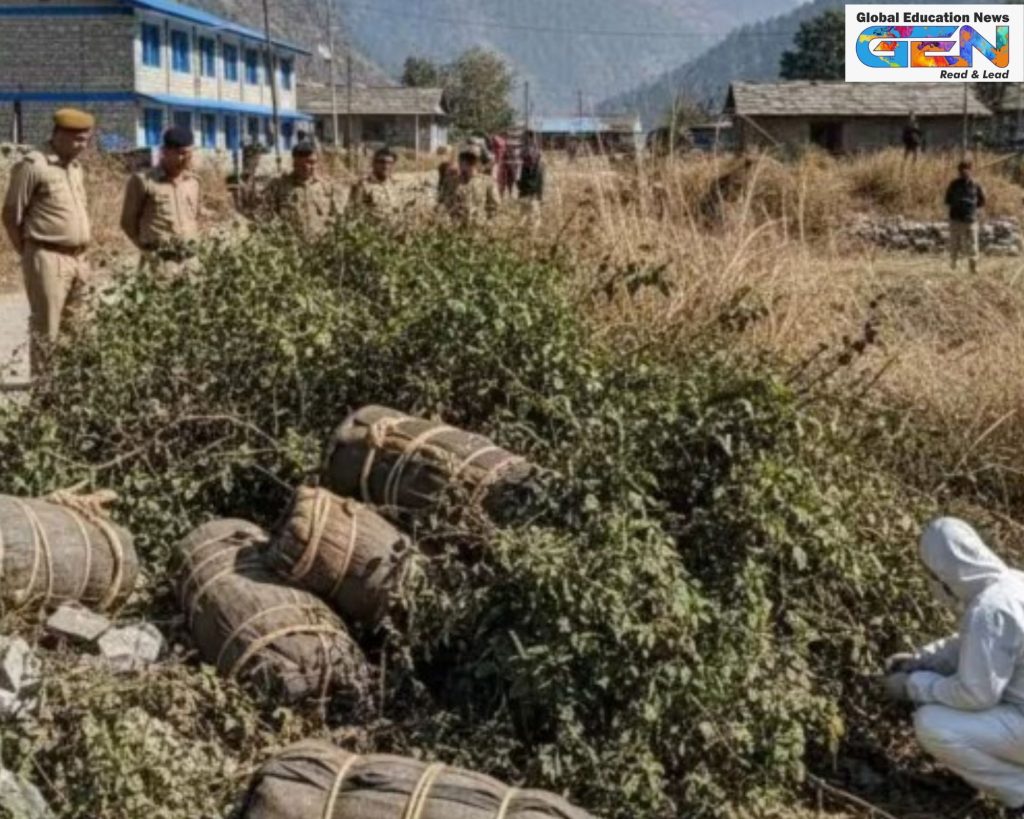
On a crisp November morning in Uttarakhand’s serene Almora district, what began as a children’s game spiraled into a major security scare. Hidden in dense bushes near a government high school lay a cache of 161 gelatin sticks—highly volatile explosives weighing over 20 kg—prompting an immediate lockdown and multi-agency mobilization. Discovered on November 23, 2025, in Dabra village’s Sult area, the find has amplified national anxieties following recent blasts in Delhi and massive seizures in Haryana. While preliminary probes lean toward a mundane construction leftover, the proximity to a school has ignited debates on lax storage protocols and rural vigilance. This analysis dissects the timeline, response, and ripple effects, underscoring vulnerabilities in India’s infrastructure-security nexus.
The Shocking Discovery: From Cricket Ball to Explosive Alert
The incident unfolded innocently yet perilously on Thursday, November 21, when students from the Government High Secondary School in Dabra village ventured into nearby bushes to retrieve a lost cricket ball. What they stumbled upon were suspicious cylindrical packets, stacked and concealed amid the foliage. School principal Subhash Singh, spotting the anomaly during a routine check on Friday, November 22, wasted no time alerting local authorities.
- Exact Site and Scale: The primary cache was unearthed just 50 meters from the school campus in the Sult area’s forested fringes. A secondary site, 20 feet away, yielded additional sticks after a canine alert. In total, 161 gelignite (gelatin) sticks—industrial explosives used for rock-blasting—tipped the scales at over 20 kg, enough to cause devastating damage if mishandled.
This serendipitous find averted what could have been a tragedy, highlighting the razor-thin margin between everyday school life and latent dangers in remote terrains.
Swift Police Response: Cordons, Searches, and Forensic Scrutiny
Uttarakhand Police sprang into action within hours, transforming the bucolic village into a high-security zone. A team from the Bhikiyasain police station arrived first, cordoning off the 1-km radius and evacuating nearby homes.
- Multi-Agency Deployment: Bomb disposal squads from Udham Singh Nagar and Nainital districts neutralized and sealed the explosives, transporting them to a secure facility for safe disposal post-court nod. Dog squads scoured the underbrush, while forensic experts from the State Forensic Science Laboratory collected soil samples, mapped the site, and tested residues to trace origins.
- Investigation Kickoff: An FIR was lodged against unidentified persons under Section 4(A) of the Explosive Substances Act, 1908, and Section 288 of the Bharatiya Nyaya Sanhita (BNS) for negligent handling. Four specialized teams—drawing from Provincial Armed Constabulary (PAC), Indian Reserve Battalion (IRB), Local Intelligence Unit (LIU), and additional forces—fanned out for combing operations across school grounds, footpaths, and adjacent forests.
Senior Superintendent of Police (SSP) Devendra Pincha emphasized a “detailed probe” into the perpetrators and intent, assuring the public of exhaustive measures. No injuries or detonations occurred, but the operation underscored the explosives’ potency.
Probing Motives: Construction Oversight or Sinister Plot?
Early leads point away from terrorism, but skepticism lingers amid a spate of national incidents. Gelatin sticks are staples in mining and road-building, legally procured yet stringently regulated.
- Leading Theory – Infrastructure Legacy: Village head Arjun Singh flagged a Pradhan Mantri Gram Sadak Yojana (PMGSY) road project completed last year, with workers’ camps just 30 meters from the site. Unused or expired sticks may have been discarded haphazardly, a common lapse in remote worksites. Forensic tests aim to match chemical signatures to licensed suppliers.
- Ruling Out Threats: SSP Pincha dismissed immediate terror angles, noting no ideological markers or accomplices. Yet, the timing coincides with the Delhi Red Fort blast probe and a 2,900 kg explosive haul in Haryana, prompting nationwide alerts and cross-state intel sharing.
| Potential Motive | Evidence | Likelihood |
|---|---|---|
| Abandoned Construction Waste | Proximity to PMGSY site; common in hill road projects | High – Samples under lab analysis |
| Terror Module Stash | Recent Delhi/Haryana cases; rural hideouts viable | Low – No links found, but monitored |
| Local Mischief/Criminal Dump | Rural theft from quarries; unregulated storage | Medium – Supplier audits underway |
Social media buzz on X reflects public unease, with users decrying “security chinks” and demanding stricter audits.
Broader Implications: Safeguarding Schools and Infrastructure
This Almora episode exposes chinks in India’s dual infrastructure-security fabric, where development often outpaces oversight in hilly terrains.
- School Safety Gaps: With over 1.5 million government schools nationwide, many in isolated pockets, such finds amplify calls for perimeter fencing, regular sweeps, and community drills under the National Disaster Management Authority (NDMA) guidelines.
- Regulatory Wake-Up: Explosives Act violations highlight porous supply chains; Uttarakhand’s mining-heavy economy sees 500+ annual seizures, per state data. The incident could spur amendments mandating GPS-tracked storage and post-project audits.
- National Security Echoes: Amid 2025’s uptick in blasts (15% rise per MHA reports), it fuels inter-agency coordination via the Multi-Agency Centre (MAC), with Uttarakhand’s border proximity adding layers.
Experts advocate tech infusions like drone surveillance for remote sites, balancing growth with vigilance.