Date: October 13, 2026
Place: New Delhi, India
News Category: World News, Elections and Current Affairs
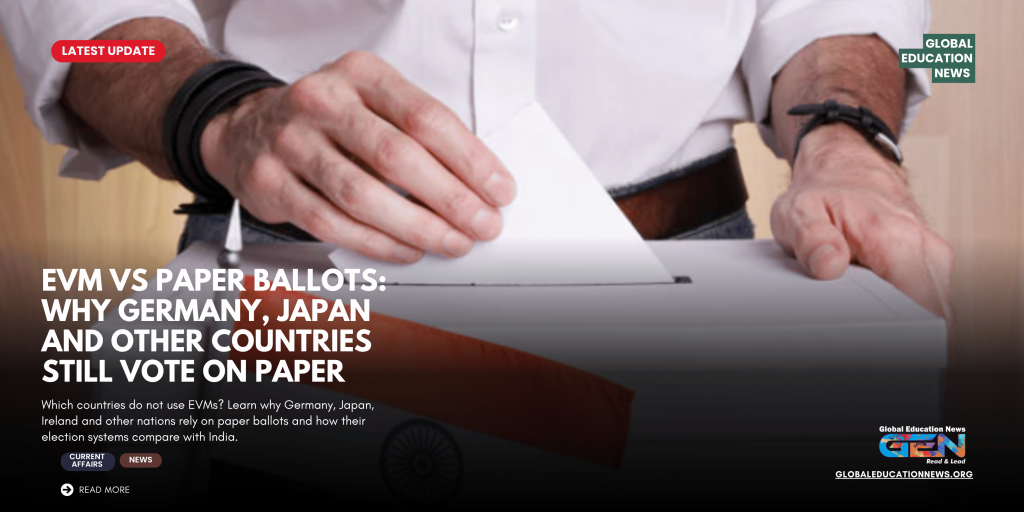
India conducts its national elections using Electronic Voting Machines (EVMs), but many other democracies continue to rely on paper ballots to record votes. Countries such as Germany, Japan, Ireland and the Netherlands have not adopted electronic voting machines for their regular elections in the way India has, while some countries have discontinued or restricted particular electronic voting systems.
The difference raises an important question: why do technologically advanced countries continue to use paper ballots when electronic systems can speed up vote counting?
The answer involves more than technology. Election laws, public confidence, the ability to independently verify results, implementation costs and the risks of technical errors all influence how countries choose to conduct elections. There is no single voting system followed by every democracy, and the use of electronic technology can vary between national and local elections.
Key Highlights: Countries That Prefer Paper Ballots Over EVMs
- Germany: Electronic voting machines were ruled unconstitutional for general elections under a landmark 2009 court decision.
- Netherlands: Electronic voting machines were abandoned for regular elections amid concerns about transparency and security.
- Ireland: A planned electronic voting system was discontinued after major cost and implementation concerns.
- Japan: Paper ballots remain central to national elections, although electronic voting has been permitted in limited local contexts.
- Bangladesh: The country has moved away from using EVMs in national elections, although its election arrangements can change over time.
- India: EVMs are used alongside the Voter Verifiable Paper Audit Trail (VVPAT) system, which provides a paper record of a voter’s selection.
These examples illustrate different national approaches rather than a universal rejection of voting technology.
Which Countries Do Not Use EVMs in Their Regular Elections?
Several countries rely primarily on paper ballots for their regular public elections. However, the reasons differ: some have legal restrictions, some discontinued particular machines, and others have never adopted widespread electronic voting.
| Country | General voting approach | Key reason or context |
|---|---|---|
| Germany | Paper ballots | A 2009 constitutional court ruling established strict requirements for public verifiability of election results |
| Netherlands | Paper ballots | Concerns about electronic voting security and transparency led to the abandonment of voting machines |
| Ireland | Paper ballots | The planned electronic voting system was discontinued amid cost and public-confidence concerns |
| Japan | Paper ballots in national elections | Electronic voting has been used in limited local elections, rather than becoming the national standard |
| Bangladesh | Paper ballots in national elections | Authorities moved away from EVM use in national elections amid political and public-confidence concerns |
| Israel | Paper ballots | Physical ballots and multiple verification procedures remain central to the election process |
Important: This table describes broad election practices, not a claim that every form of electronic technology is prohibited in these countries. Electronic voter registration, ballot scanning, result transmission and online voting are different from electronic machines that directly record a voter’s choice.
Why Did Germany Stop Using Electronic Voting Machines?
Germany is one of the most frequently cited examples in discussions about electronic voting.
In 2009, Germany’s Federal Constitutional Court ruled that the use of the electronic voting machines involved in the case violated constitutional requirements because the essential steps of voting and the determination of results had to be verifiable by citizens without requiring specialist technical knowledge.
The ruling did not mean that all technology was banned from every part of election administration. Instead, it emphasised a central democratic principle: citizens must be able to understand and verify the essential stages of an election.
This is why Germany continues to use paper ballots for its regular public elections. The paper-based approach allows votes to be examined and counted through procedures that do not depend entirely on trusting the internal operation of a machine.
Why Did the Netherlands Abandon Voting Machines?
The Netherlands previously used electronic voting machines in elections but moved back to paper ballots.
Concerns about the transparency of electronic systems and whether their operation could be independently checked contributed to the change. Public debate also focused on the possibility of technical interference and the difficulty of verifying how a machine recorded votes.
Paper ballots provide a physical record that can be inspected during counting or a recount. However, paper voting is not automatically free from mistakes or manipulation; election officials still need secure ballot storage, transparent counting procedures and effective oversight.
The Dutch experience illustrates how public confidence and verifiability can influence election policy even in countries with advanced technology.
Why Did Ireland Discontinue Its Electronic Voting Plan?
Ireland invested in an electronic voting system but ultimately discontinued the planned rollout.
The decision followed concerns over the system’s cost, its readiness for implementation and whether it could provide sufficient confidence in the accuracy and transparency of results. The machines were not adopted as the country’s regular voting method.
The case demonstrates that purchasing election technology does not guarantee its long-term use. Governments must also consider maintenance, training, auditing, public acceptance and whether the system can be independently verified.
Does Japan Use EVMs or Paper Ballots?
Japan relies on paper ballots for its national elections. Voters generally write the name of their preferred candidate or political party on a ballot paper, depending on the election.
Electronic voting has been used in some local elections under specific arrangements, but it has not replaced paper ballots as the standard method for national elections.
Japan’s experience is a reminder that a country may use technology in selected local settings without adopting electronic voting machines across its entire electoral system.
Why Did Bangladesh Move Away From EVMs?
Bangladesh experimented with electronic voting machines in parts of its electoral process, but the system became a subject of political disagreement and public-confidence concerns.
The country’s election authorities subsequently moved away from using EVMs in national elections. The shift highlights how political consensus, trust in election administration and confidence in the counting process can affect decisions about voting technology.
Election policies can change between election cycles, so readers should check the latest announcements from the country’s election authorities before treating any particular arrangement as permanent.
EVM vs Paper Ballots: Which Voting System Is Better?
Neither system is automatically better in every situation. The reliability of an election depends on how the voting method is designed, secured, audited and administered.
| Factor | Electronic Voting Machines | Paper Ballots |
|---|---|---|
| Counting speed | Can produce results quickly | Manual counting can take longer |
| Physical record | Depends on the machine and whether a paper audit trail is provided | A marked paper ballot provides a physical record |
| Verification | Requires appropriate testing, auditing and transparent safeguards | Ballots can be inspected and recounted under established procedures |
| Human error | Reduces some manual counting tasks but can introduce technical or procedural risks | Can be affected by invalid markings, counting errors or ballot-handling problems |
| Infrastructure | Requires machines, maintenance, training and secure procedures | Requires ballot printing, secure storage and organised counting |
| Public confidence | Depends on trust in the system and its safeguards | Depends on transparent handling, counting and oversight |
A well-designed electronic system can reduce some administrative burdens. A well-managed paper-ballot system can make physical verification and recounts more straightforward. Both require safeguards, trained personnel and credible election oversight.
How Does India’s EVM System Differ From Paper-Ballot Elections?
India uses EVMs to record votes and VVPAT units to provide a paper record of the voter’s selection.
When a voter casts a vote, the VVPAT system produces a printed slip showing the selected candidate’s details. The slip is visible to the voter for a short period before it drops into a sealed compartment.
This arrangement combines electronic vote recording with a physical verification component. The paper slips can be used for prescribed verification procedures under election rules.
However, the presence of a paper trail does not mean that every vote is automatically counted twice. Verification is carried out according to established procedures, and the applicable rules determine how records are checked.
India’s system and the paper-ballot systems used in countries such as Germany differ in how votes are recorded and counted. Comparisons should therefore examine the complete election process rather than treating every form of electronic technology as identical.
What Can India Learn From Countries That Use Paper Ballots?
International experience shows that election technology must be judged by its ability to support accurate results, transparent procedures and public trust.
Several lessons emerge:
- Make verification understandable: Voters and observers should be able to understand how election results are checked.
- Maintain credible safeguards: Any voting system needs clear procedures for security, testing, audits and dispute resolution.
- Evaluate technology independently: Systems should be assessed by qualified experts under transparent rules.
- Build public confidence: Election authorities need to explain procedures clearly and address legitimate concerns with evidence.
- Consider local conditions: Population size, geography, staffing, cost and election rules all affect which voting method is practical.
The international comparison does not establish that paper ballots are always safer or that EVMs are inherently unreliable. It shows that countries make different choices based on their legal frameworks, election administration and confidence in available safeguards.
FAQs: Countries That Do Not Use EVMs
1. Which countries use paper ballots instead of EVMs?
Germany, the Netherlands, Ireland, Japan and Israel are examples of countries that rely primarily on paper ballots for regular public elections. Bangladesh has also moved away from EVMs in national elections. The precise arrangements vary by country and election type.
2. Why did Germany stop using electronic voting machines?
In 2009, Germany’s Federal Constitutional Court ruled that the electronic voting system involved in the case did not meet constitutional requirements for citizens to verify the essential steps of voting and counting without specialist technical knowledge.
3. Are electronic voting machines banned in every developed country?
No. Countries use different voting arrangements, and some use electronic systems in national elections, local elections or particular regions. It is inaccurate to claim that all developed countries reject EVMs.
4. Does Japan use EVMs in national elections?
Japan’s national elections rely on paper ballots. Electronic voting has been used in some local elections, but it has not become the standard national voting method.
5. Why do some countries prefer paper ballots?
Reasons include the ability to inspect physical ballots, conduct recounts, make counting procedures visible and reduce reliance on the internal operation of electronic devices. Paper systems also have risks and require careful administration.
6. Does India use paper ballots or EVMs?
India primarily uses EVMs for its public elections, with VVPAT units providing a paper record of voters’ selections. Paper ballots are also used in certain other election-related contexts under applicable rules.
7. Are paper ballots more secure than EVMs?
There is no universal answer. Security depends on the system’s design, the transparency of procedures, the availability of audits, the protection of records and the quality of election administration.
8. Do countries that use paper ballots count votes manually?
Many use manual counting, but some also use scanners or other technologies to assist with counting. Using technology to count paper ballots is different from using a machine to record a voter’s selection directly.
Conclusion
The global debate over EVMs and paper ballots is ultimately about how democracies balance speed, accuracy, transparency and public confidence. Germany’s constitutional ruling, the Netherlands’ return to paper voting and Ireland’s discontinued electronic voting plan show that election technology must meet public and legal expectations as well as technical requirements.
For India, international comparisons are most useful when they examine the safeguards and rules behind each system rather than simply declaring one method superior. Trustworthy elections depend not only on how votes are recorded, but also on whether the process can be checked, explained and accepted as credible.
Global Education News will continue to explain major developments in elections, public policy and international affairs through clear, fact-focused current-affairs reporting.