Date: October 13, 2026
Place: United Kingdom
Education News: Global Higher Education and Study Abroad
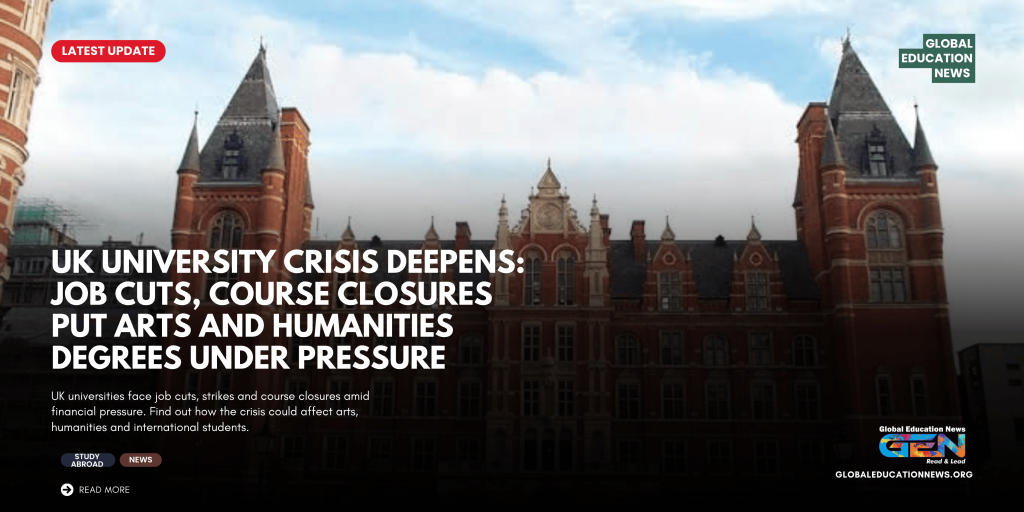
The UK university financial crisis is putting arts and humanities degrees under growing pressure, with job cuts, staff strikes and course closures raising concerns about student choice and the future of higher education. The University of Nottingham has approved a controversial restructuring plan that includes job reductions, the suspension of modern languages and music courses for new students, and changes to traditional one-to-one personal tutoring.
The financial difficulties extend beyond a single institution. Universities across the United Kingdom are reviewing staffing, academic programmes and operating costs as they respond to uncertainty over student recruitment, inflation and rising expenses. Staff at Nottingham, Edinburgh and Dundee have also taken industrial action over proposed redundancies and academic cuts.
For students, including those considering studying in the UK from India, the developments raise important questions about course availability, academic support, tuition commitments and the risks of choosing a programme that may later be restructured.
Why Are UK Universities Facing a Financial Crisis?
UK universities are dealing with a combination of financial pressures rather than one single cause. England’s higher education regulator, the Office for Students (OfS), has highlighted uncertainty over student recruitment, inflation, rising operating costs and pressure on institutional cash flow.
Its financial analysis indicated that around 45% of higher education institutions in England faced a deficit in 2025–26. The regulator also warned that some institutions were relying more heavily on credit facilities to manage income and expenditure.
The pressure is not uniform across the sector. Some universities and specialist institutions have recorded improvements in their financial positions, while other providers—particularly some larger research-intensive and teaching-intensive institutions—have faced worsening financial performance.
Key factors behind the university funding pressure
- Uncertain student recruitment: Changes in domestic and international enrolment can affect tuition income.
- Rising operating costs: Inflation and higher running expenses are increasing financial pressure.
- Cash-flow challenges: Some universities have limited reserves to manage unexpected costs.
- Staffing expenses: Institutions are considering redundancies and organisational restructuring.
- Policy uncertainty: Proposed additional costs, including an international student levy, could affect future budgets.
The financial picture varies between institutions, meaning students should assess individual universities rather than assume that every UK university faces the same level of risk.
University of Nottingham: What Do the Course Closures and Job Cuts Mean?
The University of Nottingham has become a prominent example of the pressures affecting UK higher education. Its restructuring plan includes job losses and changes to academic programmes.
The university announced proposals in May to cut 609 of its 7,363 full-time-equivalent roles over three years. It also announced the suspension of modern languages and music courses for new students and said it was considering reducing its nursing provision.
The university has argued that changes are necessary because its long-term financial prospects were unsustainable. However, the proposals have triggered opposition from staff concerned about redundancies, academic provision and the effect on students.
The changes also include ending the traditional one-to-one personal tutoring system, raising concerns about how students will receive individual academic guidance.
These developments illustrate how financial decisions can affect not only university employees but also the range of subjects available to future applicants and the support offered to enrolled students.
Why Are Arts and Humanities Degrees Under Pressure in the UK?
Arts and humanities subjects—including history, literature, philosophy, music and modern languages—are facing difficult questions about funding and their perceived economic value.
Universities under financial pressure may review courses based on recruitment, operating costs and expected income. Programmes with smaller student numbers can become vulnerable when institutions prioritise savings.
However, measuring a degree’s value only through immediate salary outcomes can overlook the wider skills developed through humanities education.
These subjects can strengthen communication, research, critical thinking, cultural understanding and analytical reasoning. Such skills can be useful across education, business, public service, media, publishing and the creative industries.
Research cited in UK higher education debates has also highlighted the contribution of humanities graduates to a range of employment sectors. The challenge for universities is to balance financial sustainability with academic diversity, research, cultural contribution and student choice.
How Could the Crisis Affect International Students, Including Indian Applicants?
For international students, a course closure can create additional difficulties because studying overseas involves substantial financial and personal commitments.
Students may already have paid tuition fees, signed accommodation agreements, arranged travel and made plans around a particular degree. If a programme is withdrawn or substantially changed, transferring to another university may involve additional expenses and disruption.
Potential effects include:
- Course availability: Some degrees may no longer accept new applicants.
- Academic continuity: Existing students may need alternative arrangements if their programme changes.
- Financial commitments: Students may need clarity on refunds, compensation and other contractual protections.
- Immigration considerations: A transfer or change in study arrangements may require students to check how their circumstances affect their immigration permission.
- Academic support: Staffing changes or industrial action may affect teaching, assessments and access to tutors.
England’s regulator has said that international students are entitled to the same protections as domestic students when courses close. Universities are expected to follow their student protection plans and applicable refund and compensation policies.
However, individual circumstances differ. International students should seek written information from their university and consult official immigration guidance where a course change could affect their study arrangements.
Are UK University Staff Strikes Affecting Students?
Staff strikes have added another layer of uncertainty at several universities.
Industrial action at Nottingham, Edinburgh and Dundee has been linked to proposed redundancies, staffing reductions and changes to academic programmes. These disputes reflect tensions between university management teams seeking to reduce costs and staff members opposing job losses and changes to working conditions.
Strikes can disrupt teaching, assessments and access to academic support. The extent of the impact depends on the institution, the duration of industrial action and the arrangements made for affected students.
Applicants should check current university announcements for programme-specific information. Students already enrolled should monitor communications about teaching schedules, assessments, academic support and any changes to graduation requirements.
How Are UK Universities Responding to Financial Pressure?
Alongside cost reductions, some UK universities are exploring new sources of income to diversify their finances.
Strategies include international branch campuses, partnerships with overseas institutions, online learning and executive education. Expanding internationally may help universities reach new student markets and reduce dependence on a single source of income.
These initiatives are taking place alongside domestic restructuring. Universities are therefore attempting to balance international expansion, academic quality and financial sustainability while reviewing their existing programmes.
Whether these strategies improve financial stability will depend on student demand, the costs of expansion, partnership arrangements and each institution’s ability to manage its finances.
What Should Students Check Before Choosing a UK University?
Students planning to study in the UK should consider more than a university’s reputation or a degree’s headline ranking. The current financial pressures make it particularly important to investigate the stability and delivery of the specific programme they intend to pursue.
Before accepting an offer, students should:
- Check the course page: Confirm that the programme is accepting applicants for the intended academic year.
- Review official updates: Look for announcements about course suspensions, restructuring or changes to teaching arrangements.
- Ask about student protection: Understand what happens if a course is discontinued or significantly changed.
- Read refund conditions: Check the university’s written policies before paying fees or making non-refundable commitments.
- Review academic support: Find out how tutoring, supervision and student services are organised.
- Consider alternatives: Identify comparable courses at other institutions in case plans change.
- Check immigration implications: Use official guidance if a transfer or course change could affect student immigration status.
These checks do not mean that students should avoid UK universities as a whole. They help applicants make informed decisions based on the circumstances of the institution and course they are considering.
UK University Crisis: Key Facts at a Glance
| Issue | Latest reported information |
|---|---|
| Main concern | Financial pressure across parts of UK higher education |
| University of Nottingham | Restructuring involving proposed job cuts and course changes |
| Proposed Nottingham job cuts | 609 of 7,363 full-time-equivalent roles over three years |
| Courses affected at Nottingham | Modern languages and music suspended for new students |
| Financial position in England | Around 45% of higher education institutions faced a deficit in 2025–26 |
| Other universities affected by staff disputes | Edinburgh and Dundee, among others |
| Potential effect on students | Course availability, teaching, assessments and academic support |
| Protection for international students | Student protection plans and applicable refund and compensation policies |
| Key advice for applicants | Check course status and official university announcements before committing |
Frequently Asked Questions (FAQs)
1. Why are UK universities cutting jobs and closing courses?
Universities are responding to financial pressures that include uncertain student recruitment, inflation, rising operating costs and cash-flow difficulties. The effects vary between institutions.
2. Which courses are affected at the University of Nottingham?
The reported restructuring includes the suspension of modern languages and music courses for new students. The university has also said it is considering reducing its nursing provision.
3. Are arts and humanities degrees disappearing from UK universities?
No. The reported closures and restructuring show pressure on particular programmes and institutions, not the disappearance of arts and humanities degrees across the entire UK higher education system.
4. How many English higher education institutions faced a deficit in 2025–26?
The regulator’s reported analysis indicated that around 45% of higher education institutions in England faced a deficit during the 2025–26 financial year.
5. Could course closures affect Indian students planning to study in the UK?
Yes. A course closure or major change could affect programme choice, tuition arrangements, accommodation plans and study timelines. Applicants should confirm the status of their specific course before committing financially.
6. What happens if an international student’s course is closed?
Universities are expected to follow their student protection plans and applicable refund and compensation policies. Students should request written guidance from their institution and check official immigration guidance if their study arrangements change.
7. Are all UK universities facing the same financial problems?
No. Financial performance differs considerably across the sector. Students should examine the latest information about their chosen institution and programme rather than generalise from individual cases.
8. Should students reconsider studying arts and humanities in the UK?
Students should assess their academic interests, career plans, course availability and the university’s ability to deliver the programme. The current situation highlights the importance of checking official course information, not a blanket reason to reject humanities degrees.
Conclusion
The financial pressures affecting UK universities are creating difficult decisions about staffing, academic programmes and student support. The University of Nottingham’s restructuring and industrial disputes at several institutions show how these challenges can influence the choices available to students.
For international applicants, the most important step is to verify the status of a chosen course, understand student protection arrangements and obtain written clarification before making major financial commitments. Arts and humanities education continues to offer valuable skills, but students need clear information about the programmes and institutions they choose.
Global Education News will continue tracking global university funding, study-abroad developments and changes affecting international students.