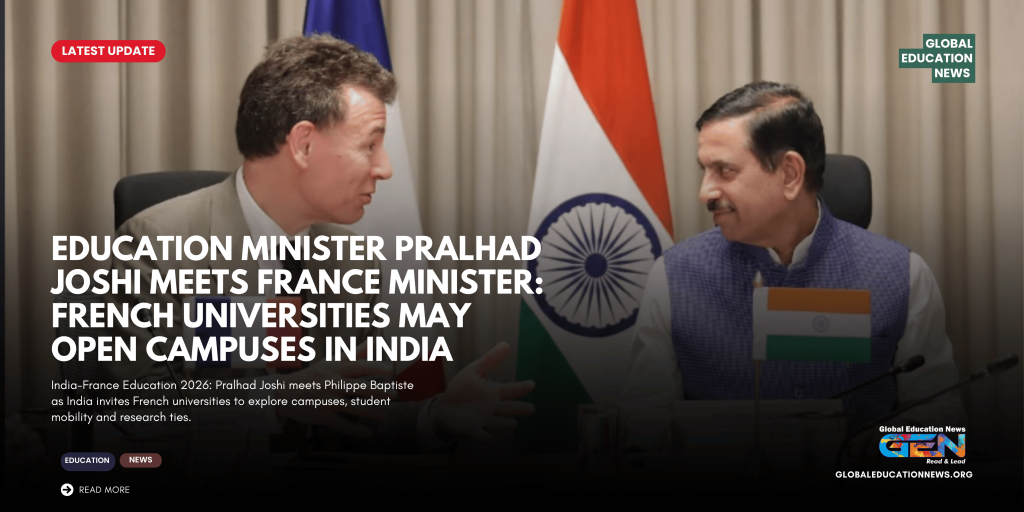
New Delhi, India — India-France education cooperation is moving into a more practical phase, with Union Education Minister Pralhad Joshi and France’s Minister for Higher Education, Research and Space, Philippe Baptiste, discussing new avenues for universities, students, researchers and faculty from both countries.
At a bilateral meeting in New Delhi on September 28, the two ministers discussed higher education partnerships, academic mobility, collaborative programmes, research cooperation and innovation. India also invited French higher educational institutions to explore opening branch campuses in India, including in GIFT City, Gujarat, as well as locations where French companies operate and need technically skilled human resources.
The meeting comes during the India-France Year of Innovation 2026, giving the education relationship a wider setting that links universities with research, technology and industry.
India-France Higher Education Cooperation Gets a New Campus Focus
The discussions went beyond traditional academic exchanges.
Both sides examined ways to strengthen institutional links between Indian and French universities and expand opportunities for students, faculty and researchers to move between the two countries.
Collaborative academic programmes and exchanges were also discussed, along with greater cooperation in life sciences, social sciences and humanities.
For students, that could eventually mean more avenues for joint academic programmes, international exposure and research collaborations. For institutions, it points towards a relationship built not only around sending students abroad but also around creating stronger academic connections inside India.
French Universities Asked to Explore Campuses in India
One of the most significant developments from the meeting was India’s invitation to French higher educational institutions to consider establishing branch campuses in the country.
GIFT City in Gujarat was specifically identified as one possible location. French institutions were also encouraged to examine locations where French companies have a presence and require technical human resources.
The move fits into India’s broader effort to bring international higher education institutions into the country.
Rather than requiring every student seeking a French academic experience to travel overseas, foreign campuses in India could create opportunities for international programmes, research collaborations and industry-linked education closer to home.
The actual establishment of campuses, however, would depend on institutions coming forward and meeting the applicable regulatory requirements.
Student and Faculty Mobility Remains a Central Priority
Academic mobility was another major part of the discussions.
India and France explored expanding the movement of students, faculty members and researchers, alongside new institutional partnerships and academic exchanges.
Such mobility can connect universities through joint teaching, research projects and academic programmes while giving students and researchers opportunities to work across different education systems.
The discussions also covered new avenues for joint academic and research initiatives, building on collaborations that already exist between institutions in the two countries.
Mutual Recognition of Qualifications Could Matter for Students
Another issue with direct relevance to students is the ongoing revision of the Mutual Recognition of Qualifications (MRQ) Agreement between India and France.
Recognition of qualifications can influence how degrees and academic credentials are understood across borders. Any changes to the agreement could therefore have implications for students pursuing education or professional opportunities involving both countries.
The two sides also discussed sharing academic expertise and strengthening cooperation in teacher education and language learning.
That gives the education partnership a broader reach — from university research and student exchanges to the skills needed to make international academic cooperation work on the ground.
India-France Year of Innovation 2026 Adds Momentum
The talks took place against the backdrop of the India-France Year of Innovation 2026, which has brought research, technology, universities and innovation ecosystems into closer focus.
India and France have been expanding cooperation across areas including science, technology, artificial intelligence, healthcare and research. The education relationship is increasingly connected to that larger innovation agenda.
Earlier in 2026, the two countries jointly launched initiatives aimed at strengthening innovation partnerships, including the Bharat Innovates platform in Nice, where Indian higher education institutions, innovators and international partners participated.
The academic dimension is significant because universities are increasingly expected to connect research with industry, entrepreneurship and emerging technologies.
Digital Learning and Language Education Also on the Agenda
The New Delhi discussions also covered technology-enabled learning and digital education.
India and France exchanged views on sharing best practices in digital education and using technology to widen access to quality learning.
Language education and teacher education were also part of the conversation.
These areas may appear less dramatic than a new university campus, but they are critical to sustaining cross-border academic partnerships. Students and faculty need language skills, digital infrastructure and compatible academic practices for international collaborations to function effectively.
What the India-France Education Push Could Mean for Students
The immediate outcome of the meeting is a set of discussions and invitations rather than a completed list of new French university campuses or newly launched academic programmes.
But the direction is clear.
India and France are looking at higher education through several connected channels:
- French universities exploring campuses in India
- Greater student and faculty mobility
- More institutional partnerships
- Joint academic and research programmes
- Cooperation in life sciences, social sciences and humanities
- Revision of the Mutual Recognition of Qualifications agreement
- Stronger language and teacher education
- Technology-enabled and digital learning
For Indian students, the most tangible developments will depend on what universities and governments implement after these discussions.
A Partnership Moving From Exchange to Infrastructure
The significance of the meeting lies partly in its breadth.
India-France education cooperation is no longer being discussed only in terms of students travelling between two countries. The agenda now includes university campuses, research networks, qualification recognition, faculty mobility, digital education and industry-linked skills.
That could create a more interconnected higher education ecosystem if the proposals discussed in New Delhi translate into formal agreements and operational programmes.
For now, the French minister’s three-day India visit has opened another chapter in that conversation — one in which universities, researchers and students sit much closer to the centre of the India-France relationship.