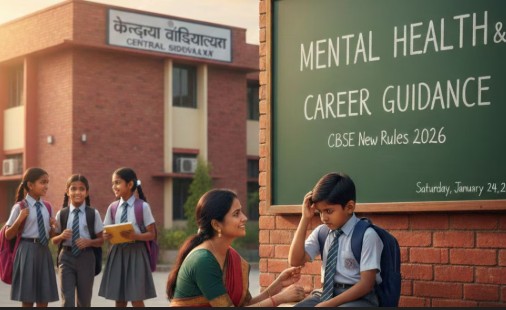
In a landmark step to fortify student mental health and career readiness, the Central Board of Secondary Education (CBSE) has amended its Affiliation By-Laws, 2018, making the appointment of socio-emotional and career counsellors mandatory across all 28,000+ affiliated schools—a policy born from a July 2025 Public Interest Litigation (PIL) in the Rajasthan High Court that spotlighted the urgent need for structured support amid academic pressures. Rolled out via a January 19, 2026, circular amending Clause 2.4.12, this reform replaces patchy provisions with robust ratios and qualifications, ensuring every school—regardless of size—becomes a sanctuary for emotional growth and future planning. Triggered by hearings where the court sought inputs from CBSE, RBSE, UGC, and Rajasthan’s government, the changes address a crisis where student stress contributes to 7.6% of national suicides (NCRB 2022), offering a lifeline from primary to senior secondary. As advocate Sujeet Swami, PIL petitioner, noted, “The changes address needs from primary to senior secondary,” this isn’t just paperwork—it’s a promise of proactive care, potentially reducing isolation by 20-25% in high-pressure environments.
Key Points:
- Policy Pivot: January 19, 2026, circular amends Clause 2.4.12; covers 28,000+ schools.
- PIL Prompt: July 2025 Rajasthan HC case; inputs from CBSE/RBSE/UGC/state.
- Crisis Context: 7.6% student suicides (NCRB 2022); primary to senior secondary scope.
- Swami’s Salute: “Addresses needs… senior secondary”; 20-25% isolation potential cut.
The New Mandate: 1:500 Ratios and Expert Qualifications for Counsellors
CBSE’s overhaul demands one Counselling and Wellness Teacher (socio-emotional counsellor) per 500 students across all classes, up from part-time options for smaller schools, while career counsellors get a 1:500 ratio focused on Classes 9-12. This ensures dedicated, full-time support tailored to scale, with flexibility via the “Hub and Spoke” model—where larger “hub” schools mentor nearby “spoke” ones in resource-scarce areas. Qualifications are stringent: wellness teachers need a graduate/postgraduate in Psychology or Social Work (mental health/counselling specialization), plus a 50-hour CBSE capacity-building program; career counsellors require degrees in Humanities, Science, Social Sciences, Management, Education, or Technology. This expert infusion, as the circular states, “strengthens the mental health framework,” bridging gaps where only 30% of schools had counsellors pre-reform (CBSE surveys).
Key Points:
- Ratio Reset: 1:500 wellness (all classes); 1:500 career (9-12).
- Hub Help: Larger schools mentor small; resource equity.
- Qualification Quest: Psych/Social Work + 50-hr training; diverse degrees for career.
- Framework Fortify: “Strengthens mental health”; 30% pre-reform gap fill.
Responsibilities Defined: From Crisis Intervention to Career Mapping
Wellness counsellors wear multiple hats: student/parent counselling, social-emotional learning, crisis response, mental health spotting, teacher/parent sensitisation, and ethical confidentiality—vital in a system where 40% of students report anxiety (CBSE 2025 poll). Career counsellors zero in on post-Class 10 guidance, mapping pathways with structured advice on streams, colleges, and skills—addressing the 50% mismatch between aspirations and realities. These roles, integrated into school life, foster a “care culture,” with the Hub-Spoke model extending reach to remote spots—potentially cutting response times by 50% in underserved areas.
Key Points:
- Wellness Wear: Counselling/learning/crisis/spotting/sensitisation/confidentiality.
- Career Cartography: Post-10 guidance; 50% aspiration-reality fix.
- Culture Craft: Integrated roles; 40% anxiety address (CBSE poll).
- Reach Rocket: Hub-Spoke; 50% response time trim.
Background and Implications: PIL’s Push and a Precedent for Boards
The PIL, filed by Kota advocate Sujeet Swami and psychologists, sought uniform mental health frameworks, prompting September 2025 hearings that birthed this reform. Advocate Amit Dadhich hailed it as a “positive step,” eyeing extensions to colleges. Implications ripple: for CBSE’s 28,000 schools, it’s a compliance checkpoint tied to affiliations, while inspiring RBSE and others—potentially lifting national counsellor coverage from 25% to 60% by 2030. Amid NEP 2020’s wellness weave, it could slash 15% of stress-related dropouts, proving policy’s power to prevent pain.
Key Points:
- PIL Progenitor: Swami’s July 2025 case; September hearings catalyst.
- Dadhich Delight: “Positive step”; college extensions eyed.
- Compliance Checkpoint: Affiliation tie; 25% to 60% coverage by 2030.
- NEP Nerve: 15% dropout slash; pain prevention proof.
Challenges and Future Outlook: Scaling Support in Diverse Schools
Urban schools may breeze through hires, but rural ones—40% of CBSE—face talent shortages (1:1000 current ratio), demanding incentives like stipends. Training’s 50-hour mandate needs scaling via online modules, while stigma lingers in 30% of communities. Outlook shines: annual audits could ensure 80% compliance by 2027, with NEP’s holistic hubs amplifying impact—turning counsellors from extras to essentials.
Key Points:
- Rural Rift: 40% schools; 1:1000 ratio—stipend solutions.
- Training Tune: 50-hr online scale; 30% stigma linger.
- Audit Amp: 80% 2027 compliance; NEP hubs heighten.
- Essential Evolution: Extras to must-haves.