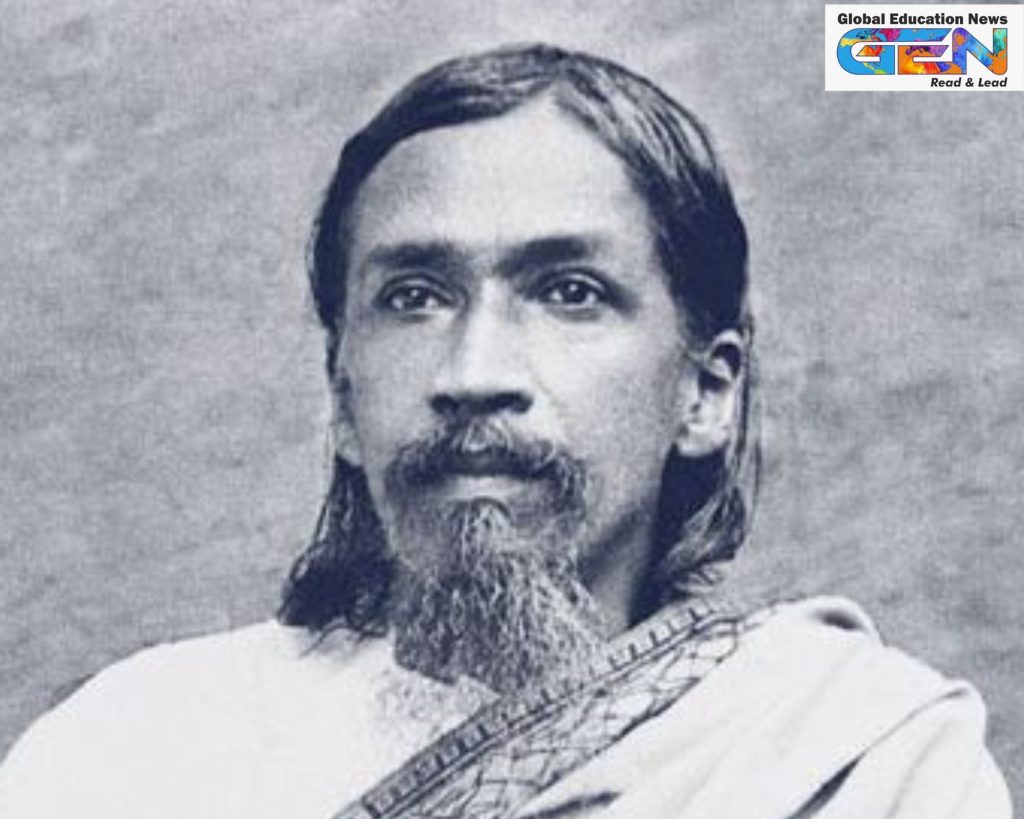
On August 15, 2025, as India celebrates its 79th Independence Day, we commemorate the 153rd birth anniversary of Aurobindo Ghose, a towering figure who seamlessly blended revolutionary nationalism with spiritual vision. Born in 1872, Aurobindo’s brief but impactful political career (1902–1910) and his later spiritual journey in Pondicherry reshaped the discourse on Swaraj, dharma, and nationalism. His nuanced ideas, expressed through fiery writings in Bande Mataram and profound speeches like the Uttarpara address, continue to inspire UPSC aspirants and scholars alike.
Key Points:
- Born: August 15, 1872, in Calcutta, to a Brahmo Samaj-influenced family.
- Political Phase: 1902–1910, marked by revolutionary writings and leadership in the nationalist faction of the Indian National Congress (INC).
- Spiritual Turn: Post-1910, Aurobindo embraced yoga and spiritual philosophy in Pondicherry, redefining nationalism as a divine mission.
- Legacy: Known for his polyglot mastery (12 languages) and integrating Indian culture with revolutionary ideals.
From England to India: A Transformative Journey
Aurobindo’s early life was shaped by his father’s anglophile aspirations. Sent to England at age seven, he excelled academically, mastering 12 languages and studying at King’s College, Cambridge. Despite clearing the Indian Civil Service (ICS) exam, he was disqualified for missing the riding test, returning to India in 1893 to join the Baroda Service.
Key Points:
- Education: Raised in Manchester, educated in London, and graduated from Cambridge.
- Baroda Years (1893–1906): Learned Sanskrit and Indian languages, distancing himself from his English upbringing to reconnect with Indian culture.
- Political Awakening: Sparked by the 1905 Partition of Bengal, leading him to leave Baroda for Calcutta to join the nationalist movement.
- Role: Became Principal of Bengal National College (now Jadavpur University) in 1906, advocating for Swaraj.
His Baroda years were pivotal, fostering a deep understanding of Indian civilization that fueled his revolutionary zeal.
Nationalism Beyond Politics: A Divine Mission
Aurobindo’s conception of nationalism transcended mere political demands, infusing it with spiritual and religious dimensions. Unlike the INC’s moderate faction, which sought reforms within colonial structures, Aurobindo viewed Swaraj as a sacred quest for India’s cultural and spiritual revival.
Key Points:
- Swaraj as Dharma: In his 1908 Bombay speech, Aurobindo called nationalism a “work of God,” urging followers to embrace it with religious fervor.
- Uttarpara Speech (1909): Post his release from Alipur jail, he declared India’s national revival as a vehicle for spreading the “universal truth of Hinduism” globally.
- Sanatan Dharma: Aurobindo saw nationalism as rooted in India’s eternal spiritual principles, blurring the lines between religion and politics.
- Critique of Moderates: Through Bande Mataram, he criticized the INC’s “convenient politics,” advocating for a radical, self-reliant struggle.
His writings framed nationalism as a divine calling, not just a political program, inspiring a generation to see freedom as a spiritual imperative.
Passive Resistance: Aurobindo vs. Gandhi
Aurobindo’s advocacy of passive resistance was distinct from Mahatma Gandhi’s Satyagraha, reflecting contrasting philosophies and strategies in the freedom struggle.
Key Points:
- Aurobindo’s Passive Resistance: An “organized refusal” to cooperate with colonial authorities, leveraging India’s indispensable role in British administration. He saw it as a practical tool to paralyze colonial governance, not inherently non-violent.
- Gandhi’s Satyagraha: Emphasized “soul-force” and personal suffering to assert moral rights, rooted in absolute non-violence and fearlessness, as outlined in Hind Swaraj.
- Key Differences:
- Aurobindo supported the “sword of the warrior” for justice when necessary, viewing passive resistance as a strategic choice, not a moral absolute.
- Gandhi’s approach was rigid, centered on moral superiority and non-violence as an end in itself.
- Implications: Aurobindo’s flexibility allowed for active resistance if needed, while Gandhi’s rigidity shaped a mass movement but limited tactical options.
UPSC Insight: Compare their approaches in Mains answers, highlighting Aurobindo’s pragmatic nationalism versus Gandhi’s moral absolutism.
Aurobindo’s Political Impact and Retreat
Aurobindo’s political career peaked during 1906–1910, marked by his leadership in the extremist faction of the INC and his role in the 1907 Surat Split. His prosecution in the 1908 Alipur Conspiracy Case and subsequent spiritual experiences in jail shifted his focus from politics to yoga and mysticism.
Key Points:
- Bande Mataram (1906–1908): Aurobindo’s editorials galvanized nationalist sentiment, criticizing British rule and INC moderates.
- Alipur Case (1908–1909): Imprisoned for alleged involvement, his acquittal and spiritual awakening led to the Uttarpara speech, blending nationalism with mysticism.
- Karmayogin and Dharma (1909): Launched these weeklies to revive the nationalist movement, but failing to unify his party, he withdrew to Pondicherry in 1910.
- Pondicherry Years (1910–1950): Focused on spiritual philosophy, developing Integral Yoga and founding the Sri Aurobindo Ashram, leaving active politics behind.
His brief but intense political engagement laid the groundwork for radical nationalism, influencing later leaders like Subhas Chandra Bose.
A Visionary’s Timeless Impact
On his 153rd birth anniversary, Aurobindo Ghose stands as a beacon of revolutionary nationalism and spiritual wisdom. His vision of Swaraj as a divine mission, his advocacy of passive resistance, and his critique of colonial and moderate politics reshaped India’s freedom struggle. While his retreat to Pondicherry marked a shift to spiritualism, his early contributions remain a cornerstone of India’s nationalist legacy. For UPSC aspirants, Aurobindo’s life offers a lens to explore the interplay of culture, politics, and philosophy in shaping modern India.