Date: October 15, 2026
Place: New Delhi, India
Education News: World Students’ Day 2026, APJ Abdul Kalam birth anniversary, student development and science education
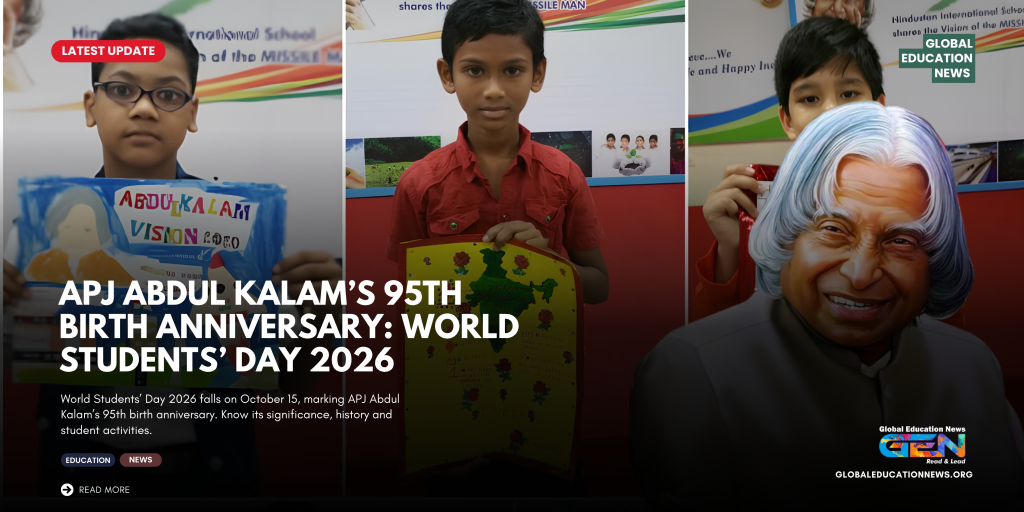
India is observing the 95th birth anniversary of former President and renowned scientist Dr APJ Abdul Kalam on October 15, 2026. Widely remembered as the ‘Missile Man of India’ and the ‘People’s President’, Kalam made significant contributions to India’s space and missile programmes while encouraging students to pursue education, scientific thinking and innovation.
World Students’ Day is observed on the same date in recognition of Kalam’s close connection with young people and his commitment to education. His life continues to inspire students to explore science, develop practical skills and use knowledge to address real-world challenges.
The occasion also brings attention to the role of schools, colleges and teachers in helping young people develop curiosity, independent thinking and a sense of responsibility.
World Students’ Day 2026: Date and Significance
World Students’ Day is observed on October 15, the birth anniversary of Dr APJ Abdul Kalam, who was born in Rameswaram, Tamil Nadu, in 1931.
The day highlights the importance of accessible education, student participation, scientific curiosity and youth empowerment. It encourages educational institutions to create opportunities for students to learn beyond textbooks through experiments, discussions, creative projects and collaborative activities.
Although the observance is widely associated with Kalam’s legacy, October 15 is not officially designated as World Students’ Day by the United Nations.
Who Was Dr APJ Abdul Kalam?
Avul Pakir Jainulabdeen Abdul Kalam was an aerospace scientist, author and the 11th President of India. He served as President from 2002 to 2007 and remained closely connected with students and educational institutions throughout his public life.
Born into a family in Rameswaram, Kalam developed a strong interest in learning and science. He graduated in physics from St Joseph’s College in Tiruchirappalli before studying aerospace engineering at the Madras Institute of Technology.
He worked with India’s Defence Research and Development Organisation (DRDO) and the Indian Space Research Organisation (ISRO). His contributions to launch vehicle development and the country’s guided missile programmes earned him the title ‘Missile Man of India’.
After his presidency, Kalam continued to teach, write and interact with young people. He died on July 27, 2015, while delivering a lecture at the Indian Institute of Management Shillong.
Why Is APJ Abdul Kalam’s Birth Anniversary Important for Students?
Kalam believed that education should help students develop knowledge, confidence, creativity and the ability to solve problems. His legacy remains relevant as students prepare for a world shaped by artificial intelligence, scientific research, digital technology and changing career opportunities.
The anniversary highlights several important lessons for students:
- Scientific curiosity: Asking questions and testing ideas can lead to deeper understanding.
- Learning through practice: Experiments, projects and real-world problem-solving can strengthen classroom learning.
- Persistence: Difficulties and setbacks can become opportunities to learn and improve.
- Ethical responsibility: Knowledge and technology should be used responsibly for the benefit of society.
- Lifelong learning: Education continues beyond examinations, degrees and formal classrooms.
These principles can help students connect academic learning with personal development and future career goals.
How Can Schools and Colleges Celebrate World Students’ Day 2026?
Schools, colleges and universities can use the occasion to encourage meaningful participation rather than limiting celebrations to speeches and ceremonies.
Possible activities include:
- Science exhibitions: Students can present experiments, working models and research projects.
- Innovation challenges: Teams can propose practical solutions to problems in their communities.
- Essay and speech competitions: Students can discuss Kalam’s contributions to science, education and public service.
- Career guidance sessions: Teachers and professionals can explain pathways into research, engineering, teaching and technology.
- Reading and discussion activities: Students can explore Kalam’s life and ideas through biographies and classroom discussions.
- Student-led projects: Groups can work on environmental awareness, digital literacy or other community-focused initiatives.
Such activities can encourage teamwork, communication, creativity and independent thinking.
What Is the Connection Between World Students’ Day and Science Education?
Science education is an important part of Kalam’s legacy. His work demonstrated how scientific research, engineering and teamwork can contribute to national development.
For students, science education is not limited to memorising formulas or preparing for examinations. It also involves observing problems, asking questions, analysing evidence and testing possible solutions.
Schools can strengthen this approach by providing practical learning opportunities, supporting science clubs, encouraging student research and helping learners connect classroom concepts with everyday life.
Students interested in science and technology can also explore robotics, environmental science, coding, electronics and research projects according to their interests and available resources.
World Students’ Day 2026: Key Facts at a Glance
| Key detail | Information |
|---|---|
| Occasion | World Students’ Day |
| Date in 2026 | October 15, 2026 |
| Birth anniversary | 95th birth anniversary of Dr APJ Abdul Kalam |
| Year of birth | October 15, 1931 |
| Birthplace | Rameswaram, Tamil Nadu |
| Presidential term | 2002–2007 |
| Popular titles | Missile Man of India; People’s President |
| Main focus | Education, scientific thinking, innovation and youth development |
| UN status | Not an officially designated UN international day |
Frequently Asked Questions (FAQs)
1. When is World Students’ Day 2026 observed?
World Students’ Day 2026 is observed on Thursday, October 15, coinciding with the birth anniversary of Dr APJ Abdul Kalam.
2. Why is October 15 celebrated as World Students’ Day?
The date is associated with Kalam’s birth anniversary and his lifelong commitment to teaching, education and inspiring young people.
3. How old would APJ Abdul Kalam have been in 2026?
Dr APJ Abdul Kalam was born on October 15, 1931. His 95th birth anniversary falls on October 15, 2026.
4. What was APJ Abdul Kalam known for?
Kalam was an aerospace scientist and India’s 11th President. He played important roles in the country’s space and missile programmes and was widely respected for his engagement with students.
5. Is World Students’ Day an official United Nations observance?
No. World Students’ Day is widely observed on October 15 in honour of Kalam, but it is not an officially designated United Nations international day.
6. How can students celebrate World Students’ Day?
Students can participate in science exhibitions, essay competitions, discussions, innovation challenges, reading activities and community projects.
7. What is the main message of APJ Abdul Kalam’s legacy for students?
His legacy encourages students to keep learning, think independently, explore scientific ideas and use their knowledge responsibly to contribute to society.
Conclusion
Dr APJ Abdul Kalam’s 95th birth anniversary is an opportunity to reflect on the importance of education, scientific curiosity and youth development. His journey from Rameswaram to the presidency demonstrates the lasting value of learning, dedication and public service.
For students, the most meaningful way to honour his legacy is to remain curious, develop practical skills and use education to understand and solve real-world problems. Schools and colleges can support this vision by encouraging experimentation, critical thinking and inclusive learning opportunities.
Global Education News will continue to cover education developments, student opportunities, science initiatives and policies shaping the future of young people.