Date: October 15, 2026
Place: Mumbai, Maharashtra
Education News: IIT Bombay anti-discrimination guidelines, student protests, caste discrimination concerns and campus welfare
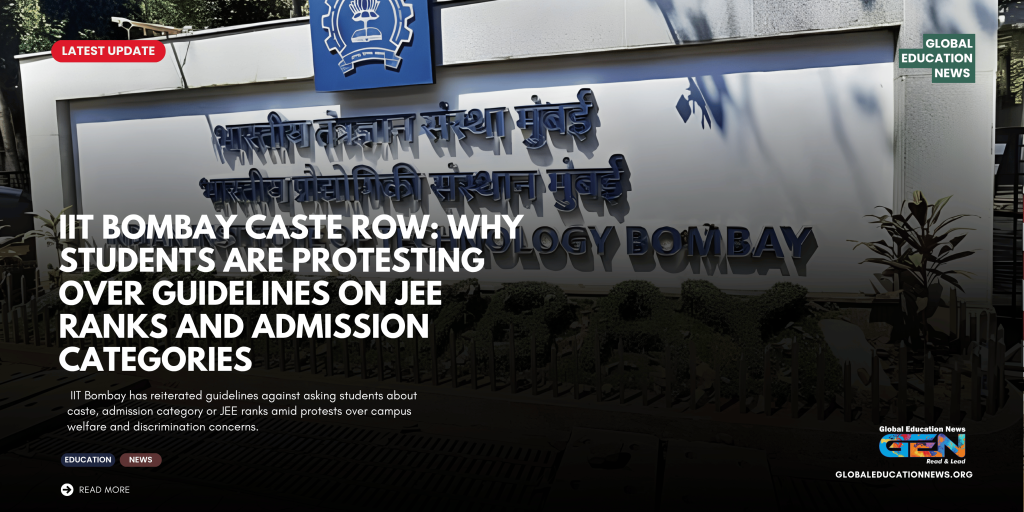
The Indian Institute of Technology Bombay (IIT Bombay) has reiterated its anti-discrimination guidelines advising students, faculty members and staff not to ask fellow students about their caste, admission category, JEE Advanced rank or GATE score. The institute says such questions, even when asked out of curiosity, can create conscious or unconscious bias and negatively affect students.
The renewed advisory comes amid student protests over campus welfare, institutional accountability and concerns about caste discrimination following the death of a second-year student in September. Protesters have criticised the administration’s communication and are seeking direct engagement over their concerns.
The development has renewed discussion about inclusion in India’s premier engineering institutions, the treatment of students from different social backgrounds and the need for effective grievance-redressal mechanisms on campuses.
What Are IIT Bombay’s Anti-Discrimination Guidelines?
IIT Bombay’s guidelines aim to promote an inclusive campus where students can interact without being judged on the basis of caste, religion, socioeconomic background or other personal characteristics.
The institute advises members of its community against asking students about their birth or admission category. It also considers questions about JEE Advanced ranks, GATE scores and similar information inappropriate when they could reveal a student’s caste or related background.
The guidance encourages students to build friendships around shared interests, such as academic subjects, sports, music, hobbies and hometowns.
The institute has also stated that abusive, hateful, casteist or sexist messages, religious prejudice and harassment are prohibited. This applies to communication on social media, messaging platforms, email and in-person interactions. Violations may lead to disciplinary action.
Why Has IIT Bombay Repeated Its Caste Guidelines?
The latest communication reiterates guidelines that IIT Bombay first circulated in July 2023. Similar advice was subsequently repeated, including in 2024.
The guidelines have resurfaced amid renewed campus tensions and concerns about how institutions respond to allegations of discrimination and student distress.
The institute’s stated position is that questions about caste, admission category or entrance-examination ranks can contribute to bias, even if the person asking does not intend to cause harm.
The renewed advisory has also prompted criticism from protesting students, who argue that communication alone does not address their wider concerns and that the administration should engage directly with students.
Why Are Students Protesting at IIT Bombay?
Student protests have focused on concerns about campus welfare, accountability and the institution’s response following the death of second-year BTech student Sahil Wakode on September 18, 2026.
The incident has led to scrutiny of the institute’s grievance mechanisms and the way student concerns are handled. Protesters have called for dialogue with the administration and broader measures to address issues raised by the campus community.
The renewed anti-discrimination email has become part of this wider debate. Some protesters have criticised the use of a circulated advisory instead of direct discussions about their demands.
The disagreement highlights two related but distinct questions: how an institution should discourage discriminatory behaviour and how it should respond to students seeking accountability and changes to campus systems.
What Are the Caste Discrimination Allegations?
Sahil Wakode’s family has alleged that he experienced caste-based discrimination. These allegations have become part of the wider scrutiny surrounding the case.
The allegations remain subject to investigation and should not be treated as established findings. The circumstances surrounding the student’s death and the concerns raised by his family require careful examination through the appropriate investigative processes.
The case has also renewed attention to the importance of accessible reporting channels, fair investigations and institutional responses that take complaints seriously.
It is important to distinguish between allegations made by individuals, the institute’s stated position and conclusions that may emerge from an investigation.
What Do the Guidelines Mean for Students Asking About JEE Rank or Caste?
The guidelines advise students, faculty and staff against asking peers about their caste, admission category, JEE Advanced rank or GATE score when such questions could expose personal background or encourage bias.
The issue is not simply whether a question is asked out of curiosity. The institute’s guidance highlights how a question may be experienced by the person receiving it and whether it could create an uncomfortable or discriminatory environment.
Students can build academic and social connections through common interests without making assumptions about another person’s caste, admission route or socioeconomic background.
The guidelines also stress that respectful behaviour should extend to online conversations, group chats and other digital spaces, where messages can spread quickly and cause harm.
What Does the Controversy Mean for Campus Inclusion in IITs?
The debate raises broader questions about how higher education institutions can make inclusion a practical part of campus life.
Anti-discrimination policies can set expectations for respectful conduct, but students also need clear ways to report concerns and understand how complaints will be handled.
Important areas for institutions include:
- Accessible grievance mechanisms: Students should know where and how to raise concerns.
- Fair investigations: Allegations should be examined impartially, without premature conclusions.
- Direct communication: Regular dialogue can help administrators understand student concerns.
- Awareness and education: Campus communities need to understand how discriminatory language and behaviour can affect others.
- Accountability: Institutions should communicate clearly about processes and appropriate follow-up while respecting privacy.
The IIT Bombay episode illustrates why policies, student support and transparent procedures all matter when a campus faces concerns about discrimination and welfare.
IIT Bombay Caste Guidelines and Student Protests: Key Facts
| Detail | Information |
|---|---|
| Institution | Indian Institute of Technology Bombay |
| Latest development | Anti-discrimination guidelines reiterated |
| Topics covered | Caste, admission category, JEE Advanced rank and GATE score |
| Original guideline circulation | July 2023 |
| Recent context | Student protests and concerns about campus welfare |
| Student at the centre of the current controversy | Sahil Wakode, a second-year BTech student |
| Date of his death | September 18, 2026 |
| Family’s position | Has alleged caste-based discrimination |
| Status of allegations | Subject to investigation |
| Main issues raised | Inclusion, accountability, grievance mechanisms and student welfare |
Frequently Asked Questions (FAQs)
1. What are IIT Bombay’s caste guidelines?
They are anti-discrimination guidelines advising students, faculty and staff not to ask peers about caste, admission category, JEE Advanced rank or GATE score when such questions could reveal personal background and contribute to bias.
2. Why does IIT Bombay discourage questions about JEE ranks?
The institute says entrance-examination ranks and similar details may reveal a student’s admission category or caste-related background and could lead to conscious or unconscious bias.
3. When were the guidelines first circulated?
The guidelines were first circulated in July 2023 and were reiterated in subsequent communications, including in 2024.
4. Why are students protesting at IIT Bombay?
The protests concern campus welfare, accountability and the administration’s response following Sahil Wakode’s death in September 2026. Students have also called for direct dialogue about their concerns.
5. What has Sahil Wakode’s family alleged?
His family has alleged caste-based discrimination. These claims remain subject to investigation and should not be presented as established findings.
6. Do the guidelines prohibit casteist or hateful messages?
Yes. The institute’s guidance prohibits abusive, hateful, casteist and sexist messages, as well as content involving religious prejudice or harassment. Violations may result in disciplinary action.
7. What can colleges do to improve campus inclusion?
Institutions can strengthen grievance mechanisms, investigate complaints fairly, promote respectful conduct, communicate clearly with students and provide opportunities for direct dialogue.
8. Why is this issue important for engineering students across India?
It highlights how campus culture, fair treatment and effective support systems are important alongside academic opportunities. Students should be able to participate in campus life without facing discrimination or harassment.
Conclusion
IIT Bombay’s renewed anti-discrimination guidelines have brought attention to the relationship between campus inclusion, student welfare and institutional accountability. The institute has advised its community against questions that could reveal caste or admission background, while protesting students are calling for more direct engagement over wider campus concerns.
The allegations raised by Sahil Wakode’s family remain subject to investigation. As the matter develops, careful fact-finding, fair procedures and meaningful communication will be important in addressing concerns and strengthening trust within the campus community.
Global Education News will continue to follow developments in higher education, campus policies, student welfare and efforts to build inclusive learning environments.