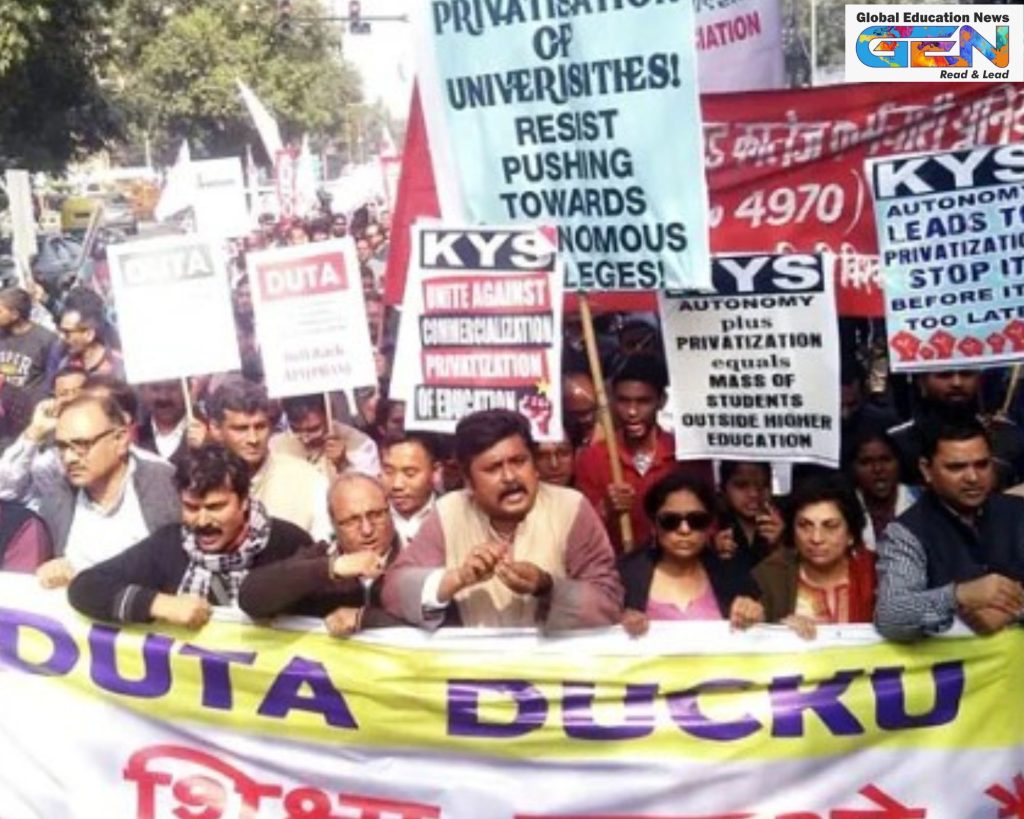
On December 15, 2025, the Lok Sabha witnessed heated debates as the Viksit Bharat Shiksha Adhishthan (VBSA) Bill 2025 was introduced—a bold government push to overhaul higher education regulation. Aimed at creating a unified framework, the bill seeks to merge the University Grants Commission (UGC), All India Council for Technical Education (AICTE), and National Council for Teacher Education (NCTE) into a single commission backed by three specialized councils. But beneath the promise of streamlined governance lies a storm of opposition from central university teachers, students, and academics.
Their core fear? The bill’s shift of funding powers from the regulator to the Ministry of Education (MoE) could erode institutional independence, politicize grants, and squeeze public funding for universities. As protests echo from Delhi University to JNU, this clash highlights deeper tensions in India’s quest for world-class higher education. With the government hinting at a Joint Parliamentary Committee (JPC) review, the stakes couldn’t be higher for the nation’s 1,000+ higher education institutions.
What is the VBSA Bill? Core Provisions at a Glance
The VBSA Bill envisions a “one nation, one regulator” model to cut red tape and boost efficiency. Proponents argue it will foster innovation and global competitiveness, aligning with the National Education Policy (NEP) 2020’s vision. However, critics see it as a Trojan horse for centralization.
Key Provisions:
- Single Commission Structure: A central Higher Education Commission (HEC) led by a chairperson, overseeing regulation, accreditation, and academic standards through three councils.
- Funding Overhaul: Strips the new body of grant-disbursing powers, handing them directly to the MoE— a departure from UGC’s dual role.
- Repeal of Existing Acts: Dissolves UGC (1956), AICTE (1987), and NCTE (1993), aiming to eliminate overlaps and enforce uniform compliance.
- Implementation Timeline: If passed, expected to roll out by mid-2026, with transitional provisions for ongoing projects.
This blueprint promises consistency but raises red flags on how it will safeguard diverse institutional needs in a federal setup.
Why the Backlash? Teachers’ Concerns Over Autonomy and Funding
Central university teachers aren’t holding back—their opposition is fierce and unified. Bodies like the Joint Forum for Movement on Education (JFME) and Democratic Teachers’ Front warn that delinking regulation from funding invites ministerial overreach, turning universities into extensions of government agendas. With public funding already dwindling (just 0.7% of GDP on higher education), the bill could accelerate privatization and fee hikes.
Major Concerns Highlighted:
- Erosion of Autonomy: Without an independent funding arm, universities risk arbitrary grant cuts, stifling research and curriculum freedom—especially in social sciences and humanities.
- Politicized Allocations: MoE control could prioritize politically aligned projects, echoing past controversies like UGC’s “deemed-to-be” university dilutions.
- Impact on Service Conditions: Teachers fear job insecurity, with service rules potentially overridden by centralized norms, affecting promotions and pensions.
- Centralization Risks: A one-size-fits-all regulator ignores regional disparities, from rural colleges to elite central varsities, potentially widening the urban-rural education divide.
Protests have included dharnas at Parliament and open letters signed by thousands, demanding the bill’s withdrawal or major amendments.
Voices from the Frontlines: Quotes and Stakeholder Perspectives
The debate is personal for those on the ground. Educators and opposition voices paint a picture of an “assault on public universities,” urging a rethink before it’s too late.
Notable Statements:
- Manoj Jha, RJD MP: “This bill has been in the works for many years and referring it to the JPC just delays the inevitable. This bill attempts to fundamentally alter how the universities function.”
- Nandita Narain, JFME President and Educationist: “The VBSA Bill is to make the Ministry of Education (MoE) responsible for disbursing grants. This will make the process of grant allocation more bureaucratic, arbitrary and subject to political considerations.”
- Student Activists from JNUSU: “We’re not just fighting for funding—we’re defending the soul of critical thinking against a homogenized, market-driven education system.”
- Academic Unions: “Feedback from consultations has been completely ignored; this isn’t reform, it’s regression for India’s knowledge economy.”
These voices underscore a shared dread: a future where universities prioritize compliance over creativity.
Broader Implications: Reshaping India’s Higher Education Landscape
If enacted, the VBSA Bill could turbocharge efficiency but at what cost? Supporters tout reduced duplication and faster accreditations, potentially elevating India’s QS World Rankings (currently 40th globally). Yet, detractors predict a 20-30% funding dip for non-STEM fields, exacerbating brain drain and inequality—vital as India aims for a $5 trillion economy by 2027.
Potential Ripple Effects:
- On Students: Higher fees and curtailed scholarships could lock out marginalized groups, clashing with NEP’s equity goals.
- On Research: Politicized grants might choke interdisciplinary work, hindering breakthroughs in climate and health sciences.
- Policy Precedent: Success here could inspire similar overhauls in states, but failure might stall NEP implementation nationwide.
- Government Stance: While open to JPC scrutiny, officials defend it as “empowering” regulators to focus on quality over cash flow.
This isn’t isolated—it’s part of a global tug-of-war between autonomy and accountability in higher ed.