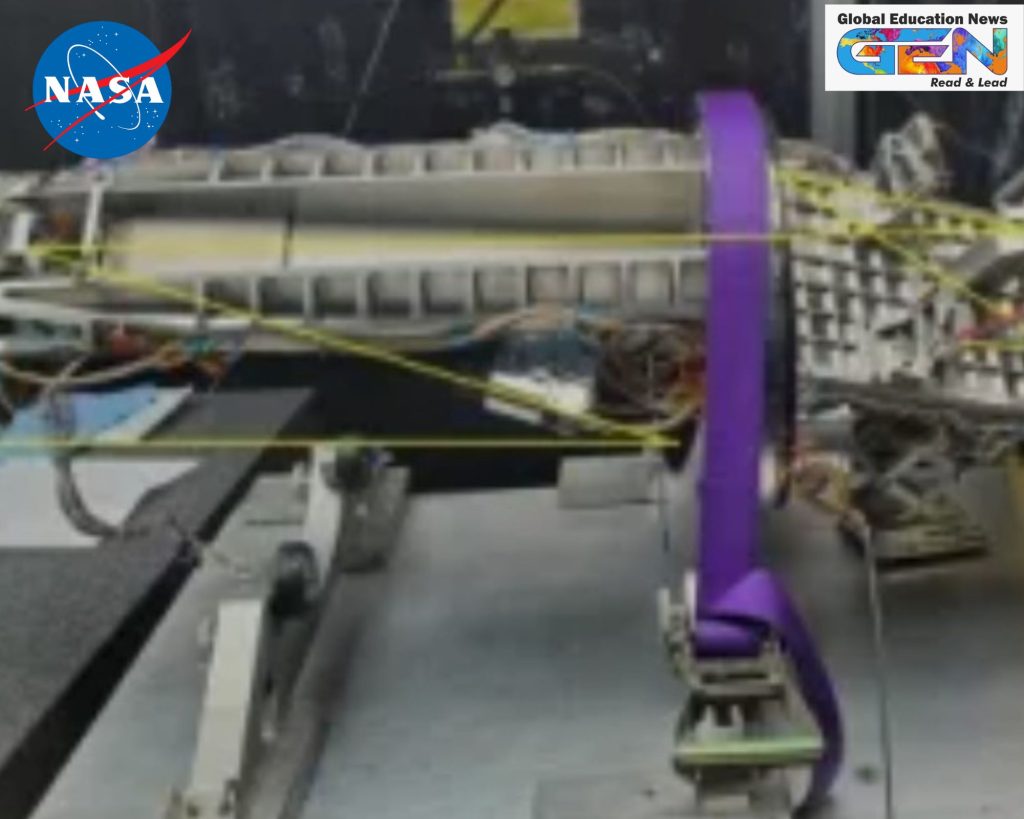
In 2025, NASA and international solar physicists are set to unravel one of the Sun’s greatest mysteries with the Solar EruptioN Integral Field Spectrograph (SNIFS) mission. Targeting the chromosphere—the dynamic, reddish layer between the Sun’s visible surface and its scorching corona—this groundbreaking mission uses cutting-edge technology to decode solar activity and solve the puzzle of why the corona reaches million-degree temperatures. Led by NASA’s Goddard Space Flight Center, with partners from the University of Colorado and Queen’s University Belfast, SNIFS is poised to revolutionize our understanding of the Sun. Here’s your guide to this stellar mission and its quest to illuminate the chromosphere’s secrets!
Key Points:
- First UV integral field spectrograph to study the Sun’s chromosphere
- Brief sounding rocket flight in 2025 to capture real-time solar data
- Aims to explain the corona’s extreme heat and solar activity dynamics
What is the Chromosphere? The Sun’s Dynamic Middle Layer
The chromosphere is a thin, fiery layer sandwiched between the Sun’s photosphere (visible surface) and its corona (outer atmosphere). Known for its reddish glow, it’s a hotspot for solar flares, plasma jets, and intense energy flows. With temperatures soaring from 6,000°C to over 1 million°C, this region is critical to understanding why the corona is dramatically hotter than the Sun’s surface—a mystery that has puzzled scientists for decades.
Key Points:
- Located between the photosphere and million-degree corona
- Hosts dynamic events like solar flares and plasma jets
- Temperature ranges from 6,000°C to over 1 million°C
SNIFS: A Revolutionary Tool for Solar Exploration
The Solar EruptioN Integral Field Spectrograph (SNIFS) is the first ultraviolet integral field spectrograph designed for solar studies. Unlike traditional instruments, SNIFS captures high-resolution spectral data across a full 2D field of view, creating a 3D data cube with a complete spectrum for every pixel in real time. Its primary focus is the hydrogen Lyman-alpha line, the brightest UV emission from the upper chromosphere, which holds clues to the Sun’s energy dynamics.
Key Points:
- First UV spectrograph for 3D solar data collection
- Targets the hydrogen Lyman-alpha line for detailed analysis
- Delivers real-time, high-resolution spectral data
Mission Goals: Decoding the Chromosphere’s Mysteries
The SNIFS mission aims to unlock the chromosphere’s secrets by analyzing the Lyman-alpha line to measure plasma temperatures, velocities, and densities. These insights will improve models of the chromosphere’s complex magnetic and plasma interactions, which defy standard thermodynamic rules. By providing detailed observations, SNIFS seeks to clarify how energy flows through this layer to heat the corona, a key question in solar physics.
Key Points:
- Measures plasma properties via Lyman-alpha line analysis
- Improves models of magnetic and plasma interactions
- Seeks to explain energy transfer to the corona
Challenges in Studying the Chromosphere
The chromosphere is a tough nut to crack. Composed of ionized plasma with charged and neutral particles, it behaves unpredictably under magnetic fields, challenging conventional physics. Limited detailed observations have hindered progress, but SNIFS’s advanced technology promises to overcome these barriers, offering unprecedented data on energy supply and dissipation mechanisms.
Key Points:
- Complex plasma and magnetic interactions defy standard models
- Limited past observations due to technological constraints
- SNIFS aims to provide detailed, real-time data
Global Collaboration: Who’s Behind SNIFS?
The SNIFS mission is a collaborative powerhouse, uniting top institutions:
- NASA’s Goddard Space Flight Center: Leads mission design and execution
- University of Colorado: Contributes expertise in solar instrumentation
- Queen’s University Belfast, UK: Enhances spectroscopic analysis
This international team ensures the mission leverages cutting-edge technology and global expertise for maximum impact.
Key Points:
- Partnership between NASA, University of Colorado, and Queen’s University Belfast
- Combines expertise in solar physics and spectroscopy
- Strengthens global collaboration in space research
The Mission: A Brief but Powerful Journey
The SNIFS mission will take flight on a sounding rocket in 2025, with a window of less than 10 minutes to capture critical data. This short but intense observation period is designed to collect high-resolution data on the chromosphere’s dynamic processes, such as solar flares and plasma jets, in real time. The brevity of the flight underscores the precision and efficiency of SNIFS’s technology.
Key Points:
- Sounding rocket flight lasting under 10 minutes
- Captures real-time data on chromospheric dynamics
- High-resolution observations for maximum scientific impact
Public Buzz: Excitement for Solar Breakthroughs
The SNIFS mission is generating buzz on platforms like X, with users like @NASA_Sun and @SpaceNews_Inc hailing it as a “game-changer for solar science.” Researchers and space enthusiasts, such as @AstroKatie, emphasize its potential to solve the coronal heating mystery. Some voices raise questions about the mission’s short duration, but experts assure that even brief data collection can yield transformative insights.
Key Points:
- Strong support on X for SNIFS’s innovative approach
- Enthusiasm for solving the coronal heating puzzle
- Assurance that short flight yields high-impact data
Why SNIFS Matters: A Step Toward Solar Mastery
The SNIFS mission is more than a scientific experiment—it’s a key to understanding the Sun’s role in space weather, solar storms, and their impact on Earth’s technology, like satellites and power grids. By decoding the chromosphere’s energy dynamics, SNIFS will enhance our ability to predict solar events, supporting NASA’s broader goals of advancing space exploration and planetary protection. It also strengthens India’s growing role in global space research, with institutions like ISRO showing interest in similar solar studies.
Key Points:
- Improves space weather prediction and planetary protection
- Advances understanding of solar storms’ impact on Earth
- Inspires global solar research, including in India
How to Stay Engaged with SNIFS
Want to follow this solar adventure? Here’s how to stay in the loop:
Key Points:
- Track Updates: Follow nasa.gov for mission news and data releases
- Engage on X: Join discussions via hashtags like #SNIFS and #SolarScience
- Learn More: Explore resources from NASA Goddard and partner universities
- Inspire Others: Share the mission’s goals with science enthusiasts
- Contact NASA: Reach out via nasa.gov/contact for queries