Higher education systems across the world are facing a common challenge: preparing students for jobs that may not even exist today.
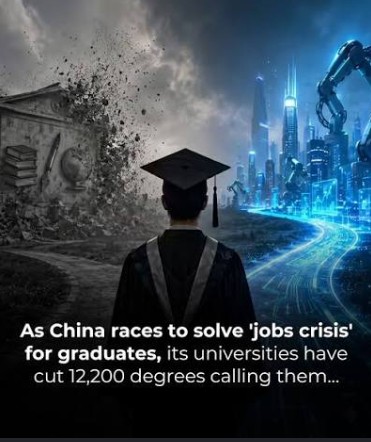
In one of the most ambitious academic restructuring exercises ever undertaken, China has removed or suspended 12,200 undergraduate degree programmes while introducing more than 10,200 new programmes between 2021 and 2025. The reforms have affected over 30 percent of university programmes nationwide, making it one of the largest curriculum realignments in modern higher education.
The move reflects a growing belief among policymakers that universities must become more responsive to technological disruption, labour-market demands, and national development priorities.
As artificial intelligence, robotics, advanced manufacturing, biotechnology, and digital technologies reshape economies worldwide, the debate is no longer about whether higher education should change—but how quickly it can adapt.
For India, which produces millions of graduates every year and aspires to become a global knowledge and innovation hub, China’s experiment offers important lessons and equally important warnings.
Why China Is Overhauling Its University Degrees
The restructuring is not merely an academic exercise. It is closely linked to China’s long-term economic strategy.
Chinese policymakers have expressed concern about a growing mismatch between university education and labour-market requirements. At the same time, the country is investing heavily in emerging industries such as artificial intelligence, semiconductors, advanced robotics, clean energy, and next-generation manufacturing.
Universities have therefore been encouraged to:
- Eliminate programmes with declining demand
- Reduce duplication of oversaturated courses
- Expand technology-oriented disciplines
- Promote interdisciplinary education
- Integrate AI into teaching and learning
- Improve graduate employability outcomes
The objective is straightforward: ensure that educational institutions produce talent aligned with future economic priorities rather than past industrial realities.
The Rise of AI-Era Degrees
Many newly introduced programmes are linked directly to emerging technologies and future industries.
Among the areas receiving increased attention are:
Artificial Intelligence and Machine Learning
AI has become central to China’s industrial strategy. Universities are expanding programmes that focus on machine learning, intelligent systems, data modelling, and AI applications across sectors.
Robotics and Automation
As manufacturing becomes increasingly automated, demand for specialists in robotics engineering, automation systems, and intelligent production technologies continues to rise.
Semiconductors and Integrated Circuits
The global race for technological self-reliance has intensified investment in semiconductor education and research.
Brain-Machine Science and Embodied Intelligence
Some universities have launched cutting-edge interdisciplinary programmes combining neuroscience, computing, robotics, and cognitive science.
Renewable Energy and Future Engineering
New programmes are also focusing on energy transition technologies, sustainable infrastructure, and climate-resilient development.
The Graduate Employability Factor
One of the strongest drivers behind the reforms is employability.
Around the world, employers increasingly report that graduates often possess academic credentials but lack skills directly relevant to modern workplaces.
This challenge is particularly visible in rapidly changing industries where technological advancements can transform job requirements within just a few years.
Many policymakers now argue that universities should be evaluated not only by academic reputation but also by:
- Graduate employment rates
- Industry partnerships
- Innovation output
- Skill development
- Workforce readiness
The debate has shifted from “What should students learn?” to “What skills will students need in the next decade?”
Does This Mean Humanities and Arts Are Becoming Irrelevant?
Absolutely not.
One of the biggest misconceptions surrounding China’s reforms is that humanities and social sciences no longer matter.
While some programmes have faced reductions, experts caution against equating technological advancement with the disappearance of human-centred disciplines.
In fact, the rise of artificial intelligence may make uniquely human skills even more valuable.
These include:
Critical Thinking
The ability to evaluate information, challenge assumptions, and make informed decisions.
Communication Skills
Effective communication remains one of the most sought-after workplace skills.
Creativity and Innovation
AI can generate content, but human creativity continues to drive innovation and cultural development.
Ethics and Social Understanding
As AI becomes more powerful, ethical decision-making and social awareness become increasingly important.
Research on higher education in the AI era consistently highlights the need for a balance between technological expertise and human-centred capabilities.
The Real Trend: Interdisciplinary Education
Perhaps the most important lesson from China’s reforms is not the elimination of programmes but the rise of interdisciplinary learning.
Future challenges rarely fit neatly within traditional academic boundaries.
Tomorrow’s professionals may require combinations such as:
- AI + Healthcare
- Robotics + Agriculture
- Data Science + Economics
- Engineering + Sustainability
- Psychology + Technology
- Biotechnology + Artificial Intelligence
Universities worldwide are increasingly recognizing that innovation often occurs at the intersection of disciplines rather than within isolated academic silos.
What Does This Mean for India?
India’s higher education system serves one of the largest student populations in the world.
The country has already initiated reforms through multidisciplinary education, skill-based learning, digital education initiatives, and greater curriculum flexibility.
However, several challenges remain:
Curriculum Modernization
Many university programmes continue to rely on outdated content that does not adequately reflect current industry requirements.
Employability Gap
Employers frequently identify skill gaps among graduates despite increasing qualification levels.
Industry-Academia Disconnect
Collaboration between universities and industries often remains limited.
Emerging Technology Readiness
AI literacy, data skills, and digital competencies are still not uniformly integrated across disciplines.
To remain globally competitive, Indian universities may need faster mechanisms for reviewing and updating academic programmes.
Should India Follow China’s Model?
The answer is both yes and no.
Yes, India Should:
- Modernize outdated curricula
- Promote future-focused disciplines
- Strengthen industry partnerships
- Encourage interdisciplinary learning
- Integrate AI literacy across education
- Expand skill-based and experiential learning
No, India Should Not:
- Remove programmes solely based on short-term market trends
- Undervalue humanities and social sciences
- Reduce education to employment statistics alone
- Ignore regional and cultural educational needs
A successful higher education system must balance economic relevance with intellectual diversity.
The Future University: From Degrees to Lifelong Learning
The broader lesson extends beyond specific degree programmes.
The future of higher education may not revolve around a single degree earned at age 21.
Instead, it is increasingly moving toward:
- Continuous upskilling
- Micro-credentials
- Industry certifications
- Flexible learning pathways
- Lifelong education models
As technology evolves faster than traditional curricula, learning itself may become a lifelong process rather than a one-time academic milestone.
Conclusion: A Wake-Up Call for Global Higher Education
China’s decision to scrap 12,200 degree programmes and introduce 10,200 new ones represents far more than curriculum reform.
It reflects a fundamental shift in how governments, industries, and universities view the relationship between education and employment.
For India, the takeaway is not that arts, humanities, or traditional disciplines should disappear. Rather, it is that universities must become more agile, interdisciplinary, and future-oriented.
The challenge facing higher education today is not choosing between technology and humanities.
It is creating graduates who can combine technical expertise with creativity, ethics, adaptability, and critical thinking.
The countries that successfully achieve this balance will be best positioned to lead the next era of innovation, economic growth, and global competitiveness.