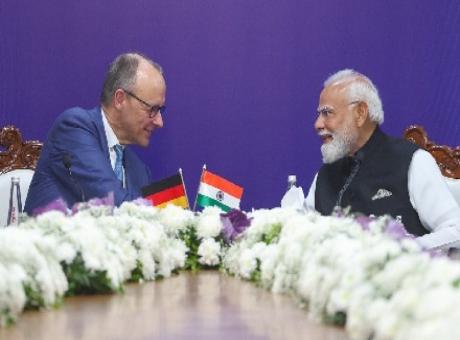
On the cusp of the 75th anniversary of diplomatic ties and the 25th of their Strategic Partnership, Prime Minister Narendra Modi extended a warm invitation to German universities to establish campuses in India during Chancellor Friedrich Merz’s two-day visit from January 12-13, 2026. Addressing a joint press conference in New Delhi, Modi hailed the move as a cornerstone of a comprehensive higher education roadmap, designed to foster academic exchanges and innovation under the National Education Policy (NEP) 2020. This overture, coupled with Modi’s gratitude for Germany’s visa-free transit announcement for Indian citizens, underscores a deepening people-to-people bond—potentially easing access for over 20,000 Indian students annually pursuing studies in Germany. The discussions, blending historical reverence (nodding to Tagore, Vivekananda, and Bhikaji Cama) with forward-looking agendas, signal India’s pivot toward global academic hubs, where foreign institutions can operate with full autonomy per NEP guidelines. Amid a 15% YoY rise in Indo-German trade (reaching €25 billion in 2025), this education thrust could amplify collaborations, boosting India’s GER in higher education from 28.4% to 35% by 2030 while channeling German expertise in engineering and sustainability to Indian youth.
Key Points:
- Visit Context: Jan 12-13, 2026; marks 75th diplomatic anniversary and 25th Strategic Partnership.
- Modi’s Invitation: German universities to set up campuses; aligns with NEP’s international focus.
- Visa Gratitude: Thanks for transit-free entry; eases mobility for 20,000+ Indian students yearly.
- Historical Tie-In: References Tagore/Vivekananda; blends legacy with modern roadmap.
Core Invitations and Gratitude: Education Mobility Takes Center Stage
Modi’s pitch for German campuses positions India as an attractive destination for European academia, leveraging NEP’s provisions for foreign institutions to offer degrees with 100% repatriation of earnings and minimal regulatory hurdles. This builds on 2023’s UGC approvals for global setups, targeting fields like AI, renewable energy, and vocational training where Germany excels—potentially creating 50,000 joint seats by 2030. Parallelly, the visa-free transit—extending 90-day Schengen access without prior approval—addresses a key barrier, reducing costs by 20-30% for short-term exchanges and research stints. Modi’s thanks to Merz (and a nod to former Chancellor Merkel for defense trade simplifications) highlighted mutual trust, with the duo emphasizing G4 reforms for UNSC seats as a shared global vision. These gestures, amid signed MoUs, could triple student flows, fostering a bilateral “knowledge corridor” that rivals US-India ties.
Key Points:
- Campus Appeal: NEP-enabled autonomy; targets AI/renewables for 50,000 seats by 2030.
- Transit Boost: 90-day visa-free; cuts 20-30% mobility costs for exchanges.
- Gratitude Echo: To Merz/Merkel for trade ease; ties to G4 UNSC push.
- Flow Projection: Triple Indo-German student exchanges via MoUs.
Higher Education Roadmap: From Campuses to Collaborative Ecosystems
The unveiled roadmap charts a multi-pronged path for Indo-German academia, integrating campus establishments with joint research in green hydrogen, urban mobility, and secure supply chains—sectors where Germany’s Fraunhofer model meets India’s Atmanirbhar push. Key pillars include faculty swaps (targeting 1,000 annually), dual-degree programs under NEP’s credit framework, and tech transfer hubs for co-development in defense and EVs. Discussions also touched global challenges like terrorism and climate action, with Modi-Merz committing to peaceful resolutions and energy pacts. This framework, formalized via MoUs, extends beyond education to holistic ties—urban planning via Siemens-inspired models and security via joint exercises—potentially injecting €5 billion in FDI by 2028, while elevating India’s innovation index by 10-15 ranks through German mentorship.
Higher Education Roadmap Table:
| Pillar | Focus Areas | Projected Outcomes |
|---|---|---|
| Campus Setup | German branches in tech hubs (e.g., Bengaluru, Hyderabad) | 50,000 seats; full degree repatriation under NEP. |
| Research Ties | Green H2, EVs, AI; faculty exchanges (1,000/year) | €5B FDI; 10-15 innovation rank uplift. |
| Mobility Programs | Dual degrees, short-term visas | Triple student flows; 20% cost savings. |
| Broader Collabs | Defense co-prod, urban dev, climate pacts | Joint exercises; secure supply chains. |
This ecosystem not only democratizes elite education but also aligns with Viksit Bharat’s skill goals, creating a symbiotic loop of talent and tech.
Key Points:
- Research Synergy: Green H2/EVs; 1,000 faculty swaps yearly.
- Degree Flexibility: NEP credits for dual programs; €5B FDI influx.
- Global Alignment: Terrorism/climate focus; G4 UNSC advocacy.
- Symbiotic Gains: Talent exchange elevates India’s skill ecosystem.
Implications for Students and Bilateral Ties: A Win-Win for Global Talent
For Indian students, German campuses mean world-class education at home—slashing €10,000-15,000 annual costs abroad—while visa-free transit unlocks apprenticeships at firms like Bosch and Siemens, boosting employability by 25% in engineering sectors. Women and rural aspirants gain via scholarships in the roadmap, addressing 40% gender gaps in STEM abroad. Bilaterally, this cements India-Germany as a “natural alliance,” per Modi, with MoUs accelerating defense (co-prod roadmaps) and energy (H2 projects), potentially doubling trade to €50 billion by 2030. In a multipolar world, these ties counterbalance influences, fostering resilient supply chains and shared UN reforms—transforming historical bonds into a 21st-century powerhouse.
Key Points:
- Student Perks: Home-based German degrees; 25% employability rise.
- Inclusivity Push: Scholarships for women/rurals; cuts 40% STEM gaps.
- Trade Turbo: €25B to €50B; defense/energy MoUs.
- Geopolitical Edge: Natural alliance for UN/multipolar stability.
Challenges and Future Outlook: Scaling the Indo-German Academic Bridge
Hurdles like regulatory harmonization (e.g., degree equivalence) and cultural adaptations could slow campus launches, with 10-15% initial delays projected without fast-track UGC nods. Yet, with Merz’s commitment to “deepen ties,” pilots in 2026 could scale to 10 campuses by 2028, inspiring EU-wide models. As Modi quipped on Tagore’s legacy, this roadmap “turns history into future”—poised to make India a magnet for European academia, enhancing global rankings and youth dividends in an interconnected era.
Key Points:
- Regulatory Snags: Equivalence/cultural fits; 10-15% rollout delays.
- Pilot Promise: 2026 starts; 10 campuses by 2028.
- Merz Echo: “Deepen ties” for EU inspiration.
- Legacy Forward: Tagore’s spirit fuels 21st-century bridges.