Date: October 21, 2026
Place: New Delhi
Education News: Artificial Intelligence, Student Learning and Education Technology
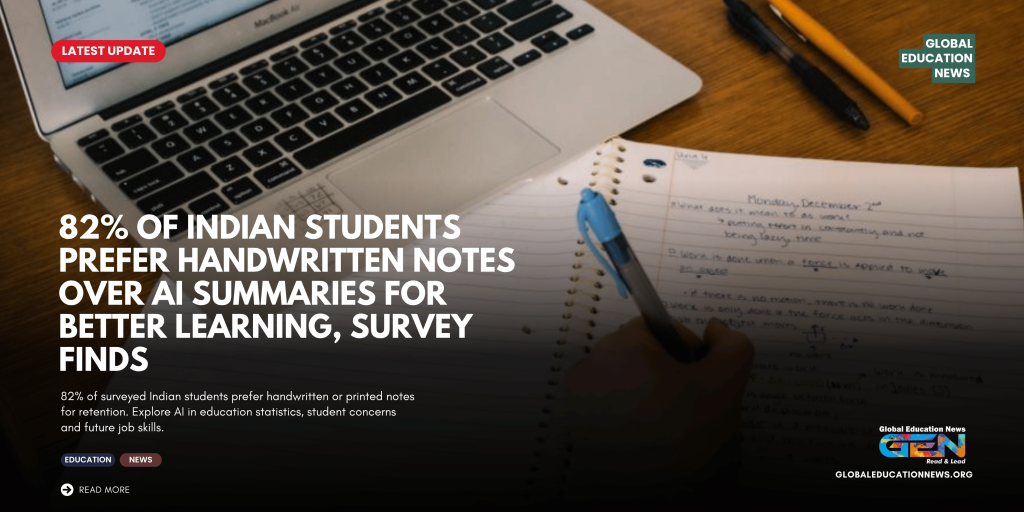
Artificial intelligence is helping students find information, understand topics and complete academic tasks faster, but many Indian students remain concerned about whether it supports deeper learning. A new global student survey found that 82% of the 758 Indian students surveyed preferred traditional methods, such as handwriting or printing notes, when they wanted to remember what they had studied.
The findings highlight a growing question for schools, colleges and universities: can students use AI to save time without losing the ability to think independently, understand complex concepts and retain information? The survey covered more than 6,000 students worldwide and also found strong optimism among Indian students about AI-related career opportunities.
The results do not prove that AI reduces learning ability. Instead, they reveal students’ preferences and concerns at a time when AI tools are becoming part of everyday academic work.
AI in Education 2026: Key Statistics at a Glance
| Survey finding | Percentage or number |
|---|---|
| Students surveyed worldwide | More than 6,000 |
| Indian students included in the survey | 758 |
| Indian students preferring handwriting or printed notes for retention | 82% |
| Indian students believing AI will create more career opportunities than it displaces | 78% |
| Indian students confident about using AI effectively and responsibly in future careers | 87% |
| Indian students who believe their education is preparing them for work | 92% |
| Students identifying AI and digital literacy as important future-work skills | 52% |
| Students identifying creativity as an important future-work skill | 48% |
| Students identifying critical thinking as an important future-work skill | 41% |
| Students identifying communication and collaboration as important future-work skills | 36% |
These figures reflect the survey responses reported for Indian students. They are not automatically representative of every student in India, and the percentages should not be interpreted as measurements of actual academic performance.
Why Do 82% of Indian Students Still Prefer Handwritten or Printed Notes?
The finding suggests that students do not necessarily see digital technology and traditional study methods as competing choices. They may use AI for quick explanations and information retrieval while turning to handwritten notes or printed material when their goal is to remember concepts.
Writing notes can require students to select important information, organise ideas and express concepts in their own words. These activities may encourage active engagement with the material. However, handwriting alone does not guarantee better learning: the benefit also depends on how students review, practise and apply what they study.
For example, a student preparing for a mathematics examination might ask AI to explain a difficult formula, then solve practice problems independently and write down the steps. This combines the speed of digital assistance with active practice and self-checking.
The central lesson is not that students should stop using AI. It is that getting an answer quickly and understanding that answer are two different things.
Does AI Make Studying Faster but Reduce Deep Learning?
AI tools can summarise long passages, explain unfamiliar terms, generate practice questions and help students organise information. These functions can save time, particularly when students need an initial explanation of a difficult subject.
The risk arises when convenience replaces the mental work required to learn. If a student repeatedly copies AI-generated answers without checking the reasoning, recalling the information or applying it to a new problem, the student may finish an assignment without developing a strong understanding of the topic.
The survey highlights concern about this distinction, but it does not establish that AI use directly causes weaker learning. To assess that question, researchers would need evidence measuring students’ understanding and retention under different learning conditions.
AI summaries versus active learning
| Study method | Potential benefit | What students should watch for |
|---|---|---|
| AI-generated summary | Quickly introduces the main points | Important details or context may be missing |
| Handwritten notes | Encourages selection and organisation of ideas | Copying without understanding may offer limited benefit |
| Printed study material | Allows annotation, review and comparison | Reading alone may not ensure long-term retention |
| AI-generated practice questions | Provides additional opportunities to practise | Answers and explanations need checking |
| Independent problem-solving | Tests whether students can apply what they know | Mistakes need to be reviewed and corrected |
| Explaining a concept in your own words | Helps reveal gaps in understanding | Explanations should be checked for accuracy |
The most useful approach is to select a method based on the learning task, rather than assuming one format works best for every student or subject.
78% of Indian Students Believe AI Will Create More Career Opportunities
Despite concerns about learning, Indian students remain optimistic about AI’s impact on employment. The survey found that 78% believed AI would create more career opportunities than it would displace.
This optimism reflects the potential for AI to support work across areas such as healthcare, education, business, engineering, research and digital services. However, new opportunities do not automatically benefit everyone equally. Students will need relevant knowledge, practical experience and the ability to use technology responsibly.
The result is a reminder for educational institutions to prepare students for both the opportunities and the challenges of an AI-enabled economy.
Which skills do Indian students consider important for future jobs?
The survey highlighted a combination of technical knowledge and human capabilities:
- AI and digital literacy — 52%: Understanding digital tools, their limitations and responsible use.
- Creativity — 48%: Developing original ideas and finding new approaches to problems.
- Critical thinking — 41%: Evaluating evidence, checking claims and identifying errors.
- Communication and collaboration — 36%: Explaining ideas clearly and working effectively with others.
These percentages describe the skills identified by survey respondents; they do not establish a universal ranking of employer requirements. Together, however, they underline an important point: learning how to operate AI tools is not the same as learning how to assess their output.
87% Feel Confident About Using AI Responsibly in Their Future Careers
The survey found that 87% of Indian respondents felt confident they would be able to use AI tools effectively and responsibly in their future careers.
That confidence is encouraging, but responsible AI use requires more than knowing how to enter a prompt. Students should understand that AI-generated information can be inaccurate, incomplete or misleading. They also need to protect personal information, respect academic rules and acknowledge AI assistance when required.
Schools and colleges can build these capabilities by teaching students to:
- Verify important facts against reliable sources.
- Explain the reasoning behind an answer instead of simply copying it.
- Identify assumptions, errors and missing context in AI-generated content.
- Protect personal and confidential information when using online tools.
- Follow institutional rules for AI-assisted assignments and research.
- Complete some tasks independently to demonstrate their own understanding.
These practices can help students develop confidence grounded in knowledge and judgement, rather than confidence in the technology alone.
92% Believe Their Education Is Preparing Them for Work: What Does This Mean?
Another notable finding is that 92% of Indian students surveyed believed their education was preparing them for the workplace.
This positive assessment coexists with concerns about how deeply students are learning. The two findings are not necessarily contradictory: students may feel prepared for future employment while still questioning how AI affects their study habits.
For colleges and universities, the challenge is to connect classroom knowledge with practical skills. Students need opportunities to solve unfamiliar problems, carry out projects, present their reasoning and work with others. AI can support these activities, but it should not remove the need for students to demonstrate their own abilities.
Institutions should therefore assess not only whether students can use digital tools, but also whether they can apply subject knowledge without constant assistance.
What Should Indian Schools and Colleges Do About AI in Education?
The survey offers a practical direction for education leaders: combine useful technology with teaching methods that develop foundational knowledge and independent thinking.
1. Set clear rules for AI-assisted assignments
Institutions should explain when students may use AI for brainstorming, research, editing or practice—and when work must be completed independently. Clear rules help students understand the difference between permitted assistance and submitting work that does not reflect their own learning.
2. Assess understanding, not just completed assignments
Teachers can ask students to explain their approach, solve related problems, discuss their conclusions or demonstrate how they reached an answer. These methods can help establish whether students understand the submitted work.
3. Teach students to check AI-generated information
AI should not be treated as an unquestionable authority. Students need practice comparing responses with textbooks, classroom material and reliable references, especially when accuracy is important.
4. Preserve foundational learning
Reading comprehension, writing, numeracy and subject knowledge remain important even when AI can assist with tasks. Digital tools should support these foundations rather than become substitutes for learning them.
5. Train teachers to integrate AI thoughtfully
Teachers need opportunities to understand AI tools, evaluate their limitations and design assignments that use technology constructively. Effective integration also requires attention to student privacy, fairness and access.
6. Evaluate whether AI improves learning outcomes
Schools and universities should examine evidence of student understanding, retention and practical application when introducing AI-based learning systems. Adoption rates alone cannot show whether a technology is improving education.
How Can Students Use AI Without Becoming Dependent on It?
Students do not have to choose between AI and traditional learning methods. They can use both in a structured way.
A practical study routine could include the following steps:
- Understand: Read the topic or attend the lesson before asking AI for help.
- Clarify: Use AI to explain a difficult concept in simpler language, then verify the explanation.
- Practise: Attempt questions independently before checking the answers.
- Write: Make notes in your own words, highlighting the ideas and steps that matter.
- Recall: Close the material and try to explain the topic from memory.
- Review: Identify gaps in understanding and revisit those areas.
For example, a student learning a science concept can ask AI for an explanation, compare it with the textbook, draw a diagram and answer a question without assistance. This makes the tool a support for learning rather than a replacement for the learning process.
Frequently Asked Questions
1. What percentage of Indian students prefer handwritten or printed notes?
The survey found that 82% of the 758 Indian students surveyed preferred conventional methods, such as handwriting or printing notes, when they wanted to retain what they had learned.
2. How many students participated in the global survey?
The survey covered more than 6,000 students worldwide, including 758 Indian students.
3. Does the survey prove that AI harms students’ learning?
No. It reports students’ views and preferences. It does not establish that AI directly causes weaker understanding, memory or academic performance.
4. Do Indian students believe AI will create jobs?
Yes. The survey found that 78% of Indian respondents believed AI would create more career opportunities than it would displace.
5. Which skills do students consider important for future careers?
Respondents identified AI and digital literacy, creativity, critical thinking, communication and collaboration as important skills for the future workplace.
6. Should students stop using AI for studying?
Not necessarily. AI can help explain concepts and provide practice opportunities. Students should verify its output, follow academic rules and make sure they can understand and apply the material independently.
7. How can teachers check whether students understand AI-assisted work?
Teachers can use oral explanations, independent problem-solving, supervised exercises, practical projects and questions that require students to apply knowledge in new situations.
Conclusion: AI Can Save Time, but Students Still Need to Learn
The latest survey presents a clear picture of Indian students’ relationship with AI: they recognise its potential to improve speed and prepare them for future careers, but many still prefer conventional study methods when retention matters.
The findings should not be read as a verdict against AI. Instead, they highlight the importance of using technology alongside active learning, foundational knowledge and independent thinking. For schools, colleges, teachers and policymakers, the priority should be to ensure that AI helps students understand more—not simply finish their work faster.
For more updates on artificial intelligence, student learning, education policy and future careers, stay connected with Global Education News.