Date: October 20, 2026
Place: Paris, France
Education News: Global Education, Artificial Intelligence in Education
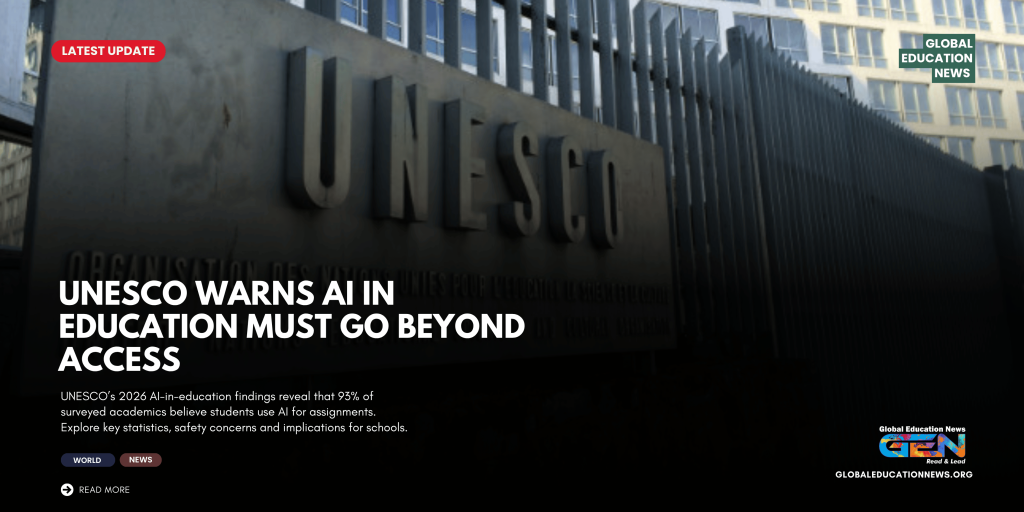
Paris, Education news: Artificial intelligence is entering classrooms and universities worldwide, but giving students access to AI tools is not enough to improve education. Education systems must also ensure that AI supports real learning, protects student data, strengthens teachers’ abilities and does not increase inequality. A UNESCO-led Strategy Lab held in Paris on September 11, 2026, brought together more than 200 policymakers, education partners and practitioners to examine how education systems can respond to the growing influence of AI.
The debate comes as new international findings raise questions about how students use AI, whether teachers are adequately prepared and how institutions should protect academic quality. In a survey released during Digital Learning Week 2026, 93% of participating academics believed students were using generative AI to produce assignments, while 63% perceived a decline in students’ cognitive capacities. These are respondents’ perceptions, not proof that AI has caused a decline in learning.
AI in Education 2026: Key Facts and Statistics
| Indicator | Reported finding | Why it matters |
|---|---|---|
| Participation in the Paris Strategy Lab | More than 200 participants | Education leaders are examining system-wide AI governance |
| Academics who believe students use generative AI for assignments | 93% | Institutions need clear rules for acceptable AI use |
| Academics who perceive declining student cognitive capacities | 63% | Schools and universities need to evaluate learning, reasoning and independent work |
| Academics favouring complete prohibition of AI for student work | Less than 1% | Many respondents favour managed use rather than a blanket ban |
| Academics recommending unrestricted AI use | 2% | Unrestricted use received little support among respondents |
| People worldwide without internet access, as of 2024 | Around 2.6 billion | Digital exclusion can become an AI education divide |
| Primary schools globally with internet access | 40% | Connectivity remains a barrier to equal digital learning |
| Lower-secondary schools globally with internet access | 50% | Access varies by education level |
| Upper-secondary schools globally with internet access | 65% | Connectivity improves at higher school levels, but gaps remain |
The academic-use figures come from a survey of the global network of UNESCO Chairs and UNITWIN Networks. The internet-access figures come from UNESCO’s work on AI, digitalisation and the right to education. The studies have different populations and methods, so the figures should not be treated as results from a single survey.
Why Is UNESCO Asking Education Systems to Look Beyond AI Access?
The central issue is the difference between having access to an AI tool and receiving a genuine educational benefit from it.
A student may use AI to summarise a chapter, explain a difficult concept or practise a language. These uses can support learning when students check the information, ask questions and work through the reasoning. However, if students simply submit AI-generated answers without understanding them, the technology may complete a task without developing the skills that task was meant to test.
For education systems, this means evaluating AI through learning outcomes rather than the number of accounts, devices or digital platforms introduced.
UNESCO’s September 2026 ministerial statement also stresses that AI should not replace human relationships or professional judgement in education. It calls for public accountability, teacher participation in technology decisions and evidence that AI systems provide educational benefits before they are deployed.
What Do the Latest AI-in-Education Statistics Reveal?
1. 93% of surveyed academics believe students use AI for assignments
The 2026 UNESCO survey found that 93% of participating academics believed students were using generative AI to produce assignments. The finding highlights how quickly AI has become part of academic work and why institutions need to explain what students may use it for.
Universities can distinguish between acceptable assistance—such as brainstorming, language feedback or practice questions—and work that must demonstrate a student’s own knowledge and reasoning. Assessment rules should explain whether AI use is permitted, what must be disclosed and how students remain responsible for submitted work.
The statistic measures academics’ beliefs about student behaviour. It does not mean that 93% of all students worldwide use AI, nor does it show that every use constitutes academic misconduct.
2. 63% perceive a decline in students’ cognitive capacities
The same survey found that 63% of participating academics perceived a decline in students’ cognitive capacities. This is a warning about educators’ concerns, rather than a measured global decline in intelligence or a causal finding about AI.
The practical question is whether students can still explain an answer, identify a mistake, compare evidence and solve a similar problem without relying on an AI tool.
Schools and universities can assess this by combining AI-assisted assignments with oral explanations, classroom problem-solving, supervised writing and projects that require students to show how they reached their conclusions.
3. Around 2.6 billion people still lacked internet access in 2024
Access to AI also depends on reliable connectivity, devices, electricity and affordability. UNESCO’s 2025 report on AI and the right to education highlighted that around 2.6 billion people worldwide remained offline in 2024.
That divide matters because AI-supported education may be easiest to access for students who already have reliable internet, suitable devices and digital skills. Students in poorly connected rural communities and under-resourced schools risk receiving fewer benefits.
Governments therefore need to consider connectivity, accessibility, local languages and the cost of maintaining technology—not simply the initial purchase or rollout.
4. Only 40% of primary schools globally have internet access
UNESCO’s published figures indicate that internet access reaches 40% of primary schools, 50% of lower-secondary schools and 65% of upper-secondary schools worldwide.
These figures show why AI education policies cannot assume that every student has the same digital starting point. Even where internet access exists, schools may lack enough devices, technical support or trained staff to integrate AI effectively.
For policymakers, the priority is to build dependable digital infrastructure while ensuring that traditional teaching and learning remain available to students who cannot consistently access online tools.
What Is UNESCO’s Six Pillars Framework for AI in Education?
The September 2026 Strategy Lab examined AI through six pillars of digital transformation. Together, they help policymakers look at the full education system rather than focus only on technology adoption.
| Pillar | What education systems need to consider |
|---|---|
| Content and solutions | Curriculum alignment, accuracy, open educational resources, assessment and parental involvement |
| Capacity and culture | Teacher preparation, student AI literacy, critical thinking and community participation |
| Connectivity and infrastructure | Internet reliability, devices, shared infrastructure and the ability to scale services |
| Cost and sustainability | Long-term costs, maintenance, affordability and environmental impact |
| Data and evidence | Data quality, transparency, traceability and proof of learning benefits |
| Coordination and leadership | Government oversight, institutional responsibility and coordination among technology providers |
The framework is intended to help education systems assess their readiness, identify gaps and determine where policy, funding and institutional support are needed. The Strategy Lab’s findings are expected to inform further work on the framework and its assessment questionnaire.
How Can AI Improve Learning Without Replacing Teachers?
AI can support teachers and students when it is used for a clear educational purpose and its output is checked. Possible applications include:
- Personalised practice: Generating additional exercises based on a student’s learning needs.
- Concept explanation: Offering alternative explanations when a student struggles with a topic.
- Teacher support: Helping educators prepare draft lesson plans, quizzes or differentiated practice material.
- Accessibility: Supporting some learners through text simplification, speech-related tools and other assistive features.
- Language support: Helping students practise language skills, provided the content is accurate and appropriate.
- Feedback: Giving preliminary feedback that teachers and students review rather than accept automatically.
These are potential uses, not guarantees of improved achievement. Results depend on the quality of the tool, the subject, the student’s age, the teacher’s guidance and the way learning is assessed.
Teachers remain essential for identifying misconceptions, understanding individual needs, building relationships and exercising professional judgement. AI should support these responsibilities rather than replace them.
Student Privacy and AI Safety: What Schools Must Check
AI systems may process students’ questions, assignments, names, learning histories or other personal information. Schools and universities should therefore assess privacy and safety before adopting a platform.
Key safeguards include:
- Data protection: Explain what student information is collected, why it is needed and how long it is retained.
- Age-appropriate use: Ensure tools and classroom activities are suitable for students’ ages and developmental needs.
- Accuracy checks: Teach students to verify AI-generated claims against reliable material.
- Bias and inclusion: Check whether the system works fairly across languages, disabilities and different learning contexts.
- Transparency: Make it clear when AI is used in teaching, assessment or administrative decisions.
- Human oversight: Provide a way for teachers or other responsible staff to review important decisions and correct errors.
- Clear academic rules: Tell students when AI assistance is permitted and when independent work is required.
The purpose is not to reject every AI tool. It is to ensure that convenience does not come at the expense of privacy, fairness or meaningful learning.
What Should Indian Schools and Universities Learn From the UNESCO Warning?
For India, the debate is relevant to schools, universities, teacher-training institutions and public digital-learning programmes. AI tools may help learners access explanations and practise skills, but their value will depend on whether students can use them safely and whether institutions can evaluate their educational impact.
Indian institutions can take several practical steps:
- Develop clear AI-use policies for homework, examinations, research and assignments.
- Train teachers to identify inaccurate AI outputs and design activities that build independent reasoning.
- Teach students to verify information, protect personal data and disclose AI assistance when required.
- Evaluate AI tools using learning outcomes, accessibility and cost rather than promotional claims alone.
- Provide offline or low-bandwidth alternatives for students with unreliable internet access.
- Include Indian languages and accessibility requirements when selecting educational technology.
For students, the most useful approach is to treat AI as a learning assistant rather than an answer machine. Asking for an explanation, checking the facts and solving a problem independently can help preserve the thinking skills that education is meant to develop.
Frequently Asked Questions
What did UNESCO say about AI in education in 2026?
A UNESCO Strategy Lab in Paris called for education systems to move beyond access to AI and address quality, teacher preparedness, safety, accountability, infrastructure and evidence of learning benefits.
What percentage of academics believe students use AI for assignments?
In a survey released during Digital Learning Week 2026, 93% of participating academics believed students were using generative AI to produce assignments.
Does the 63% figure prove that AI reduces students’ thinking abilities?
No. It records the perceptions of surveyed academics about students’ cognitive capacities. It does not establish that AI caused a decline or that the same result applies to all students.
How many people lacked internet access worldwide in 2024?
Around 2.6 billion people worldwide lacked internet access, according to UNESCO’s 2025 publication on AI and the right to education.
What percentage of primary schools have internet access globally?
UNESCO’s published figures put primary-school internet access at 40%, compared with 50% for lower-secondary schools and 65% for upper-secondary schools.
Should schools ban AI tools completely?
The appropriate policy depends on the tool, age group, educational purpose and risks. Clear rules, teacher oversight, privacy protections and assessment of learning outcomes can help institutions decide where AI is useful and where its use should be restricted.
How can students use AI responsibly?
Students should use AI to clarify concepts, practise skills and explore ideas; verify important claims; avoid sharing sensitive personal information; follow school rules; and make sure submitted work reflects their own understanding.
What is UNESCO’s Six Pillars Framework?
It examines content and solutions, capacity and culture, connectivity and infrastructure, cost and sustainability, data and evidence, and coordination and leadership.
Conclusion: Better Learning Must Come Before More Technology
The global discussion about AI in education is shifting from how quickly schools can introduce new tools to whether those tools improve learning fairly and safely. The latest statistics point to several challenges: widespread concern about AI-assisted assignments, unequal internet access and the need for stronger teacher preparation and governance.
For education systems, the test should be straightforward: does a technology help students understand more, think critically, participate safely and learn regardless of their background? AI adoption should be judged against those outcomes—not by access alone.
For more updates on AI, education policy, student learning and global education trends, stay connected with Global Education News.