New Delhi, India —
On World Vegetarian Day 2026, the global vegetarian map tells a more complicated story than a simple list of countries. India remains the most prominent country by the estimated share and number of people following vegetarian diets, while Mexico, Brazil, Taiwan, Israel, Australia and Argentina also feature prominently in widely cited international datasets.
But there is a catch.
There is no single worldwide census of vegetarians. Estimates come from surveys conducted in different countries and different years, and definitions can vary between self-identifying as vegetarian and reporting actual dietary behaviour. Recent analysis has highlighted how frequently older figures are repeated as if they were fresh 2026 data.
That makes World Vegetarian Day 2026 a useful moment not just to ask which countries have the most vegetarians, but also to understand what the numbers actually tell us.
World Vegetarian Day 2026: Which Countries Have the Most Vegetarians?
Current compiled estimates place India far ahead of most other countries in vegetarian population share. World Population Review’s 2026 compilation lists India at 29.5%, followed by Mexico at 19%, Brazil at 14%, Taiwan at 13.5%, Israel at 13% and Australia at 12.1%. Argentina is also listed at about 12%.
These figures should not be interpreted as a synchronized 2026 survey. The underlying data years differ substantially.
Here are seven countries that repeatedly appear near the top of international vegetarian-population comparisons.
1. India: The World’s Largest Vegetarian Population
India occupies a category of its own in most discussions about vegetarianism.
World Population Review’s current compilation estimates that 29.5% of India’s population is vegetarian, equivalent to about 276 million people using the dataset’s population calculation. The underlying vegetarian estimate is dated to 2020.
Other sources have produced considerably higher estimates. A widely cited dataset reproduced in country-level vegetarianism research puts India’s vegetarian share at 39%, or roughly 470 million people, based on 2019–2021-era data.
The difference illustrates the central problem with global vegetarian statistics: the answer changes depending on the survey, wording and definition used.
India’s unusually large vegetarian population has deep roots in dietary traditions, religion, regional food cultures and long-established culinary practices. Vegetarian food is not a niche category here. It is part of everyday cuisine for millions of households.
2. Mexico: A Surprisingly Large Vegetarian Community
Mexico is one of the clearest examples of a country where vegetarianism has become significant despite a food culture traditionally associated with meat as well as beans, grains, vegetables and other plant-based staples.
The commonly cited estimate puts Mexico’s vegetarian population at 19%, or approximately 23.75 million people. However, the underlying figure dates from 2016, meaning it should not be presented as a fresh 2026 measurement.
That distinction is particularly relevant for readers searching for the latest vegetarian population by country.
The percentage remains widely cited, but the underlying survey is nearly a decade old.
3. Brazil: Millions Identify With Vegetarian Diets
Brazil also occupies a prominent position in global vegetarian comparisons.
A 2018 IBOPE survey found that 14% of Brazilians aged over 16 identified themselves as vegetarian, representing roughly 22 million people at the time.
More recent dietary research, however, has produced a different picture. A 2024 analysis based on Brazil’s 2017–2018 Household Budget Survey found that around 2% of the study population reported consuming no meat.
The contrast is revealing.
Someone can identify as vegetarian while different dietary surveys may measure actual food consumption differently. That is why headline percentages from different studies cannot always be compared directly.
4. Taiwan: Vegetarianism Embedded in Food Culture
Taiwan has one of the world’s most visible vegetarian food cultures.
Estimates commonly put the vegetarian share at around 13% to 14%, with approximately 3.3 million people represented in widely cited datasets. Much of the underlying data comes from surveys conducted between 2015 and 2019.
Taiwan’s vegetarian landscape is influenced by Buddhist traditions, religious practice and a well-developed market for vegetarian restaurants and food products.
The result is a country where vegetarian eating extends beyond individual dietary choices into a recognizable part of the wider food ecosystem.
5. Israel: A High Vegetarian Share Despite a Small Population
Israel is another country that frequently appears near the top of vegetarian-share comparisons.
World Population Review currently lists 13% of the population as vegetarian, while other compiled datasets use lower estimates depending on the survey and year.
The country has also attracted attention for its relatively substantial vegan and plant-based communities.
That distinction matters: vegetarian and vegan are not interchangeable categories. Vegetarians generally avoid meat, while vegan diets exclude all animal-derived foods.
6. Australia: Vegetarianism Moves Into the Mainstream
Australia also appears prominently in global comparisons.
World Population Review lists an estimated 12.1% vegetarian share, equivalent to around 2.5 million people in the dataset. Other sources use more recent or different surveys and report different percentages.
The Australian market has seen growing interest in plant-based food, with dietary choices increasingly shaped by health, environmental and animal-welfare considerations.
But again, the number of people who occasionally reduce meat consumption is not the same as the number who identify as vegetarian.
7. Argentina: A Significant Vegetarian Population in South America
Argentina is another country that stands out in international comparisons.
A commonly cited estimate places the country’s vegetarian population at around 12%, or approximately 5.4 million people, based on 2020 data.
For a country internationally known for its beef culture, the figure offers an interesting contrast.
It also shows why vegetarianism cannot simply be mapped onto a country’s traditional cuisine. Dietary habits can change even where meat has a strong cultural and economic presence.
The Numbers Come With a Major Asterisk
Searches for “countries with the highest vegetarian population” often produce neat rankings. The reality is considerably messier.
There is no standardized global survey conducted in the same year using the same definition.
For example, the widely cited Mexico figure comes from a 2016 survey, Taiwan’s estimate draws on older studies, India’s figures vary substantially depending on the source, while some countries have much newer data.
The Vegan Society’s 2025 review similarly presents vegetarian and vegan estimates across countries while drawing attention to differences between national datasets.
So a claim such as “X% of the world is vegetarian in 2026” should be treated cautiously unless the methodology is clearly explained.
Vegetarian vs Vegan: Why the Difference Matters
The terms are often used together, but they describe different dietary patterns.
A vegetarian generally avoids meat, poultry and fish, although some vegetarians consume dairy products and eggs.
A vegan diet excludes animal-derived foods altogether.
The distinction becomes especially striking in India. World Population Review’s current compilation estimates 9% of India’s population as vegan, alongside its 29.5% vegetarian estimate.
Mexico is similarly listed at 9% vegan alongside its 19% vegetarian estimate.
These figures are not directly equivalent to the vegetarian estimates in terms of survey year or methodology, but they demonstrate how rapidly the conversation around plant-based diets has expanded beyond vegetarianism alone.
Why Are More People Choosing Vegetarian Diets?
There is no single explanation.
Research into vegetarian nutrition points to a combination of health concerns, ethical considerations, environmental concerns and social factors behind the growing international interest in vegetarian and plant-based diets.
For some people, the decision is rooted in religious or cultural traditions.
For others, it is connected to environmental concerns, animal welfare or personal health goals.
And increasingly, consumers do not necessarily move directly from a conventional diet to strict vegetarianism. Some reduce meat consumption without identifying as vegetarian at all.
That makes the modern food landscape more fluid than a simple vegetarian-versus-non-vegetarian divide.
World Vegetarian Day 2026: More Than a Food Trend
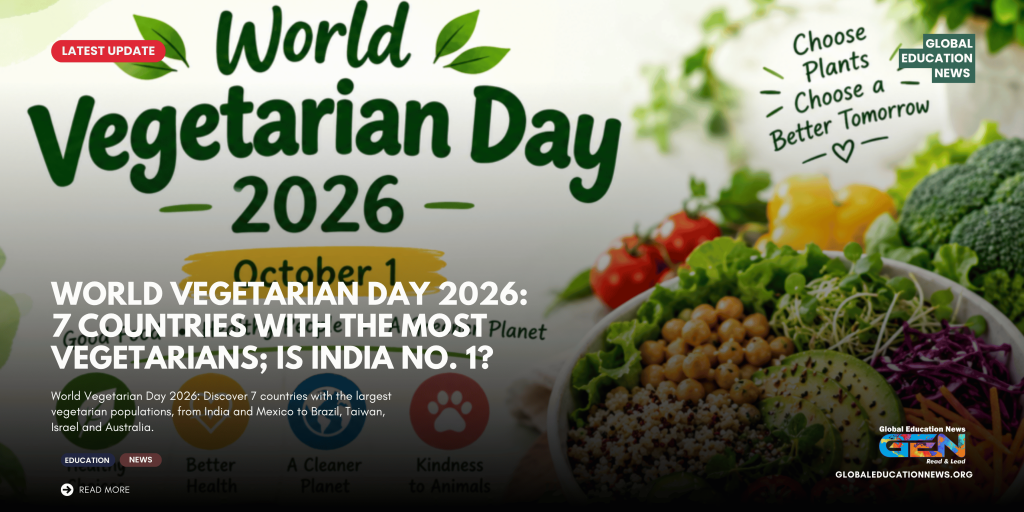
Observed every year on October 1, World Vegetarian Day begins World Vegetarian Awareness Month and highlights vegetarian lifestyles and their ethical, health and environmental dimensions. The observance was established in 1977 by the North American Vegetarian Society.
The global numbers offer an intriguing snapshot.
India’s scale is exceptional. Mexico’s share is striking. Brazil demonstrates the difficulty of measuring dietary identity. Taiwan shows how vegetarian food can become deeply embedded in a national food culture. Australia and Argentina demonstrate that vegetarianism is not confined to traditionally vegetarian societies.
But perhaps the most important lesson lies in the uncertainty behind the numbers.
The world does not have one definitive vegetarian census. It has a collection of surveys, estimates and changing dietary habits.
On World Vegetarian Day 2026, that is worth knowing before any country is declared the world’s “most vegetarian.”