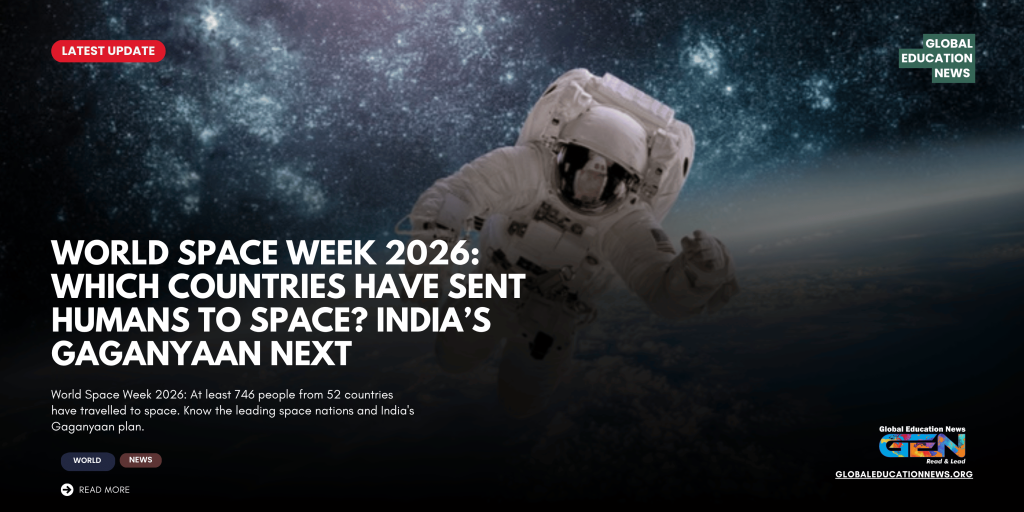
October 8, 2026 | New Delhi | Education News: As World Space Week 2026 is observed from October 4 to 10 under the theme “Rocket Revolution,” human spaceflight is entering a new phase. More countries are participating in space exploration, commercial spaceflight is expanding access to orbit, and upcoming missions are targeting the Moon and deeper destinations.
According to an Al Jazeera analysis using the 100-kilometre Kármán line as the benchmark for space, at least 746 people from 52 countries had travelled to space, including professional astronauts and paying spaceflight participants. The figures also include people with dual nationalities and travellers associated with countries or political entities that no longer exist, such as the Soviet Union.
But there is an important distinction: being a country whose citizen has travelled to space is not the same as being a country that can independently launch humans into space. So far, the United States, Russia/Soviet Union and China have independently developed and operated crewed launch systems. India is working towards joining that group through its Gaganyaan programme.
What Is World Space Week 2026?
World Space Week is an annual United Nations observance held from October 4 to October 10.
The dates commemorate two major milestones in space history:
- October 4, 1957: The Soviet Union launched Sputnik 1, the first artificial satellite to orbit Earth.
- October 10, 1967: The Outer Space Treaty entered into force.
The UN established World Space Week in 1999 to highlight the contribution of space science and technology to human welfare, encourage education and inspire future generations to pursue space-related fields.
The 2026 theme is “Rocket Revolution,” focusing on how new launch technologies, reusable rockets and the growing commercial space sector are changing access to space.
How Many Countries Have Sent People to Space?
Using the Kármán line as the benchmark, at least 52 countries have been represented among people who have travelled to space, according to the Al Jazeera analysis.
The total includes both career astronauts and commercial spaceflight participants. It therefore represents nationality, rather than the number of countries with independent human-spaceflight capabilities.
This distinction matters because many astronauts have travelled aboard spacecraft operated by another country’s space programme.
For example, astronauts from Canada, Japan and European countries have reached orbit through international partnerships and missions operated by the United States or Russia.
Human Spaceflight: Key Numbers
| Category | Current figure/highlight |
|---|---|
| People who have travelled to space | At least 746 |
| Countries represented | 52 |
| Women among those travellers | 112 |
| Women’s share | About 15% |
| Median age at first spaceflight | 40 |
| World Space Week | October 4–10 |
| World Space Week 2026 theme | Rocket Revolution |
| First human in space | Yuri Gagarin |
| First human spaceflight | April 12, 1961 |
| First human on the Moon | Neil Armstrong |
| First Moon landing | July 20, 1969 |
The figures above use the Kármán-line definition applied in the Al Jazeera analysis. Different organisations and countries can use different definitions of where space begins.
Which Countries Have Sent the Most People to Space?
The United States remains far ahead in the number of people it has sent to space.
According to the Al Jazeera analysis:
- United States: 369 people
- Soviet Union and Russia combined: 138
- China: 29
China is particularly significant because it became the third country to independently launch humans into space using its own crewed spacecraft and launch system.
The Soviet Union’s early achievements established the foundations of human spaceflight, while the United States subsequently developed the Apollo programme and later the Space Shuttle and commercial crew systems.
Who Was the First Human in Space?
The first human to travel into space was Soviet cosmonaut Yuri Gagarin.
On April 12, 1961, Gagarin launched aboard Vostok 1 and completed one orbit of Earth during a flight lasting approximately 108 minutes. His mission demonstrated that humans could survive launch, weightlessness and re-entry.
The achievement became one of the defining moments of the early Space Race.
April 12 is now also remembered internationally as the anniversary of the first human spaceflight.
Which Country Put the First Human on the Moon?
The United States achieved the first crewed lunar landing through NASA’s Apollo 11 mission in July 1969.
Astronaut Neil Armstrong became the first person to walk on the Moon on July 20, 1969.
Apollo 11 represented a major milestone in the Space Race and transformed the Moon from a distant astronomical object into a destination that humans had physically reached.
Why Is the Kármán Line Important?
There is no single universally accepted physical boundary where Earth’s atmosphere suddenly ends and space begins.
However, the Kármán line at 100 kilometres above Earth’s surface is widely used as a reference point in discussions of spaceflight.
The United States has historically used an 80-kilometre threshold for some astronaut-related definitions, which is why different datasets can produce different counts of people who have technically reached space.
This is an important point when comparing statistics from different space organisations.
Which Countries Can Independently Launch Humans Into Space?
The list becomes much shorter when the question changes from “Which countries have citizens who travelled to space?” to “Which countries have independently launched humans into space?”
Historically, three national programmes have achieved this:
Soviet Union/Russia
The Soviet Union began the era of human spaceflight with Yuri Gagarin’s 1961 mission.
The Soviet programme later developed the Soyuz spacecraft, which became one of the world’s most reliable crewed transportation systems.
After the dissolution of the Soviet Union, Russia continued the human-spaceflight programme.
United States
The United States developed Mercury, Gemini and Apollo, followed by the Space Shuttle programme and, more recently, commercial crew transportation through NASA partnerships.
The United States remains the largest contributor to human spaceflight by the number of people who have travelled to space.
China
China became the third country to independently send humans into space.
Its crewed Shenzhou programme operates alongside the country’s growing space infrastructure, including the Tiangong space station.
China is also targeting human lunar exploration around 2030.
What About India?
India has not yet independently launched a human into space, but it is preparing for that milestone through the Gaganyaan human-spaceflight programme.
The current target is a crewed Gaganyaan mission in 2027. If India successfully completes the mission using its own human-rated launch system and crewed spacecraft, it would become the fourth country to independently launch humans into space.
This makes Gaganyaan one of India’s most important upcoming space milestones.
The programme is also significant from an education and research perspective because human spaceflight requires expertise across:
- Aerospace engineering
- Propulsion
- Materials science
- Robotics
- Life sciences
- Medicine
- Artificial intelligence
- Computer science
- Space communications
- Navigation
- Environmental control systems
For students, India’s human-spaceflight programme therefore represents much more than a single rocket launch.
Why Is Gaganyaan Important for Indian Students?
Human spaceflight can create opportunities for an entire ecosystem of scientific and engineering disciplines.
A crewed mission requires thousands of technical decisions involving spacecraft design, astronaut safety, navigation, communication, thermal management and life-support systems.
That means the growth of India’s human-spaceflight programme can stimulate interest in STEM education.
Students interested in physics, mathematics, engineering, medicine and computer science can potentially contribute to future space missions.
The broader lesson of Gaganyaan is that modern space exploration is no longer limited to rocket scientists. It requires specialists from many academic fields.
How Many Women Have Travelled to Space?
Despite decades of human spaceflight, women remain a minority among space travellers.
Of the 746 people counted in the Al Jazeera analysis, 112 were women, or approximately 15 percent.
The first woman in space was Soviet cosmonaut Valentina Tereshkova, who flew aboard Vostok 6 in June 1963.
The United States’ first woman in space was Sally Ride, who flew in 1983.
The number of women travelling to space has increased in recent years, partly because commercial human spaceflight has brought new participants into the field.
Who Was the Youngest Person to Travel to Space?
Commercial spaceflight has expanded the age range of people who have travelled beyond Earth.
According to the Al Jazeera analysis, Oliver Daemen was 18 when he flew in 2021, making him the youngest person to travel to space under the benchmark used in the analysis.
At the other end of the scale, Ed Dwight became the oldest person to travel to space when he flew at age 90 years and eight months in 2024.
What Comes Next After Low Earth Orbit?
Human spaceflight is moving beyond the traditional focus on low Earth orbit.
NASA’s Artemis programme is targeting renewed human exploration of the Moon.
In April 2026, the Artemis II crew flew around the Moon and reached approximately 406,771 kilometres from Earth, surpassing the distance record set during Apollo 13 in 1970.
Future Artemis missions are intended to develop capabilities for sustained lunar exploration.
NASA currently describes Artemis III as a mission focused on demonstrating critical systems in low Earth orbit, with later missions expected to support lunar landing objectives.
Meanwhile, China is targeting a crewed lunar landing around 2030, while India is working towards its first crewed Gaganyaan mission in 2027.
How Commercial Spaceflight Is Changing Human Space Exploration
Human spaceflight was once almost entirely controlled by national governments.
That is changing.
Private companies now provide launch services and spacecraft for government astronauts, while commercial spaceflight has also enabled private individuals to travel beyond Earth.
The growing role of reusable launch vehicles is another major change.
The 2026 World Space Week theme, “Rocket Revolution,” specifically reflects this transformation in launch technology and the wider space economy.
NASA’s International Space Station programme also demonstrates how international cooperation has become central to human spaceflight. NASA records hundreds of individuals from multiple countries visiting the ISS, including astronauts and private spaceflight participants.
Why World Space Week Matters for Education
World Space Week is not only a celebration of past achievements.
The United Nations specifically highlights its role in inspiring students, building the workforce of tomorrow, educating the public and promoting international cooperation in space outreach and education.
For schools and colleges, the week provides an opportunity to connect classroom subjects with real-world scientific missions.
Subjects Connected to Space Exploration
| Subject | Role in space exploration |
|---|---|
| Physics | Gravity, propulsion, orbital mechanics |
| Mathematics | Navigation, trajectories and mission calculations |
| Chemistry | Fuels, materials and life-support systems |
| Biology | Human health and organisms in microgravity |
| Computer Science | Flight software, AI and data analysis |
| Engineering | Rockets, spacecraft and habitats |
| Medicine | Astronaut health and space medicine |
| Environmental Science | Earth observation and planetary environments |
This interdisciplinary nature is one reason human spaceflight remains such a powerful educational tool.
World Space Week 2026: The Bigger Picture
The history of human spaceflight began with a small number of superpowers competing during the Cold War.
Today, the landscape is considerably broader.
More than 50 nationalities have been represented among people travelling to space, international space stations have brought countries together, commercial companies are transporting astronauts, and new national programmes are preparing for human exploration.
India’s planned Gaganyaan mission could mark another major step in that evolution.
If successful, it would not merely place an Indian astronaut in orbit. It would demonstrate India’s ability to independently design, launch and safely return a human-rated spacecraft system.
Frequently Asked Questions
How many countries have sent people to space?
At least 52 countries have been represented among people who have travelled to space when the 100-kilometre Kármán line is used as the benchmark.
How many people have travelled to space?
At least 746 people had travelled to space under the Kármán-line definition used in the October 2026 analysis. The count includes professional astronauts and paying spaceflight participants.
Which country has sent the most people to space?
The United States, with 369 people in the Al Jazeera analysis, has the largest national total. The Soviet Union and Russia combined account for 138.
Which countries have independently launched humans into space?
The Soviet Union/Russia, United States and China have independently launched humans into space using their own crewed spaceflight systems.
Has India sent a human to space?
India has not yet independently launched a human into space. Its Gaganyaan programme is targeting a crewed mission in 2027.
When is World Space Week 2026?
World Space Week 2026 is being observed from October 4 to October 10.
What is the theme of World Space Week 2026?
The theme is “Rocket Revolution.”
Who was the first human in space?
Yuri Gagarin of the Soviet Union became the first human in space on April 12, 1961.
Who was the first woman in space?
Valentina Tereshkova became the first woman in space in June 1963 aboard Vostok 6.
Why is World Space Week important for students?
It promotes awareness of space science and technology, inspires students to pursue STEM fields and highlights how space research contributes to society.
From Gagarin to Gaganyaan: How Human Spaceflight Is Entering a New Era
Human spaceflight has travelled an extraordinary distance since Yuri Gagarin’s single orbit in 1961.
The first era was dominated by the Soviet Union and United States. China later became the third country to independently send humans into space. Today, international partnerships and commercial companies are expanding participation, while the Moon is again becoming a major destination.
India’s Gaganyaan programme could be one of the next defining milestones in that story.
For students, the message behind World Space Week 2026 is equally significant: the future of space exploration will depend not only on astronauts, but also on mathematicians, engineers, scientists, doctors, programmers, researchers and educators.
As the world observes “Rocket Revolution,” space is becoming not just a destination for astronauts but an increasingly important classroom for the next generation.
Global Education News will continue tracking India’s space education, STEM developments, Gaganyaan, astronomy, astronaut missions and major global developments shaping the future of space science.