Date: October 19, 2026
Place: New Delhi
Education News: NASA Mission, Indian-Origin Scientist and Space Research
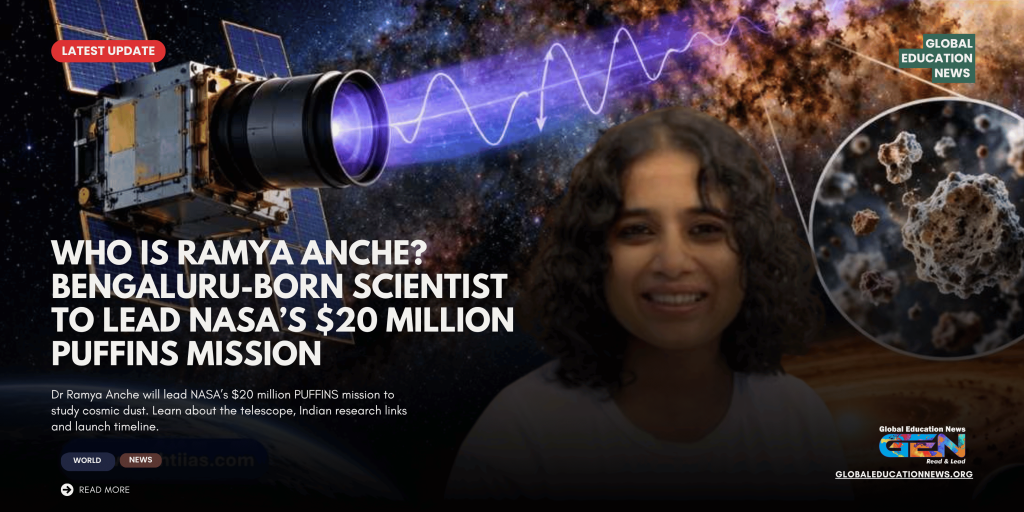
New Delhi, Education news: Dr Ramya Manjunath Anche, an astronomer who grew up near Bengaluru, has been selected to lead NASA’s $20 million PUFFINS space-telescope mission, which will investigate tiny dust particles scattered between stars. The mission aims to improve scientists’ understanding of interstellar dust, its interaction with ultraviolet light and its role in the formation and evolution of stars and planets.
Anche is an assistant research professor at the University of Arizona’s Steward Observatory and serves as the mission’s principal investigator. PUFFINS has been selected under NASA’s Astrophysics Pioneers programme, which supports astrophysics investigations using relatively small space missions and creates opportunities for early- and mid-career researchers to lead projects.
The mission is expected to use a small satellite carrying a telescope with a primary mirror about 25 centimetres across. It will observe ultraviolet light from approximately 70 stars to study how the dust between stars changes the light travelling towards Earth.
The project also has an Indian research connection, with reports identifying the Inter-University Centre for Astronomy and Astrophysics (IUCAA) in Pune and the Indian Institute of Astrophysics (IIA) in Bengaluru among the participating institutions.
Who Is Ramya Manjunath Anche, the Indian-Origin Scientist Leading NASA’s Mission?
Dr Ramya Manjunath Anche is an astronomer specialising in astronomical polarimetry, optical design, high-contrast imaging and space-telescope instrumentation.
She grew up in Devanahalli, near Bengaluru, Karnataka, and pursued her education and research in India before moving to the United States. She joined the Indian Institute of Astrophysics in 2012 and later completed doctoral research there. She joined the University of Arizona’s Steward Observatory in 2021.
Her selection as principal investigator of PUFFINS is significant because she will lead the scientific and technical development of a NASA-funded space mission. She submitted the winning proposal while working as a postdoctoral researcher.
The project will bring together scientists, engineers and students to develop an instrument capable of studying interstellar dust using ultraviolet light.
What Is NASA’s PUFFINS Mission?
PUFFINS stands for Polarimetry in the Ultraviolet to Find Features in INterStellar dust.
It is a SmallSat mission designed to measure the polarisation of ultraviolet light from distant stars. Polarisation describes properties of light that can change when it interacts with material such as dust between stars.
By studying these changes, scientists hope to learn more about the size, composition, alignment and behaviour of tiny interstellar dust grains.
| Key fact | Details |
|---|---|
| Mission name | PUFFINS |
| Full form | Polarimetry in the Ultraviolet to Find Features in INterStellar dust |
| Space agency | NASA |
| Mission lead | Dr Ramya Manjunath Anche |
| Lead institution | University of Arizona’s Steward Observatory |
| Funding | $20 million |
| Telescope mirror | Approximately 25 cm or 10 inches across |
| Planned observations | Around 70 stars |
| Main technique | Ultraviolet spectropolarimetry |
| Mission status | Early design and development phase |
| Launch target | 2030 on the mission website; NASA’s programme page lists 2029 |
The difference between the published launch years is explained below. Neither date should be treated as a confirmed launch day.
Why Is NASA Studying Interstellar Dust?
Space is not completely empty. The region between stars contains gas, dust, radiation and magnetic fields. Although individual dust grains are extremely small, they play an important role in the physical and chemical processes taking place across the galaxy.
Interstellar dust can absorb and scatter starlight, changing the light that astronomers observe. Dust grains also help shield molecules in certain environments and contribute to the conditions in which stars and planetary systems develop.
Scientists still have questions about the smallest grains, including their properties, how they align with magnetic fields and how they change under different conditions.
PUFFINS aims to address these questions by collecting ultraviolet measurements that have been difficult to obtain with dedicated space-based instruments.
How Will the PUFFINS Space Telescope Work?
The mission will use a technique called ultraviolet spectropolarimetry, which measures the polarisation of light across different ultraviolet wavelengths.
The process can be understood in three steps:
- Observe distant stars: The satellite will collect ultraviolet light from approximately 70 selected stars.
- Measure changes in the light: Its instrument will analyse the polarisation of light after it has passed through the interstellar medium.
- Study the dust: Researchers will use the measurements to investigate the properties and alignment of dust grains and how they interact with their surroundings.
The telescope is small compared with major space observatories, but its specialised instrument is designed to investigate a particular scientific problem.
According to the mission team, the survey is planned to last approximately nine months. Its observations are expected to improve the available data on ultraviolet polarisation and interstellar dust.
What Makes the PUFFINS Mission Scientifically Important?
One of the mission’s goals is to examine dust grains smaller than about 50 nanometres. These particles are difficult to study using conventional optical and infrared observations.
The mission is designed to investigate three connected questions:
- How small interstellar dust grains align with magnetic fields.
- What causes a particular ultraviolet polarisation feature associated with interstellar dust.
- How ultraviolet polarisation varies across different regions and environments in the interstellar medium.
Answering these questions could help researchers build a clearer picture of how dust forms, evolves and interacts with the material around stars.
The findings could also support the development of future astronomical instruments by helping scientists understand what ultraviolet polarimetry can reveal.
What Is India’s Connection With NASA’s PUFFINS Mission?
Although PUFFINS is led by a US university team, reports identify two Indian research institutions as participants.
| Indian institution | Location | Relevance |
|---|---|---|
| Inter-University Centre for Astronomy and Astrophysics (IUCAA) | Pune, Maharashtra | Reported participant in the international research collaboration |
| Indian Institute of Astrophysics (IIA) | Bengaluru, Karnataka | Reported participant; also part of Dr Anche’s academic background |
The participation provides a link between international space research and India’s astronomy community. It also highlights the role that university-based research institutions can play in collaborative scientific projects.
Students interested in astronomy and space science can follow the work of these institutions to learn more about research opportunities, instrumentation and astrophysics.
The exact division of responsibilities among all participating institutions should be confirmed through detailed project announcements as the mission progresses.
How Is PUFFINS Connected to NASA’s Future Search for Habitable Worlds?
PUFFINS is primarily designed to study interstellar dust, rather than directly detect life or confirm the existence of habitable planets.
However, understanding dust and ultraviolet light is relevant to wider astrophysical research. The mission team has described PUFFINS as a potential stepping stone towards NASA’s planned Habitable Worlds Observatory, a future space telescope intended to investigate planets beyond our solar system and study their potential habitability.
Measurements from PUFFINS could help scientists plan and evaluate ultraviolet spectropolarimetry instruments for future observatories.
This is a potential scientific connection, not a claim that PUFFINS itself will discover extraterrestrial life.
When Will NASA Launch the PUFFINS Mission?
The launch year requires careful attention because official sources currently differ.
The PUFFINS mission website and the University of Arizona’s announcement give 2030 as the target. NASA’s Astrophysics Pioneers programme page lists 2029.
The mission remains in its early design phase, so its schedule may change as the design, reviews and construction progress. No confirmed launch day has been announced in the sources reviewed for this article.
Students and readers should therefore treat 2029 and 2030 as published planning dates rather than a final launch commitment.
What Can Students Learn From Ramya Anche’s Achievement?
Anche’s career illustrates how specialised scientific knowledge, instrument development and persistence can lead to opportunities in major research programmes.
Students interested in space science can explore several relevant academic areas:
- Physics and astronomy: Understanding stars, galaxies, radiation and the universe.
- Optics and photonics: Learning how instruments collect and analyse light.
- Aerospace and mechanical engineering: Studying spacecraft structures and instrument systems.
- Electronics and instrumentation: Developing sensors and scientific measurement systems.
- Data analysis and computing: Processing observations and interpreting scientific results.
There is no single route into astronomy. Depending on the role, students may pursue degrees in physics, engineering, computer science or related fields, followed by specialised research or postgraduate study.
PUFFINS also includes undergraduate and graduate researchers in the instrument-development effort. This highlights how major scientific missions can provide research and training opportunities before a spacecraft is launched.
NASA PUFFINS Mission: Frequently Asked Questions
1. Who is leading NASA’s PUFFINS mission?
Dr Ramya Manjunath Anche, an assistant research professor at the University of Arizona’s Steward Observatory, is the principal investigator.
2. What is the full form of PUFFINS?
PUFFINS stands for Polarimetry in the Ultraviolet to Find Features in INterStellar dust.
3. What will the PUFFINS mission study?
It will study how interstellar dust affects ultraviolet light from approximately 70 stars, helping scientists understand the properties, alignment and behaviour of small dust grains.
4. How much funding has NASA awarded for PUFFINS?
The University of Arizona-led mission has received $20 million in NASA funding.
5. When will the PUFFINS mission launch?
The mission website and University of Arizona list 2030 as the target, while NASA’s Astrophysics Pioneers page lists 2029. The mission remains under development, and the final launch date has not been confirmed.
6. Which Indian institutions are reported to be involved?
Reports identify IUCAA in Pune and the Indian Institute of Astrophysics in Bengaluru as participating institutions.
7. Will PUFFINS search directly for alien life?
Its primary objective is to study interstellar dust and ultraviolet polarisation. Its findings may contribute to wider astronomical research relevant to future studies of planetary systems, but the mission is not a direct search for extraterrestrial life.
8. What is the connection between PUFFINS and the Habitable Worlds Observatory?
PUFFINS could provide scientific data and instrument experience relevant to ultraviolet polarimetry for NASA’s planned Habitable Worlds Observatory. This is a potential future application rather than a confirmed discovery mission.
Why Ramya Anche’s NASA Mission Matters for India’s Science Community
The PUFFINS mission brings together international astronomy, advanced scientific instrumentation and a research question that remains important for understanding the universe. For India, the reported involvement of research institutions in Pune and Bengaluru creates an additional connection to the project.
For students, the achievement also demonstrates how expertise developed through education and research can lead to leadership roles in international science missions.
As the project moves through design and development, its next milestones will include technical reviews, instrument construction and preparation for launch. Global Education News will continue to track the mission, the scientists involved and the opportunities it may create for future researchers.