Date: October 14, 2026
Place: New Delhi, India
Current Affairs: Indian Polity, Constitution, Governance and Current Affairs
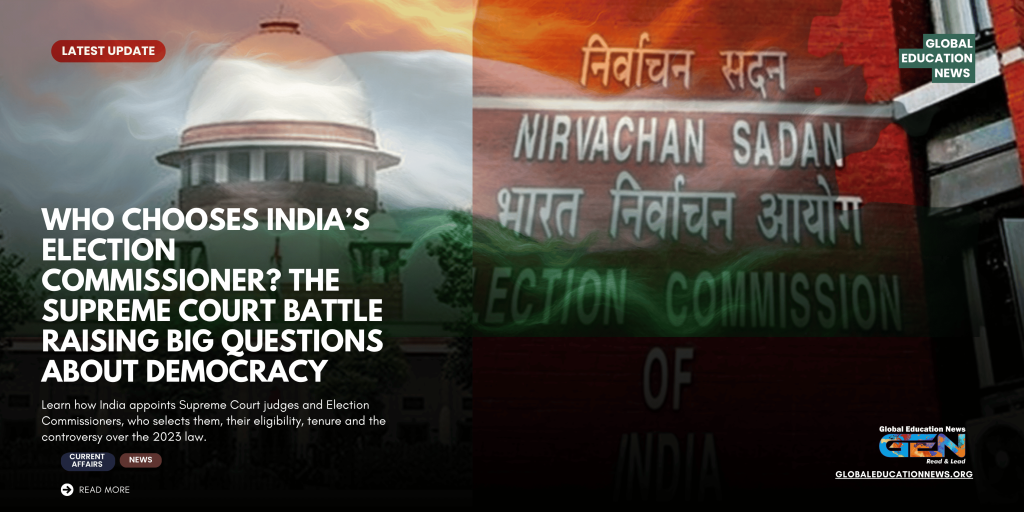
Who appoints Supreme Court judges in India, and who selects the Chief Election Commissioner (CEC) and other Election Commissioners? Both positions are crucial to India’s democracy, but their appointment processes are different.
Supreme Court judges are appointed by the President following recommendations made under the judiciary’s collegium system, which gives senior judges a central role in selecting candidates. Election Commissioners are also formally appointed by the President, but the process is governed by a 2023 law under which a selection committee comprising the Prime Minister, the Leader of Opposition in the Lok Sabha and a Union Cabinet Minister nominated by the Prime Minister recommends candidates.
The difference has become an important constitutional issue. Judicial appointments raise questions about judicial independence and transparency, while Election Commissioner appointments raise questions about the independence of the body responsible for conducting elections.
Understanding these procedures helps explain how India seeks to balance executive authority, institutional independence and democratic accountability.
Key Highlights: Appointment of Supreme Court Judges and Election Commissioners
- Supreme Court judges: Appointed by the President following recommendations under the collegium system.
- Judicial collegium: The Chief Justice of India (CJI) and senior Supreme Court judges play the central role in recommending candidates.
- Election Commissioners: Appointed by the President under the Chief Election Commissioner and Other Election Commissioners Act, 2023.
- ECI selection committee: Consists of the Prime Minister, the Leader of Opposition in the Lok Sabha and a Union Cabinet Minister nominated by the Prime Minister.
- Constitutional provisions: Article 124 deals with Supreme Court judges, while Article 324 establishes the Election Commission of India.
- Main difference: Senior judges lead the recommendation process for Supreme Court appointments; a statutory selection committee recommends Election Commissioners.
- Current legal debate: The 2023 Election Commissioner appointment law has faced a constitutional challenge in the Supreme Court.
How Are Supreme Court Judges Appointed in India?
The appointment of Supreme Court judges is governed by Article 124 of the Constitution, read with the Supreme Court’s judgments establishing the collegium system.
Although the Constitution states that Supreme Court judges are appointed by the President, the process is not simply a matter of the government selecting a candidate independently. The collegium system gives the senior judiciary the leading role in recommending appointments.
What Is the Collegium System?
The collegium system is the mechanism used to recommend appointments and transfers of judges in India’s higher judiciary. It developed through a series of Supreme Court judgments, commonly known as the Second Judges Case of 1993 and the Third Judges Case of 1998.
For appointments to the Supreme Court, the collegium generally consists of:
- The Chief Justice of India.
- The four senior-most judges of the Supreme Court.
The collegium considers candidates’ judicial experience, professional ability, integrity and other relevant factors. Recommendations are then processed by the Union government before formal appointment by the President.
The collegium system is intended to protect judicial independence by giving judges a decisive role in selecting members of the higher judiciary.
Step-by-Step Process for Appointing Supreme Court Judges
| Stage | What happens? |
|---|---|
| 1. Vacancy arises | A vacancy is expected or occurs in the Supreme Court. |
| 2. Collegium considers candidates | The CJI-led collegium evaluates eligible candidates, usually including High Court judges. |
| 3. Recommendation is made | The collegium recommends a candidate for appointment. |
| 4. Government processes the proposal | The Union government examines and processes the recommendation. |
| 5. President appoints the judge | The appointment is formally made by the President of India. |
| 6. Oath of office | The appointed judge takes the prescribed oath before entering office. |
The government may return a recommendation for reconsideration. However, under the established collegium framework, if the collegium reiterates its recommendation, the government is expected to accept it.
What Are the Eligibility Criteria for a Supreme Court Judge?
Article 124(3) sets out the constitutional qualifications for appointment as a Supreme Court judge. A candidate must be an Indian citizen and meet at least one of the following conditions:
- Have been a High Court judge for at least five years, including service across two or more High Courts in succession.
- Have been an advocate of a High Court for at least ten years, including practice across two or more High Courts in succession.
- Be, in the President’s opinion, a distinguished jurist.
The distinguished-jurist provision exists in the Constitution, although appointments through this route have been exceptional.
Who Appoints the Chief Justice of India?
The Chief Justice of India is formally appointed by the President. By convention, the senior-most Supreme Court judge considered suitable for the position is generally appointed as CJI.
The process involves consultation within the judiciary and the government’s formal appointment procedure. Seniority is an important convention, but the constitutional office is filled through the formal appointment process rather than by an automatic transfer of power.
Can a Supreme Court Judge Be Removed?
Yes, but removal is subject to a stringent constitutional process intended to protect judicial independence.
A Supreme Court judge can be removed only on the grounds of proved misbehaviour or incapacity. Each House of Parliament must pass an address seeking removal, supported by:
- A majority of the total membership of that House; and
- A majority of at least two-thirds of members present and voting.
Both Houses must meet these requirements in the same session before the President can issue an order of removal.
A judge’s retirement age is 65 years.
How Are the Chief Election Commissioner and Other Election Commissioners Appointed?
The Election Commission of India is a constitutional body established under Article 324. It supervises, directs and controls elections to Parliament, state legislatures, and the offices of the President and Vice-President.
The appointment procedure for the Chief Election Commissioner and other Election Commissioners is governed by the Chief Election Commissioner and Other Election Commissioners (Appointment, Conditions of Service and Term of Office) Act, 2023.
Under this law, the President formally appoints the commissioners on the recommendation of a three-member selection committee.
Who Is on the Election Commissioner Selection Committee?
The committee consists of:
- Prime Minister of India: Chairperson.
- Leader of Opposition in the Lok Sabha: Member.
- Union Cabinet Minister nominated by the Prime Minister: Member.
The committee recommends candidates for appointment as the Chief Election Commissioner and other Election Commissioners.
The Chief Justice of India is not a member of this committee under the 2023 law.
Step-by-Step Process for Appointing Election Commissioners
| Stage | What happens? |
|---|---|
| 1. Search committee | A committee headed by the Cabinet Secretary prepares a panel of five candidates. |
| 2. Candidate assessment | Candidates are considered against the statutory qualifications. |
| 3. Selection committee meeting | The Prime Minister, Leader of Opposition and nominated Union Cabinet Minister consider the candidates. |
| 4. Recommendation | The selection committee recommends a candidate for appointment. |
| 5. Presidential appointment | The President formally appoints the Chief Election Commissioner or Election Commissioner. |
| 6. Assumption of office | The appointee takes office under the applicable rules. |
The search committee comprises the Cabinet Secretary and two other officers of at least Secretary-level rank who have relevant knowledge and experience. The selection committee is responsible for making the recommendation for appointment.
What Are the Eligibility Criteria for Election Commissioners?
Under the 2023 Act, the Chief Election Commissioner and other Election Commissioners must be selected from among people who hold or have held a post equivalent to the rank of Secretary to the Government of India.
Candidates must also have integrity and knowledge of, and experience in, the management and conduct of elections.
This differs from the eligibility framework for Supreme Court judges, which is based on constitutional qualifications involving judicial service, legal practice or distinguished jurist status.
What Is the Tenure of an Election Commissioner?
Under the 2023 Act, the Chief Election Commissioner and other Election Commissioners hold office for six years or until they reach the age of 65, whichever occurs first. They are not eligible for reappointment.
The rules governing removal also differ according to the office held. The Chief Election Commissioner can be removed in the same manner and on the same grounds as a Supreme Court judge. Other Election Commissioners and Regional Commissioners can be removed only on the recommendation of the Chief Election Commissioner.
These safeguards are intended to protect the Election Commission from arbitrary interference.
Supreme Court Judge vs Election Commissioner: What Is the Difference?
Although both institutions are essential to democratic governance, the appointment procedures reflect different constitutional responsibilities.
| Point of comparison | Supreme Court judges | Election Commissioners |
|---|---|---|
| Constitutional provision | Article 124 | Article 324 |
| Main appointment framework | Collegium system developed through Supreme Court judgments | 2023 appointment law |
| Who recommends candidates? | CJI-led judicial collegium | Three-member statutory selection committee |
| Role of Prime Minister | Government participates in processing recommendations | PM chairs the selection committee |
| Role of Opposition | No formal seat in the judicial collegium | Leader of Opposition in Lok Sabha is a committee member |
| Formal appointing authority | President of India | President of India |
| Eligibility | Indian citizenship plus specified judicial, legal or distinguished-jurist qualification | Secretary-level government experience, integrity and election-management knowledge |
| Tenure | Until age 65 | Six years or age 65, whichever is earlier |
| Removal | Special parliamentary process for proved misbehaviour or incapacity | CEC has judge-like protection; other ECs require CEC recommendation for removal |
Why Is the Election Commissioner Appointment Process Controversial?
The 2023 law has prompted debate over whether the appointment process provides sufficient institutional independence.
Before the law was enacted, the Supreme Court’s 2023 judgment in Anoop Baranwal v. Union of India had directed that, until Parliament made a law, appointments should be recommended by a committee comprising the Prime Minister, the Leader of Opposition and the Chief Justice of India.
The 2023 legislation replaced the CJI on the committee with a Union Cabinet Minister nominated by the Prime Minister. Critics argue that this gives the government two representatives on a three-member committee, potentially weakening the Opposition’s influence. Supporters of the law have defended the statutory framework and the government’s role in the appointment process.
The law has since been challenged in court. In September 2026, a two-judge Supreme Court bench delivered a split verdict on the handling of the challenge and referred the matter to the CJI for further consideration. The legal challenge does not, by itself, mean the 2023 law has been struck down.
The central constitutional question is how to balance the elected government’s authority with the need for an independent election-management body.
Why Does the Appointment of Supreme Court Judges Matter for Democracy?
The Supreme Court interprets the Constitution, adjudicates disputes between governments and citizens, and reviews the legality of government action. Its independence is essential when cases involve fundamental rights, elections, public policy or the limits of executive power.
The collegium system seeks to reduce the possibility of political influence over judicial appointments. At the same time, it has attracted criticism over transparency, accountability and the limited role of elected institutions in the selection process.
The appointment debate is therefore not simply about who chooses judges. It is about how to maintain judicial independence while ensuring that the selection process is credible, transparent and accountable.
Why Does the Independence of the Election Commission Matter?
The Election Commission administers elections and is responsible for ensuring that electoral processes are conducted according to the Constitution and election laws.
Its independence matters because election decisions can affect the ruling party, opposition parties and the democratic rights of voters. Appointment rules are consequently important to public confidence in the institution.
A credible process must be supported by clear eligibility standards, institutional safeguards, impartial administration and confidence that election officials can carry out their duties without improper pressure.
FAQs: Appointment of Supreme Court Judges and Election Commissioners in India
1. Who appoints Supreme Court judges in India?
The President of India formally appoints Supreme Court judges following recommendations made through the collegium system.
2. What is the collegium system?
It is the judicial appointment mechanism in which the Chief Justice of India and senior Supreme Court judges recommend candidates for appointment to the higher judiciary.
3. Who appoints the Chief Election Commissioner of India?
The President appoints the Chief Election Commissioner on the recommendation of the statutory selection committee established under the 2023 Act.
4. Is the Chief Justice of India part of the Election Commissioner selection committee?
No. Under the 2023 law, the committee comprises the Prime Minister, the Leader of Opposition in the Lok Sabha and a Union Cabinet Minister nominated by the Prime Minister.
5. What is the retirement age of Supreme Court judges?
Supreme Court judges retire at the age of 65.
6. What is the tenure of the Chief Election Commissioner?
The CEC holds office for six years or until reaching 65 years of age, whichever comes first, and is not eligible for reappointment under the 2023 Act.
7. Can the government reject a collegium recommendation?
The government may return a recommendation for reconsideration. If the collegium reiterates it, the established framework expects the government to accept the recommendation.
8. Has the Supreme Court struck down the 2023 Election Commissioner appointment law?
The legal challenge has not automatically invalidated the law. A split verdict in September 2026 concerned how the challenge should proceed. Readers should consult subsequent court orders for the latest position.
Conclusion
The appointment of Supreme Court judges and Election Commissioners illustrates two different ways India seeks to protect key democratic institutions. Judicial appointments rely on the collegium system, while Election Commissioner appointments follow a statutory selection process involving the Prime Minister, the Leader of Opposition and a nominated Union Cabinet Minister.
Both processes raise important questions about independence, transparency and accountability. Their significance extends beyond administrative procedure: they shape public confidence in the judiciary, the fairness of elections and the constitutional balance of power.
Global Education News will continue to explain important developments in the Constitution, governance and public institutions to help readers understand how India’s democratic system works.