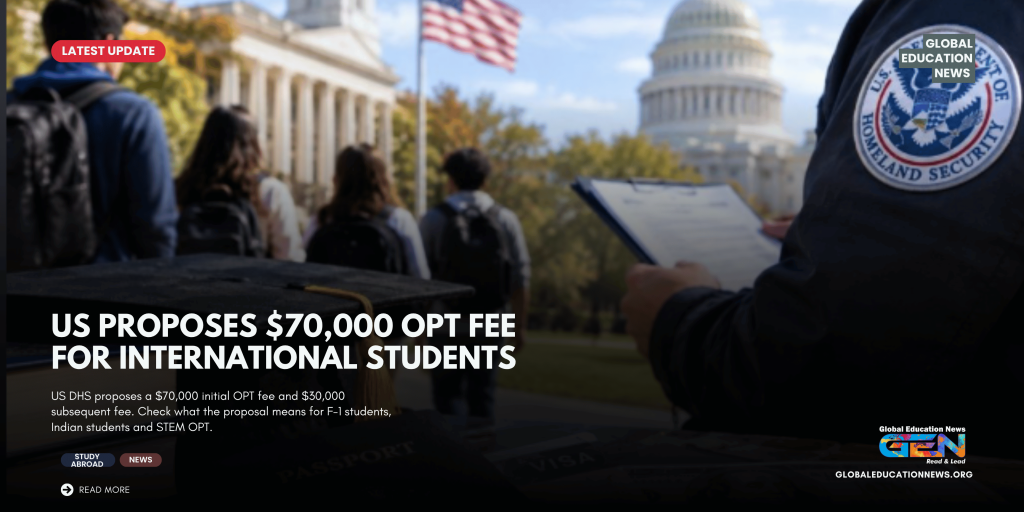
October 8, 2026 | Washington | Education News: The US Department of Homeland Security (DHS) has proposed a major new fee structure for Optional Practical Training (OPT), potentially requiring US colleges and universities to pay $70,000 when they recommend an F-1 international student for OPT for the first time.
Under the proposal, a $30,000 fee would apply to subsequent OPT recommendations, including STEM OPT extensions. The proposal could have significant implications for international students, universities and employers, particularly students from India who view post-study work opportunities as an important part of the US higher-education pathway.
However, the proposed fees are not currently in effect. The measure is going through the federal rulemaking process, meaning the final terms could change before any new fee becomes enforceable.
US OPT Fee Proposal 2026: What Has DHS Proposed?
The proposed rule would establish a new fee that an SEVP-certified educational institution would have to pay before its designated school official (DSO) recommends an F-1 student for OPT in the Student and Exchange Visitor Information System (SEVIS).
The proposed structure is:
| OPT stage | Proposed fee | Who would initially pay? |
|---|---|---|
| First OPT recommendation | $70,000 | SEVP-certified institution |
| Subsequent OPT recommendation | $30,000 | SEVP-certified institution |
| STEM OPT extension | $30,000 as a subsequent recommendation | SEVP-certified institution |
| Current status | Proposal, not in force | — |
The Federal Register proposal says the initial $70,000 fee would apply to the first OPT recommendation for an F-1 student, while the additional $30,000 fee would apply to subsequent recommendations.
Is the $70,000 OPT Fee Charged Directly to Students?
No—not under the proposed structure.
The proposed regulatory obligation falls on the SEVP-certified school, rather than directly on the international student.
However, the financial impact could still reach students. Reporting on the proposal notes that universities could potentially recover the cost from students, employers or other sources. Therefore, the eventual effect on students could depend on how individual institutions respond if the proposal becomes final.
This distinction is important: headlines describing the measure simply as a “$70,000 student fee” can be misleading because the proposed payment mechanism places the initial obligation on educational institutions.
What Is OPT and Why Does It Matter to F-1 Students?
Optional Practical Training (OPT) allows eligible students holding F-1 status to obtain temporary employment authorization for work directly related to their field of study.
Eligible F-1 students can generally receive up to 12 months of OPT at each education level. Students who graduate from qualifying STEM programmes can be eligible for an additional 24-month STEM OPT extension, potentially allowing up to three years of practical training under the applicable rules.
For many international students, OPT provides a bridge between university study and professional employment in the United States.
How Would the Proposed $70,000 and $30,000 Fees Work?
The proposal distinguishes between an F-1 student’s first OPT recommendation and later recommendations.
First OPT participation: $70,000
The first time a school recommends an F-1 student for any type of OPT, the proposed fee would be $70,000.
The proposal covers both:
- Pre-completion OPT
- Post-completion OPT
This means the proposed fee is linked to the student’s first OPT recommendation rather than simply being a charge for a particular type of OPT.
Subsequent OPT participation: $30,000
A later OPT recommendation would carry a proposed $30,000 fee.
This could include:
- Additional OPT periods
- A later post-completion OPT recommendation
- STEM OPT extensions
- Other subsequent OPT recommendations covered by the proposed rule
The proposed structure could therefore make the total institutional cost substantially higher for students who move through multiple OPT stages.
Why Has DHS Proposed the New OPT Fees?
DHS says the proposed fees are intended to address fraud and abuse in the OPT system, strengthen programme oversight and protect the integrity of the immigration system.
The agency has cited concerns involving problematic worksites, alleged false employment arrangements and so-called “pay-to-stay” schemes. DHS argues that requiring institutions to bear a significant cost would encourage greater scrutiny of OPT recommendations.
The proposal also reflects broader US government concerns about the relationship between OPT and the US labour market.
These are DHS’s stated reasons for the proposal, rather than an independent finding that international students generally misuse OPT.
How Could the Proposal Affect International Students in the USA?
The direct regulatory payment would initially fall on universities and other qualifying institutions. But the broader effects could extend to students.
Potential consequences could include:
- Higher university charges if institutions pass some costs to students.
- Greater scrutiny of OPT recommendations.
- Changes in how universities decide whether and how to support OPT participation.
- Possible changes in post-study work planning.
- Increased uncertainty for students considering US universities partly because of post-graduation employment opportunities.
The actual effect would depend on whether the proposal is finalised and how institutions respond to the new financial requirements.
Why Are Indian Students Watching the US OPT Proposal Closely?
The United States remains a major destination for Indian students, particularly for postgraduate programmes in engineering, computer science, data-related fields and other STEM disciplines.
India was the largest source of international students in US higher education during the 2024–25 academic year, with 363,019 Indian students reported in the Open Doors data cited by current reporting.
For students considering a US degree, the ability to gain practical work experience after graduation can be an important factor in evaluating the overall cost and value of an international education.
A substantial new institutional cost could therefore become another factor in university selection and financial planning if the proposal advances.
What Would Happen to STEM OPT?
STEM graduates could be particularly affected because the proposed $30,000 subsequent OPT fee would include STEM OPT extensions.
Eligible STEM graduates currently may obtain an additional 24 months of employment authorization after the initial OPT period, subject to programme and regulatory requirements.
Under the proposal, a university making the relevant subsequent recommendation would face the additional fee.
This does not mean that STEM OPT itself has been cancelled or shortened. Rather, the proposal would add a substantial institutional fee to the process.
When Could the $70,000 OPT Fee Take Effect?
It is not in effect now.
The proposed rule is subject to the federal rulemaking process. The notice is scheduled for publication in the Federal Register on October 8, 2026, followed by a public-comment period.
The proposed fees would only become applicable after the rule is finalised and takes effect.
Therefore, students currently planning OPT should not treat $70,000 or $30,000 as an immediately payable federal OPT fee.
Could the OPT Fee Proposal Change?
Yes.
Because this is a proposed rule, DHS can consider public comments before deciding whether to issue a final regulation. The final version could retain, modify or remove provisions from the proposal.
The proposal may also face legal challenges if DHS ultimately finalises it, according to immigration-law experts cited in current reporting.
For students, universities and employers, this makes it important to distinguish between the announced proposal and an enforceable final rule.
US OPT Fee Proposal 2026: Key Facts
| Question | Current position |
|---|---|
| Proposed initial OPT fee | $70,000 |
| Proposed subsequent OPT fee | $30,000 |
| Initial payment obligation | SEVP-certified educational institution |
| Direct student fee? | No, not under the proposed structure |
| STEM OPT included? | Yes, as a subsequent OPT recommendation |
| OPT currently available? | Yes, under existing rules |
| Is the new fee effective? | No |
| Rule status | Proposed |
| Public comments | Required before finalisation |
| Potential student impact | Depends partly on how institutions recover or absorb costs |
| Main DHS rationale | Fraud prevention, oversight and programme integrity |
What Does the Proposal Mean for Students Planning to Study in the US?
For prospective international students, the proposal adds another policy variable to the US study-abroad decision.
Students evaluating universities should distinguish between:
- Current OPT rules, which remain applicable unless and until changed.
- The proposed $70,000 initial institutional fee.
- The proposed $30,000 subsequent fee, including STEM OPT extensions.
- How individual universities might respond if the proposal becomes final.
- The possibility of further changes during the rulemaking process.
The proposal does not mean that every F-1 student must immediately pay $70,000 to obtain OPT.
Instead, it could create a major new cost for institutions supporting OPT participation, with the eventual financial consequences for students depending on university policies and the final federal rules.
US OPT Fee Proposal 2026 FAQ
Is the US government charging international students a $70,000 OPT fee now?
No. The $70,000 amount is part of a proposed DHS rule and is not currently an effective OPT fee charged directly to students.
Who would pay the proposed $70,000 OPT fee?
Under the proposal, the initial fee would be paid by the SEVP-certified educational institution before its designated school official recommends the student for OPT.
What is the proposed OPT renewal fee?
DHS has proposed a $30,000 fee for subsequent OPT recommendations, including STEM OPT extensions.
Can universities pass the cost to students?
The proposal would allow institutions to determine how they finance the cost, meaning students or employers could potentially bear some or all of the expense depending on institutional policy.
Does the proposal affect STEM OPT?
Yes. A subsequent OPT recommendation, including a STEM OPT extension, would fall under the proposed $30,000 fee structure.
Has the $70,000 OPT fee been finalised?
No. It remains a proposal and must go through the federal rulemaking process before it could take effect.
How long can eligible F-1 students currently work through OPT?
Eligible students can generally receive up to 12 months of OPT at each education level, while qualifying STEM graduates may receive an additional 24-month STEM OPT extension.
What Students Should Watch Next
The immediate focus is the DHS rulemaking process. Students and universities should watch for the Federal Register publication, public comments, any revisions to the proposal and, ultimately, a final rule and effective date.
Until that process is completed, the proposed $70,000 initial fee and $30,000 subsequent fee should not be treated as current student charges.
For Indian students considering US higher education, the development is nevertheless significant because it could add another layer of cost and uncertainty to the F-1-to-OPT post-study pathway.
Global Education News will continue tracking changes to US international-student policy, OPT, STEM OPT and post-study work rules that could affect students planning higher education in America.
SEO Publishing Package
Best CTR Headline:
US Proposes $70,000 OPT Fee: What It Means for Indian Students and F-1 Graduates
SEO Title:
US OPT Fee Proposal 2026: $70,000 Initial Fee and $30,000 Renewal
Tagline:
DHS proposes $70,000 for first-time OPT recommendations and $30,000 for subsequent participation, including STEM OPT extensions.
Meta Description:
US DHS proposes a $70,000 initial OPT fee and $30,000 subsequent fee. Check what the proposal means for F-1 students, Indian students and STEM OPT.
Primary SEO Keyword:
US OPT fee proposal 2026
Secondary SEO Keywords:
international students USA, F-1 OPT, US OPT fee 2026, $70,000 OPT fee, STEM OPT fee, DHS OPT proposal, OPT rules 2026, Indian students USA, US study abroad
Long-Tail SEO Keywords:
US OPT $70,000 fee proposal 2026, $70,000 OPT fee for international students, US OPT fee proposal for Indian students, F-1 OPT $70,000 fee, STEM OPT $30,000 fee, DHS proposed OPT fee 2026, who will pay $70,000 OPT fee
AEO/Search Questions:
Is the $70,000 OPT fee in effect?
Who would pay the proposed $70,000 OPT fee?
What is the US OPT fee proposal 2026?
How much is the proposed STEM OPT fee?
Will Indian students have to pay the $70,000 OPT fee?
What is OPT for F-1 students?
When could the proposed OPT fee take effect?
Does the proposal affect STEM OPT extensions?
Tags:
US OPT fee proposal 2026, international students USA, F-1 OPT, STEM OPT, DHS, US higher education, Indian students USA, study in USA, OPT rules, international education, US student visa
Suggested Slug:us-opt-fee-proposal-2026-70000-f1-international-students
Editorial Priority: HIGH PRIORITY