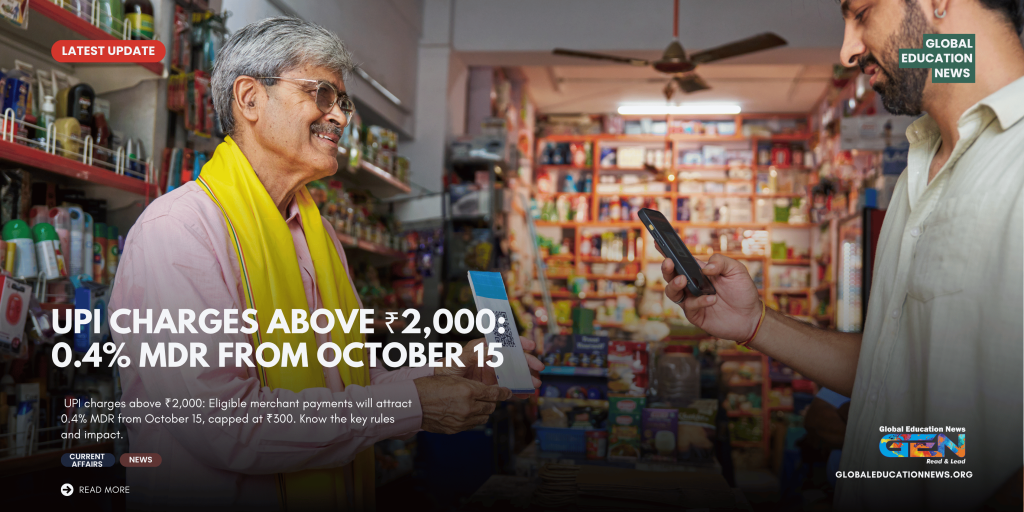
New Delhi, India — India’s UPI payment system is set for a significant change from October 15, 2026, with eligible Person-to-Merchant (P2M) UPI transactions above ₹2,000 attracting a 0.4% Merchant Discount Rate (MDR).
The change marks a shift for merchants after years of operating with zero MDR on UPI payments. But for millions of consumers who use UPI every day, the most important point is simpler: the new MDR is a merchant-side charge, not a fee directly imposed on customers.
The National Payments Corporation of India (NPCI) has set the MDR at 0.4% for qualifying transactions, with a maximum charge of ₹300 per transaction. The cap becomes relevant for transactions of ₹75,000 or more.
UPI Charges Above ₹2,000: What Is Changing?
The new framework applies to selected P2M UPI payments, meaning payments made by individuals to merchants, shops and businesses.
Transactions above ₹2,000 will attract an MDR of 0.4% from October 15.
For example, a ₹5,000 eligible merchant payment would generate an MDR of ₹20 at the stated rate. A ₹20,000 transaction would carry an MDR of ₹80.
For very large transactions, however, the charge will not continue rising indefinitely. The MDR will be capped at ₹300 per transaction.
The distinction matters because headlines about “UPI charges” can easily create the impression that customers will have to pay a new fee every time they scan a QR code. That is not what the current framework says.
Customers Will Not Be Charged for UPI Payments
The government has repeatedly clarified that UPI users will not be charged a transaction fee under the new arrangement.
Person-to-person, or P2P UPI transactions, will also continue to remain free.
That means sending money to a friend, family member or another individual will not suddenly attract the 0.4% MDR simply because the amount crosses ₹2,000.
The new charge is focused on the merchant side of the payment ecosystem.
The government has also established statutory protection for UPI payments up to ₹2,000, reinforcing the principle that customers should not face direct or indirect charges on those transactions.
Who Will Pay the 0.4% MDR?
The merchant is the party against whom the MDR is levied.
MDR, or Merchant Discount Rate, is a processing charge associated with digital payments. It is generally collected within the payments ecosystem involving acquiring banks, payment service providers and other participating entities.
For merchants, therefore, the economics of accepting higher-value UPI payments will change.
A retailer receiving a ₹10,000 eligible UPI payment would face an MDR calculated at 0.4%, subject to the applicable rules and cap.
The policy is designed to create a more sustainable financial model for the infrastructure supporting India’s enormous digital payments network.
₹300 Cap on High-Value UPI Transactions
One of the most important details for businesses is the maximum MDR.
For general eligible merchant transactions, the MDR will be capped at ₹300 per transaction.
This means that once the calculated 0.4% charge reaches the cap, the merchant will not pay more than ₹300 for that transaction.
The cap becomes particularly relevant for transactions of ₹75,000 and above.
Key UPI MDR Rules at a Glance
- Effective date: October 15, 2026
- Applicable payment type: Selected Person-to-Merchant (P2M) UPI transactions
- Threshold: Above ₹2,000
- MDR: 0.4%
- Maximum MDR: ₹300 per transaction
- P2P UPI payments: Continue to remain free
- Consumer transaction fee: No direct charge
- Transactions up to ₹2,000: Protected from charges under the government framework
Why Is India Introducing MDR on UPI?
UPI has grown into one of the world’s largest digital payment systems, handling enormous transaction volumes every month. That scale also brings significant costs for banks, payment companies and technology providers responsible for keeping the network available, secure and resilient.
The government has argued that a sustainable payments ecosystem requires continued investment in digital infrastructure, cybersecurity, innovation and payment-system resilience.
For years, the government has supported the UPI ecosystem through incentive mechanisms because the system operated without a conventional merchant MDR model.
The new arrangement attempts to preserve free consumer access while creating a limited revenue stream from higher-value merchant transactions.
Only a Small Share of Transactions, But a Large Share of Value
The most revealing part of the debate is the difference between transaction volume and transaction value.
According to recent reporting, only around 4% of P2M UPI transactions in 2025-26 were above ₹2,000, but those transactions accounted for roughly two-thirds of the total value of P2M payments.
That helps explain why the policy is focused on higher-value merchant payments rather than imposing a blanket charge across the UPI network.
The government can therefore preserve the low-cost character of UPI for everyday payments while targeting a relatively small segment of higher-value transactions.
What Does This Mean for Small Businesses?
For merchants, the impact will depend heavily on transaction size, margins and payment volumes.
A small retailer handling mostly low-value UPI payments may see little or no impact because transactions within the protected threshold remain outside the new MDR framework.
Businesses that regularly receive higher-value digital payments, however, will need to account for the additional payment-processing cost.
This could become particularly relevant in sectors such as retail, services, travel, insurance, telecom and other businesses where individual digital payments can be substantially higher than ₹2,000.
Will Merchants Pass the Cost to Customers?
This is likely to become one of the most closely watched questions after the new MDR takes effect.
The stated policy is that the charge applies to merchants rather than consumers. Whether businesses absorb the cost themselves or attempt to recover it through pricing will depend on market practices and enforcement.
For customers, the immediate takeaway remains clear: there is no announced blanket UPI transaction fee for consumers.
That distinction will be important as businesses, banks and payment companies adjust to the new framework.
UPI Remains Free for Person-to-Person Payments
The change does not turn UPI into a paid money-transfer service.
A student sending money to a parent, a friend repaying another friend, or an individual transferring money to another person’s bank account through UPI will continue to fall under the free P2P model.
This preserves one of UPI’s most widely used features: instant, low-friction transfers between individuals.
Why the ₹2,000 Threshold Matters
The ₹2,000 threshold has been central to India’s digital-payment policy for years.
Earlier government incentive schemes were designed to encourage low-value BHIM-UPI merchant payments, particularly those involving small merchants. The latest framework continues that policy direction by protecting lower-value transactions while opening the door to MDR on selected higher-value payments.
The result is a two-tier approach: everyday low-value digital payments remain protected, while higher-value merchant transactions contribute to the cost of maintaining the payments ecosystem.
What UPI Users Should Know Before October 15
For consumers, there is no need to stop using UPI simply because the MDR regime is changing.
The most important points are:
UPI is not becoming a paid service for ordinary users.
P2P transactions remain free.
The 0.4% MDR applies to eligible merchant transactions above ₹2,000.
The MDR is a merchant-side charge, with a ₹300 cap for general eligible transactions.
For merchants, the priority will be understanding how their acquiring bank or payment service provider applies the new rules and how the MDR affects settlement amounts.
The Bigger Question: Can UPI Stay Cheap as It Gets Bigger?
India’s UPI story has always rested on scale, convenience and low cost. The new MDR framework tests another part of that model: whether the country’s most important digital payment infrastructure can remain financially sustainable without shifting costs directly onto consumers.
The government has chosen a relatively narrow route rather than introducing a universal UPI fee.
That could help preserve consumer adoption while giving banks and payment companies a mechanism to recover part of the cost associated with high-value merchant payments.
For consumers, the QR code may look exactly the same on October 15. Behind that familiar scan-and-pay experience, however, the economics of India’s digital payments system will be changing.