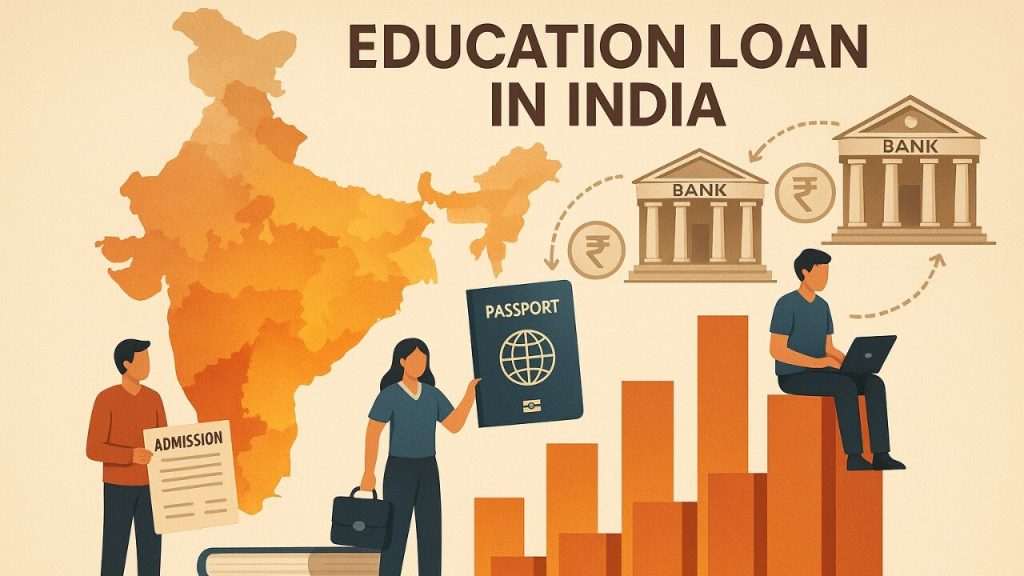
Every year during the admission season, lakhs of meritorious students in India secure seats in prestigious colleges and universities. Yet, for many, the real battle begins after the offer letter arrives. Converting admission into enrolment requires immediate payment of hefty fees, often running into several lakhs.
A timely opinion piece in The Hindu (March 2026) highlights this financing crunch — a structural mismatch between fast-paced admission cycles and the slow, documentation-heavy education loan processes. As higher education costs soar and the National Education Policy (NEP) 2020 expands access, the current loan system is struggling to keep pace, leaving many deserving students and families in distress.
The Core Problem: Timeline Mismatch
Admission processes demand quick decisions and rapid fee payments within narrow windows. In contrast, education loans involve lengthy verification of parental income, credit history, and extensive documentation.
This misalignment creates panic: students who cleared tough entrance exams often lose seats because funds are not readily available. The pressure shifts from academic merit (cut-offs) to financial liquidity, turning a moment of achievement into one of uncertainty.
Key Issues Identified:
- Loans are assessed on the family’s past financial record rather than the student’s future potential, institution reputation, or programme employability.
- Conventional risk models treat students as high-risk due to lack of income or credit history, ignoring strong indicators like admission to quality institutes.
- First-generation learners and families with stable but undocumented or non-salaried income (common outside metros) face repeated rejections.
- Limited guidance for students on bridging the financing gap during critical admission phases.
The Bigger Picture: Rising Costs vs Limited Access
India’s higher education system serves over 4 crore students, one of the largest globally. Yet, only a small fraction of the actual financing demand is met through formal banking channels. Most families still rely on personal savings, informal borrowings, or delayed arrangements.
Supporting Trends (2025-2026 Context):
- Total outstanding education loans have surged (crossing ₹1.37 lakh crore in recent data), but the number of active loan accounts has declined over the years.
- Despite schemes like PM Vidyalaxmi and collateral-free loans up to ₹7.5 lakh (with Credit Guarantee Fund), sanction and disbursement rates remain low in many cases.
- Education inflation continues to outpace general inflation, with professional courses, private institutions, and NEP-aligned multidisciplinary programmes driving higher costs.
- Demand is growing from Tier-2/3 cities and diverse socio-economic backgrounds, but the system remains metro-centric and rigid.
This results in talented students being priced out before they even begin their higher education journey.
Impacts on Students and Families
The financing crunch has far-reaching consequences:
- High-stakes professional programmes (engineering, medicine, management, etc.) become inaccessible despite merit.
- Families face immense stress, often mobilising funds at short notice through high-interest informal sources.
- Psychological burden: Anxiety, mental health issues, and in extreme cases, tragic outcomes linked to education-related debt pressure.
- Broader inequity: NEP 2020 aims for 50% Gross Enrolment Ratio (GER) with inclusive access, but financial barriers undermine this goal by favouring those who can pay upfront.
In short, access to higher education is increasingly defined not by who qualifies, but by who can afford to enrol immediately.
Why the System Needs Urgent Reform
The author, Prashant A. Bhonsle (Founder & CEO, Kuhoo Finance), argues that education financing must evolve from a documentation-led, risk-averse model to an outcome-oriented, student-centric framework.
Recommended Changes:
- Lenders should incorporate institutional quality, placement records, and programme employability into credit decisions.
- Greater transparency from educational institutions on outcomes to help banks assess future repayment capacity.
- Alignment of loan processing timelines with admission cycles for faster disbursals.
- Expanded support for diverse student profiles, including first-generation aspirants and non-traditional income households.
- Stronger collaboration between banks, fintech players, educational institutions, and regulators to build flexible, digital-first products.
Additional reforms suggested in recent parliamentary discussions include simplifying processes, improving awareness (especially in rural areas), extending moratorium periods, and stricter enforcement of collateral-free lending norms.
Actionable Tips for Students & Parents in 2026 Admissions
- Start Early: Begin exploring education loan options as soon as you shortlist colleges — do not wait for the offer letter.
- Compare Lenders: Evaluate public banks (lower rates, collateral rules), private banks, and NBFCs/fintech platforms for speed and flexibility.
- Prepare Documents: Keep income proofs, academic records, admission letters, and fee structures ready. For collateral-free loans (up to ₹7.5 lakh), focus on recognised institutions.
- Check Schemes: Explore government-backed options like Credit Guarantee Fund and interest subsidies.
- Seek Alternatives: Look into scholarships, institutional aid, education loan apps, and repayment calculators for better planning.
- Verify Timelines: Confirm exact fee payment deadlines and ask banks about processing time for your specific case.