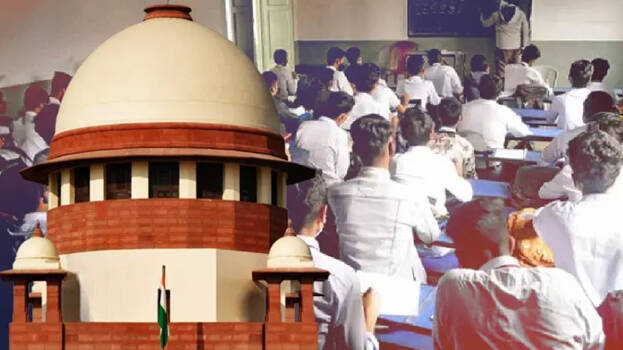
In a significant development for India’s education system, the Supreme Court of India has sought responses from the Centre, all states, and Union Territories on a Public Interest Litigation (PIL) concerning the effective implementation of the Right to Education (RTE) Act.
The move highlights growing concerns over gaps in the execution of the landmark law, which guarantees free and compulsory education for children aged 6 to 14 years.
What the PIL Demands
The PIL calls for a more robust and uniform implementation of the Right of Children to Free and Compulsory Education Act, 2009, along with the broader adoption of reforms outlined in the National Education Policy (NEP) 2020.
Key issues raised in the petition include:
- Inconsistent implementation of RTE provisions across states
- Need for stronger enforcement mechanisms
- Inclusion of early childhood education (pre-primary level) within the legal framework
- Alignment of RTE with the NEP 2020 vision
The petitioner also stressed that education reforms must go beyond policy announcements and translate into ground-level execution across all regions.
Supreme Court’s Observations
A bench comprising senior judges issued notices to the Centre and state authorities, stating that the matter requires detailed examination.
The Court indicated that it would review the concerns raised in the PIL after receiving responses from all stakeholders, signalling a possible judicial intervention to strengthen education rights in India.
RTE Act: A Landmark but Challenged Law
The Right to Education Act, 2009 was enacted to ensure universal elementary education in India. It mandates:
- Free and compulsory education for children aged 6–14
- Admission to neighbourhood schools
- Reservation of 25% seats in private schools for economically weaker sections
However, despite its transformative intent, challenges remain in implementation, including infrastructure gaps, funding issues, and lack of uniform compliance across states.
Focus on Pre-Primary Education
One of the most critical aspects of the PIL is the demand to extend the right to education to children below six years of age.
Currently, early childhood education falls under policy directives rather than enforceable fundamental rights. The petition argues that excluding the 3–6 age group creates a gap in foundational learning, which is crucial for long-term educational outcomes.
This aligns with the NEP 2020 framework, which introduces a 5+3+3+4 system covering ages 3 to 18 and emphasises early childhood care and education.
Why This Case Matters
The Supreme Court’s intervention could have far-reaching implications:
- Strengthening enforcement of the Right to Education Act
- Expanding the scope of education as a fundamental right
- Ensuring uniform education standards across India
- Accelerating implementation of NEP 2020 reforms
If the Court rules in favour of the petition, it could redefine the constitutional understanding of education and make early childhood education legally enforceable.
What Happens Next
The case will proceed after responses are submitted by the Centre, states, and Union Territories. The Court is expected to examine:
- Implementation gaps in RTE
- Feasibility of expanding the law
- Alignment with national education reforms
The outcome could play a pivotal role in shaping India’s education policy and legal framework in the coming years.