October 7, 2026 | Stanford, California | Education News: A Stanford Medicine-led study has challenged a long-standing model of human brain evolution and development, finding evidence that the brain’s front and back regions arise from two distinct populations of early progenitor cells rather than from a single developmental source.
Published in Nature Neuroscience on September 18, the research identified separate developmental pathways for the forebrain and midbrain on one side and the hindbrain on the other. The researchers say the pattern appears to have been conserved across roughly 550 million years of evolution, raising new questions about how ancient nervous systems eventually became integrated into the vertebrate brain.
The study also produced functional human hindbrain motor neurons in the laboratory — a development that could provide new research models for neurological conditions including amyotrophic lateral sclerosis (ALS) and spinal muscular atrophy (SMA).
What Did the Stanford Brain Study Discover?
For decades, scientists have worked with a model in which a common early neural progenitor population gives rise to the major regions of the developing brain.
The Stanford research points to a different developmental blueprint.
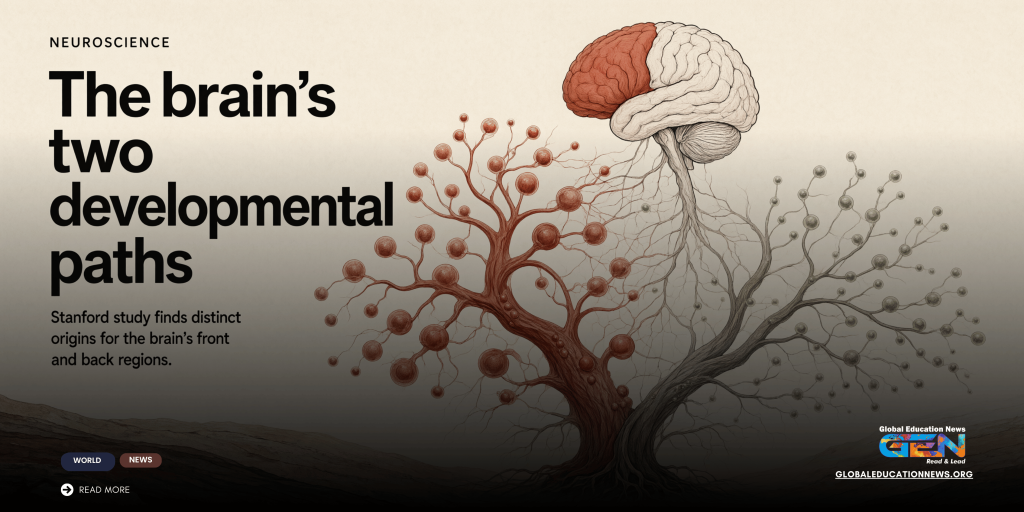
Researchers studying mouse embryos identified two distinct progenitor populations during gastrulation, an early stage of embryonic development:
- One population develops into the forebrain and midbrain.
- A second population develops into the hindbrain.
- The two populations remain distinct and do not overlap.
- Their cells also show different patterns of DNA packaging, helping direct them toward different developmental fates.
Kyle Loh, associate professor of developmental biology at Stanford Medicine, described the finding as evidence that the front and back of the brain originate from different progenitor cells.
How Could the Human Brain Have Two Developmental Histories?
The researchers’ findings raise an evolutionary possibility: that the brain may represent the integration of two ancient nervous-system lineages.
The study found evidence that the two-part developmental pattern is not limited to mice. Researchers traced related patterns across several animals, supporting the possibility that the arrangement is deeply conserved in evolutionary history.
The Stanford researchers propose that these two developmental systems may have existed along separate evolutionary paths before becoming integrated into the brain structures found in modern vertebrates.
However, the distinction between developmental evidence and evolutionary interpretation is important. The study directly demonstrates separate progenitor lineages in development; the idea that these represent two ancient nervous systems that were subsequently joined is the researchers’ evolutionary interpretation of that evidence.
Which Parts of the Brain Develop From the Separate Cell Populations?
The research divides the developing brain into two major developmental lineages.
| Brain region | Developmental origin identified in study | Major functions |
|---|---|---|
| Forebrain | Anterior neural ectoderm progenitor | Higher-order cognition, language and reasoning |
| Midbrain | Anterior neural ectoderm progenitor | Sensory, motor and other neural functions |
| Hindbrain | Posterior neural ectoderm progenitor | Essential automatic functions and motor control |
| Hindbrain motor neurons | Posterior developmental pathway | Facial, swallowing and related motor functions |
The anterior progenitor population expresses Otx2, while the posterior population is associated with Gbx2. The researchers found that the two lineages follow separate developmental trajectories from an early stage.
Why Does the Hindbrain Finding Matter for Neuroscience?
The hindbrain includes regions involved in fundamental functions such as breathing, heartbeat regulation and swallowing.
Yet researchers have faced significant challenges in generating authentic human hindbrain neurons in the laboratory.
The Stanford team used its understanding of the separate developmental pathway to guide human pluripotent stem cells into functional hindbrain motor neurons. The resulting cells showed electrical activity and characteristics associated with specific hindbrain regions.
This gives scientists a new laboratory model for studying cells that are difficult to obtain or reproduce.
How Could the Study Help ALS and Spinal Muscular Atrophy Research?
The discovery could have implications for neurological disease research because some disorders affect neurons associated with the brainstem and hindbrain.
The Stanford team specifically points to ALS and spinal muscular atrophy as areas where improved laboratory models could be valuable. Researchers could use the newly generated hindbrain neurons to study how disease affects these cells and to investigate potential mechanisms.
This does not mean the study has produced a treatment for ALS or SMA. Its immediate significance is the creation of a better experimental model for future research.
What Does the Study Reveal About Human Brain Evolution?
The research adds another layer to the question of how complex brains evolved.
The conventional picture treats the brain as a highly integrated organ whose regions ultimately emerge from a shared developmental origin. The new evidence suggests that at least some major regions follow separate developmental programmes from a very early stage.
The researchers’ finding that similar developmental arrangements can be traced across a large evolutionary timescale strengthens the case that this is an ancient biological pattern rather than a feature that appeared only in mammals.
The study’s publication records describe the two progenitor systems as potentially conserved across approximately 550 million years, from early-diverging animals to mammals.
Why Are Scientists Calling This a Two-Part Brain?
The phrase “two separate organs” has attracted attention because it offers an easy way to describe the discovery.
But it needs scientific context.
The research does not mean that humans literally have two independent brains functioning separately. The adult human brain is one interconnected organ.
Instead, the study shows that its major front and back regions can have distinct developmental origins. The evolutionary proposal is that these lineages may reflect ancient nervous systems that were eventually integrated.
That distinction is important when interpreting headlines about the research.
What Does This Mean for Stem Cell Research?
One of the study’s most immediate contributions may be to developmental biology and stem cell research.
Scientists attempting to produce specific neurons from pluripotent stem cells need to understand which developmental pathway produces those cells.
The Stanford researchers found that trying to transform a forebrain/midbrain progenitor into a hindbrain cell may fail because the two populations are fundamentally committed to different developmental paths.
Starting with the correct early progenitor population instead allowed the researchers to produce hindbrain motor neurons.
This demonstrates why understanding the earliest stages of human development can be crucial for regenerative medicine and disease modelling.
Why Is the Stanford Study Important for Neuroscience Students?
The research connects several major areas of modern science:
- Neuroscience: understanding how different brain regions form.
- Developmental biology: studying how early cells acquire specialised identities.
- Evolutionary biology: examining how nervous systems changed over hundreds of millions of years.
- Stem cell research: producing specialised human neurons in the laboratory.
- Medical research: creating models for neurological diseases.
- Genetics and epigenetics: understanding how gene expression and chromatin organisation influence cell fate.
For students, the study is a useful example of how a discovery in basic developmental biology can eventually influence medical research.
What Happens Next in Human Brain Evolution Research?
The discovery leaves major questions unanswered.
Scientists still need to understand precisely how the two developmental systems became integrated, when that integration occurred during evolutionary history and how their interaction shaped the complex vertebrate brain.
The researchers are also interested in extending the developmental framework to other parts of the nervous system and investigating how disease affects hindbrain neurons.
The ability to grow functional human hindbrain motor neurons in the laboratory provides a new platform for such research.
Frequently Asked Questions
What did the Stanford brain study find?
The Stanford Medicine-led study found that the forebrain and midbrain develop from one early progenitor population, while the hindbrain develops from a separate population.
Does the study prove that humans have two brains?
No. The human brain remains one interconnected organ. The study shows that major brain regions have distinct developmental origins and proposes that these lineages may reflect ancient nervous systems that became integrated during evolution.
How old is the evolutionary pattern identified by researchers?
The researchers report evidence suggesting that the two-progenitor developmental pattern has been conserved across approximately 550 million years of evolution.
What are Otx2 and Gbx2?
Otx2 and Gbx2 are genes associated with the distinct developmental pathways identified by the researchers. Otx2 marks the anterior pathway that produces the forebrain and midbrain, while Gbx2 is associated with the posterior pathway that produces the hindbrain.
Can scientists now grow human hindbrain neurons?
The Stanford team successfully generated functional human hindbrain motor neurons from human pluripotent stem cells in the laboratory.
Could this research help ALS or SMA research?
Potentially. The lab-grown hindbrain neurons provide a new model for studying neurological diseases involving these cells. The research is an experimental advance, not a proven treatment for ALS or SMA.
Where was the research published?
The study was published in Nature Neuroscience on September 18, 2026.
The Bigger Picture
The Stanford brain study challenges a basic assumption about human brain evolution and development: that the entire brain follows one common developmental route.
Instead, the evidence points to two parallel developmental programmes that produce the front and back portions of the brain. The researchers’ evolutionary interpretation suggests that this may preserve the legacy of ancient nervous systems that were eventually brought together.
The finding is significant not only for understanding how the human brain evolved, but also for modern neuroscience. By identifying the developmental route to hindbrain neurons, researchers have opened a new avenue for studying difficult-to-model neurological disorders.
For students and researchers, the study offers a powerful reminder that major advances in medicine can begin with seemingly fundamental questions about how cells develop.
Global Education News will continue tracking major neuroscience discoveries, medical research breakthroughs and scientific developments shaping the future of education and human understanding.