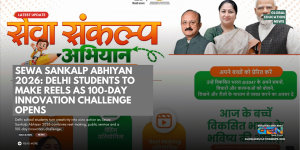
NEW DELHI — Delhi government school students are being given a new way to put civic responsibility into their own words — and on camera. Under the Sewa Sankalp Abhiyan 2026, students will participate in the “Meri Seva, Mera Sankalp” reel-making competition, alongside drawing and speech contests focused on public service, social responsibility, environmental protection and nation-building.
The month-long campaign runs from September 17 to October 17, 2026, according to the Directorate of Education. The initiative is designed to move beyond conventional school competitions by giving students space to communicate their ideas through short-form video, artwork and speeches.
At the same time, Delhi Education Minister Ashish Sood has launched the Seva First Innovation Challenge 2026, a 100-day programme aimed at students and young innovators working on practical problems. The challenge is built around areas such as agriculture, waste management, education and other real-world social and public-sector challenges.
Sewa Sankalp Abhiyan puts student voices at the centre
The Sewa Sankalp Abhiyan 2026 is being conducted across Delhi government schools, with the Directorate of Education asking schools to encourage participation in the different competitions.
For the reel-making component, students can create short videos around “Seva Mera Yogdan — My Contribution to Society”. The themes cover acts of kindness, compassion and community service, as well as youth participation in nation-building.
Other subjects include cleanliness, environmental responsibility, civic duties, public participation, helping elderly and vulnerable people, and respecting public property and national symbols. Students can also present innovative ideas for social good and their vision for India under “Viksit Bharat @2047 — My Vision, My Contribution.”
The approach reflects a broader shift in how schools can engage students with civic themes: instead of limiting expression to essays or classroom discussions, the campaign gives young participants a familiar digital format through which to tell stories and present ideas.
Competitions extend beyond reels
The campaign is not limited to social-media-style videos.
Drawing competitions are being organised for different age groups, while speech competitions are aimed at students in Classes 10, 11 and 12. The speech competition allows participation in Hindi or English.
The Directorate’s schedule also provides for district-level competitions and exhibitions, followed by a state-level exhibition, competition and felicitation programme.
Schools have also been instructed to pay attention to issues such as student consent, originality, privacy and child safety when preparing and submitting photographs and videos. Selected material may be shared through official school or district social-media channels.
100-day Seva First Innovation Challenge targets real-world problems
Running alongside the school campaign is a more technology-oriented initiative: the Seva First Innovation Challenge 2026.
Launched at Delhi Technological University, the challenge is intended to bring together students, educational institutions and young innovators to work on practical problems faced by government departments, public-sector organisations, municipalities and other institutions.
The official challenge portal says participation is open to school students from Classes 9 to 12, as well as students from ITIs, colleges and universities. Interdisciplinary teams are also allowed.
The programme gives participants a route from problem identification to solution development. Registration runs from September 18 to October 17, problem statements are scheduled to open on October 9, and teams can submit their concepts and methodology between October 10 and November 6. Shortlisted teams will proceed towards the December finale.
From an idea to a working prototype
The challenge is structured around more than simply proposing an idea.
Teams are expected to select genuine problems, develop solutions and submit technical material for evaluation. The official schedule describes the final stage as an opportunity for shortlisted teams to demonstrate working prototypes before a jury.
According to the Delhi Tribune’s report on the launch, the initiative will cover Delhi and neighbouring states and Union Territories, with DTU serving as the anchor university. The areas identified include agriculture, waste management, education and rural challenges.
The challenge also promises mentorship and exposure to government and public-sector problems, giving participating students an opportunity to see how an idea could move beyond a classroom project.
Why the two initiatives matter for students
The two strands of the Sewa Sankalp Abhiyan approach student participation from different directions.
The reel-making competition asks students to observe society and communicate what they see. The innovation challenge asks young participants to identify problems and build possible solutions.
That distinction gives the wider campaign an educational dimension beyond competition itself. A student documenting a neighbourhood cleanliness issue, for instance, is engaging with a civic problem; a team attempting to design a technology-based solution for waste management is approaching the same broad area through innovation.
Delhi has previously backed student innovation programmes that have brought government-school students together to present technology-based projects addressing real-life problems. Earlier this year, students showcased projects through the NEEEV initiative, while separate government-backed programmes have focused on incubation, infrastructure and support for promising student ideas.
Key dates for Sewa Sankalp Abhiyan and innovation challenge
For students, schools and institutions planning to participate, the timelines are particularly important.
Sewa Sankalp Abhiyan: The school campaign runs from September 17 to October 17, 2026, with reel-making, drawing and speech activities forming part of the programme.
Seva First Innovation Challenge: Team registration runs from September 18 to October 17. Problem selection begins on October 9, while synopsis submissions are scheduled from October 10 to November 6. The grand finale is scheduled for December 2 and 3, 2026.
The official challenge portal currently lists a ₹1 crore prize pool for the 2026 edition. This differs from some early media reports that described the launch as carrying a ₹2 crore pool, making the official portal the more appropriate reference for the current competition details.
A different classroom for civic learning
For Delhi’s students, the initiatives create two very different stages.
One is the smartphone camera, where a short reel can turn an act of kindness, an environmental concern or a civic observation into a story. The other is the innovation challenge, where students are expected to move from identifying a problem to thinking about technology, prototypes and implementation.
Together, the programmes place student creativity, civic responsibility and innovation at the centre of a month-long public-service campaign — with the results potentially extending well beyond the competition dates.