On July 30, 2025, Russia’s Kamchatka Peninsula experienced a dramatic sequence of natural events: an 8.8 magnitude earthquake followed by the eruption of the Klyuchevskoy volcano, the tallest active volcano in Europe and Asia. This rare combination, reported by the Russian Geophysical Survey, underscores the region’s geological volatility within the Pacific Ring of Fire. These events, while visually spectacular, caused no major casualties or damage due to the area’s sparse population, making them critical for competitive exam preparation in topics like geography and natural phenomena.
The Klyuchevskoy Eruption: A Fiery Display
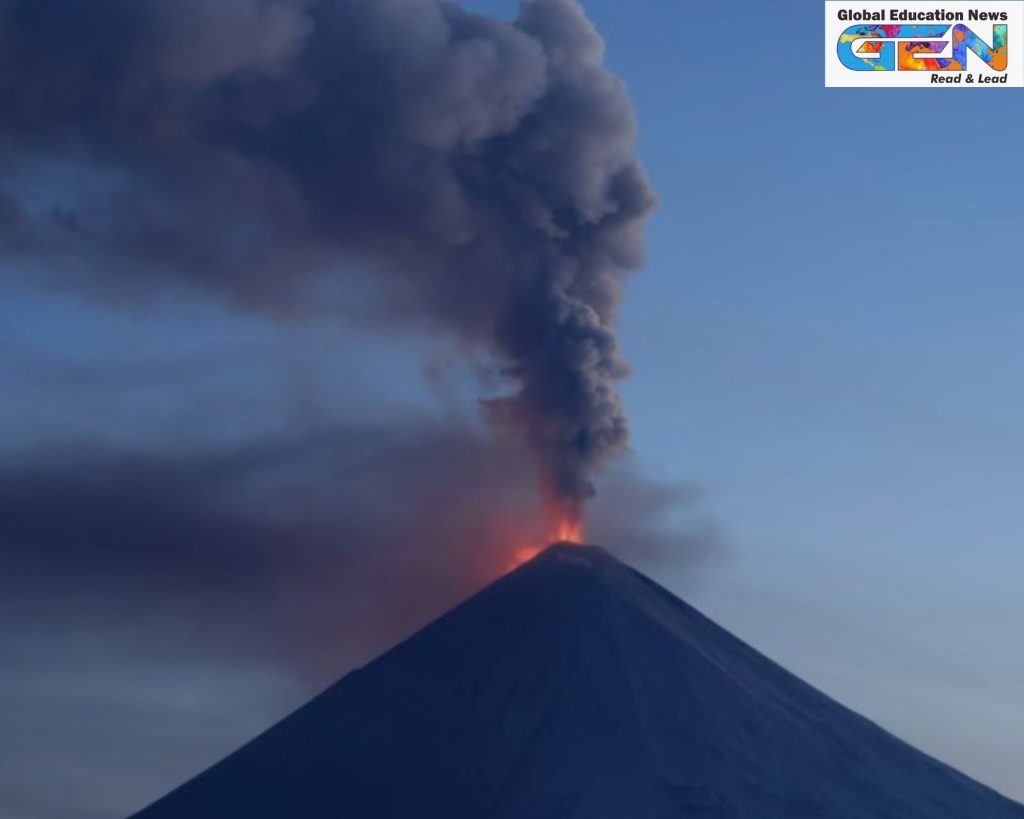
The Klyuchevskoy volcano, standing at 4,700 meters (15,000 feet), erupted hours after the earthquake, illuminating the night sky with lava flows, ash plumes, and explosions.
- Key Observations:
- Orange glow and red-hot lava flowed down the western slope.
- Explosions accompanied by ash and lava discharge were reported.
- Monitored by the Kamchatka Volcanic Eruption Response Team (KVERT) and Smithsonian Institution’s Global Volcanism Program.
- Frequency: The volcano has erupted at least 18 times since 2000, with another eruption on August 3, 2025, alongside the Krasheninnikov volcano after 600 years of dormancy.
- Impact: Minimal risk to human life due to the remote location, with the nearest major settlement, Petropavlovsk-Kamchatsky, hundreds of kilometers away.
- Exam-Relevant Points:
- Klyuchevskoy is Europe and Asia’s tallest active volcano.
- Eruption triggered by seismic activity on July 30, 2025.
- Question Example: What characterized the Klyuchevskoy volcano eruption in 2025?
Answer: Lava flows, ash plumes, and explosions following an 8.8 magnitude earthquake.
The 8.8 Magnitude Earthquake and Tsunami Alert
The 8.8 magnitude earthquake, one of the strongest recorded globally, struck off Kamchatka’s Pacific coast on July 30, 2025, at a depth of 30 km.
- Tsunami Warning:
- Issued across Kamchatka and extended to Japan, prompting coastal evacuations to higher ground.
- Lifted 11 hours later after confirming no massive waves reached populated areas.
- Impact:
- Minor injuries and light structural damage in Petropavlovsk-Kamchatsky and Severo-Kurilsk.
- No significant casualties due to the quake’s offshore epicenter and sparse population.
- Monitoring: The Russian Geophysical Survey and US Geological Survey (USGS) continue to track aftershocks, with 150 recorded by August 4, 2025.
- Exam-Relevant Points:
- Earthquake tied for the sixth strongest globally, per USGS records.
- Triggered tsunami alerts but caused minimal damage.
- Question Example: Why was the tsunami warning lifted after the Kamchatka earthquake in 2025?
Answer: No massive waves reached populated areas after 11 hours.
Kamchatka: A Geological Hotspot
The Kamchatka Peninsula lies in the Pacific Ring of Fire, a region where tectonic plate collisions fuel frequent earthquakes and volcanic eruptions.
- Volcanic Activity: Home to 300 volcanoes, with 29 active, including Klyuchevskoy, Shiveluch, and Krasheninnikov.
- Seismic Context: The Pacific Plate’s subduction under the Okhotsk Plate drives intense geological activity.
- Significance: Attracts scientists and adventurers, with ongoing monitoring by KVERT and global agencies to assess risks.
- Exam-Relevant Points:
- Kamchatka hosts 29 active volcanoes in the Pacific Ring of Fire.
- Question Example: Why is Kamchatka Peninsula prone to volcanic eruptions?
Answer: It lies in the Pacific Ring of Fire, where tectonic plates collide.
Broader Implications for Exam Preparation
- Geographical Significance: The event highlights the Pacific Ring of Fire’s role in global seismic and volcanic activity, a key topic in UPSC, SSC, and Banking exams.
- Environmental Context: Demonstrates the interplay between earthquakes and volcanic eruptions, relevant for geography and disaster management questions.
- Global Monitoring: Emphasizes the role of agencies like KVERT, USGS, and Smithsonian’s Global Volcanism Program in tracking natural phenomena.
- Sample MCQ:
- Question: Which region’s geological activity triggered the Klyuchevskoy eruption in 2025?
- A. Himalayan Belt
- B. Pacific Ring of Fire
- C. Alpine Fault
- D. Mid-Atlantic Ridge
- Answer: B. Pacific Ring of Fire
- Question: Which region’s geological activity triggered the Klyuchevskoy eruption in 2025?
Conclusion: A Natural Phenomenon with Exam Relevance
The Klyuchevskoy volcano eruption and 8.8 magnitude earthquake on July 30, 2025, underscore the Kamchatka Peninsula’s status as a geological hotspot. While causing minimal human impact due to the remote location, these events are critical for competitive exam aspirants, offering insights into tectonic activity, disaster management, and global monitoring systems. Candidates should study these details, practice related MCQs, and follow credible sources like Adda247 and USGS to stay prepared for exams like UPSC and SSC.