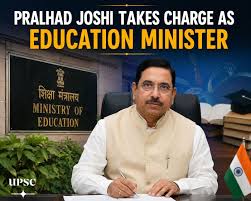
New Delhi: India has entered a new chapter in its education governance with Pralhad Joshi officially assuming charge as the Union Education Minister, succeeding Dharmendra Pradhan, who resigned from the post. The leadership transition comes at a pivotal moment when the Ministry of Education is steering several major reforms, including the implementation of the National Education Policy (NEP) 2020, the overhaul of the National Testing Agency (NTA), expansion of digital learning, and strengthening of higher education institutions.
After taking charge, Joshi described education as a “new subject” for him and said he would first familiarize himself with the ministry’s functioning before making policy decisions. He also expressed gratitude to Prime Minister Narendra Modi for entrusting him with the responsibility and assured that the ongoing initiatives of the ministry would continue with renewed focus.
Leadership Transition Comes During a Critical Phase
The change in leadership follows months of heightened public attention on India’s examination system, entrance test administration, and education governance.
The Ministry of Education is currently overseeing several high-priority initiatives, including:
- Strengthening the National Testing Agency (NTA)
- Implementation of the National Education Policy (NEP) 2020
- Digital transformation of schools and universities
- Skill-based and multidisciplinary education
- Expansion of research and innovation
- Internationalisation of higher education
- Increased use of Artificial Intelligence and emerging technologies in education
With millions of students preparing for national entrance examinations every year, the ministry’s leadership is expected to play a crucial role in restoring confidence in the education ecosystem.
Who is Pralhad Joshi?
A five-time Member of Parliament from Karnataka’s Dharwad constituency, Pralhad Joshi is among the Bharatiya Janata Party’s senior leaders with extensive administrative experience.
Before taking charge of the Education Ministry, he handled several important portfolios, including:
- Consumer Affairs
- Food and Public Distribution
- New and Renewable Energy
- Parliamentary Affairs
- Coal
- Mines
Known for his administrative skills and parliamentary experience, Joshi now steps into one of the country’s most closely watched ministries, responsible for shaping the future of over 250 million students.
Immediate Priorities Before the New Education Minister
Education experts believe the new minister’s initial focus is likely to be on ensuring continuity while accelerating reforms already underway.
1. National Testing Agency (NTA) Reforms
One of the ministry’s biggest priorities remains improving the credibility of national entrance examinations.
The government has already initiated technology-driven reforms, including the appointment of a high-powered task force led by technology expert Nandan Nilekani to recommend structural and digital improvements for the NTA.
Strengthening examination security, transparency, and governance is expected to remain at the top of the ministry’s agenda.
2. Faster Implementation of NEP 2020
The National Education Policy continues to reshape India’s education system through reforms such as:
- Multidisciplinary education
- Flexible curriculum
- Skill-based learning
- Digital classrooms
- Academic Bank of Credits
- Multiple entry and exit options
- Greater research opportunities
The ministry is expected to continue working closely with states and educational institutions to ensure smoother implementation.
3. Improving Higher Education Quality
India’s higher education sector is witnessing rapid expansion with increasing focus on:
- Research excellence
- Innovation ecosystems
- Global university collaborations
- Industry-academia partnerships
- Employability and future-ready skills
Strengthening universities while improving global competitiveness remains a long-term priority.
4. Digital Education and AI Integration
The government has significantly expanded digital learning initiatives in recent years.
Future priorities are expected to include:
- AI-enabled learning tools
- Digital classrooms
- Online education platforms
- Teacher capacity building
- Technology-enabled assessments
- Digital public infrastructure for education
These initiatives aim to make education more accessible, inclusive, and resilient.
Continuity Rather Than Disruption
Officials indicate that the ministry’s existing programmes are expected to continue without interruption despite the leadership change.
Major initiatives already underway include:
- PM SHRI Schools
- Expansion of digital education
- School infrastructure development
- Research funding
- Skill development
- Examination reforms
- University modernisation
- International collaborations
The transition is therefore viewed more as a change in leadership than a shift in policy direction.
Students and Institutions Watching Closely
For students, teachers, universities, and educational institutions, the coming months will be significant as the ministry advances reforms aimed at improving quality, transparency, and efficiency.
Particular attention will remain on:
- Entrance examination reforms
- Student welfare measures
- Digital education initiatives
- Research funding
- Employability-focused curriculum
- Regulatory simplification
- International education partnerships
Education stakeholders hope the leadership transition will accelerate reforms while maintaining policy stability.
What This Means for India’s Education Future
Pralhad Joshi assumes office at a time when India’s education system is undergoing one of its most ambitious transformations.
With the implementation of NEP 2020 gathering pace, increasing use of technology in classrooms and examinations, and renewed emphasis on innovation and global competitiveness, the Ministry of Education faces both opportunities and challenges.
The success of the new leadership will be measured by its ability to strengthen public trust, improve learning outcomes, modernise educational institutions, and ensure that reforms translate into meaningful benefits for students across the country.