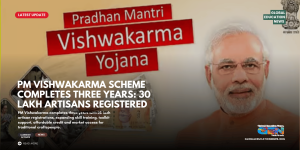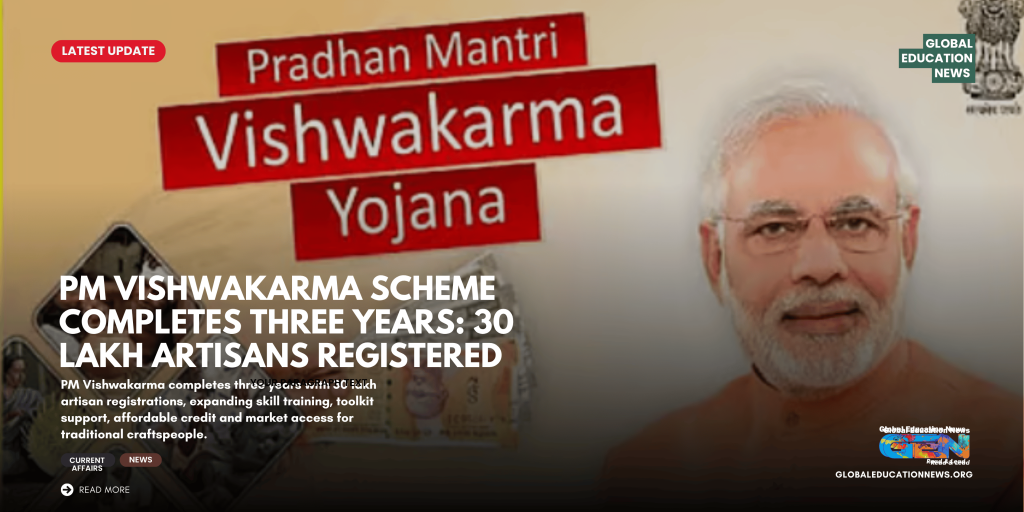
NEW DELHI — Three years after the launch of the PM Vishwakarma Scheme, the government’s flagship programme for traditional artisans and craftspeople has reached its target of 30 lakh registered beneficiaries, bringing renewed attention to how the initiative is translating registration into skills, tools, credit and market support.
Launched on September 17, 2023, PM Vishwakarma was designed to support artisans working in 18 traditional trades, from carpentry and blacksmithing to pottery, sculpting, goldsmithing and basket making. The Central Sector Scheme carries an outlay of ₹13,000 crore for 2023-24 to 2027-28.
The registration milestone itself was reached well before the scheme’s original five-year target. Government records indicate that the 30-lakh registration target had already been achieved in 2025, while implementation has since shifted towards training, toolkits, affordable credit, digital payments and market access.
PM Vishwakarma Scheme: 30 Lakh Registrations, but Implementation Is the Bigger Story
The headline figure is substantial, but the more revealing measure is what has happened after registration.
As of September 15, 2026, more than 24.37 lakh artisans had received basic skill training, according to the latest government-linked reporting. More than 18.16 lakh beneficiaries had also received modern toolkits intended to improve productivity and working capabilities.
The scheme provides basic training for five to seven days, followed by advanced training of 15 days or more for eligible beneficiaries. Trainees receive a ₹500-per-day stipend during training, while the toolkit support can be worth up to ₹15,000.
That makes PM Vishwakarma different from a programme focused solely on financial assistance. Its design attempts to connect recognition, skill development, technology, finance and market opportunities in one support framework.
What Is PM Vishwakarma Yojana? Key Benefits Explained
PM Vishwakarma was created specifically for artisans and craftspeople whose livelihoods are often built around traditional, family-based skills.
The scheme’s support architecture includes:
Recognition and Identity
Eligible beneficiaries receive a PM Vishwakarma Certificate and ID Card after completing the prescribed registration and verification process. This formal recognition is intended to help artisans access the scheme’s subsequent benefits.
Skill Training
Basic and advanced training is designed to improve traditional skills while introducing beneficiaries to more modern production methods.
The basic training component lasts five to seven days, with a ₹500 daily stipend for trainees. Advanced training can continue for 15 days or longer.
Modern Toolkit Support
Beneficiaries can receive modern toolkits valued at up to ₹15,000. The assistance is aimed at upgrading equipment and improving productivity without requiring artisans to make the entire initial investment themselves.
Collateral-Free Credit
The PM Vishwakarma loan component provides access to collateral-free enterprise development credit. The total support can reach ₹3 lakh in two tranches, with the first tranche of up to ₹1 lakh followed by a second tranche of up to ₹2 lakh, subject to the applicable conditions. The concessional interest rate is 5%.
Digital Transaction Incentives
The scheme also encourages beneficiaries to adopt digital payments. Eligible beneficiaries can receive a ₹1 incentive per digital transaction, subject to a maximum of 100 eligible transactions per month.
18 Traditional Trades Covered Under PM Vishwakarma
PM Vishwakarma focuses on traditional occupations in which skills are frequently passed from one generation to another.
The covered trades include:
- Carpenter
- Boat maker
- Armourer
- Blacksmith
- Hammer and toolkit maker
- Locksmith
- Goldsmith
- Potter
- Sculptor
- Stone carver
- Stone breaker
- Cobbler, shoesmith and footwear artisan
- Mason
- Basket, mat and broom maker
- Doll and toy maker
- Barber
- Garland maker
- Washerman
The broad coverage reflects the scheme’s attempt to bring diverse traditional occupations into a formal support system.
From Registration to Enterprise: Where the Scheme Is Headed
The next phase of PM Vishwakarma is likely to be judged less by the number of registrations and more by the depth of support reaching beneficiaries.
The latest figures show that the programme has moved beyond its initial registration milestone. By September 16, 2026, more than 6.19 lakh collateral-free loans had been sanctioned, with the sanctioned amount reaching about ₹5,316 crore, according to current scheme reporting. More than 8.11 lakh beneficiaries had also received digital incentives worth over ₹42 crore.
These figures point towards a broader policy objective: helping traditional artisans move from informal, often household-based production towards more productive and financially connected micro-enterprises.
Why PM Vishwakarma Matters for India’s Traditional Artisan Economy
For generations, many Indian crafts have survived through family knowledge rather than formal institutions. A carpenter may learn the trade from a parent; a potter may inherit techniques developed over decades; a goldsmith’s expertise can remain within a family for generations.
The challenge is that traditional skill alone does not guarantee economic security.
Access to modern equipment, affordable credit, digital payments, formal recognition and wider markets can determine whether such occupations remain viable for the next generation.
PM Vishwakarma attempts to address that gap through an integrated support model built around three broad ideas—Samman, Samarthya and Samriddhi—or recognition, capability and prosperity.
PM Vishwakarma Scheme 2026: Key Numbers at a Glance
| Indicator | Latest reported figure |
|---|---|
| Registered beneficiaries | 30 lakh |
| Traditional trades covered | 18 |
| Scheme outlay | ₹13,000 crore |
| Basic training completed | 24.37 lakh+ |
| Modern toolkits received | 18.16 lakh+ |
| Collateral-free loans sanctioned | 6.19 lakh+ |
| Loans sanctioned | About ₹5,316 crore |
| Maximum toolkit assistance | ₹15,000 |
| Maximum loan support | ₹3 lakh |
| Training stipend | ₹500 per day |
| Concessional loan interest rate | 5% |
The figures are based on the latest government-linked reporting available around September 15-16, 2026 and can change as implementation data are updated.
The Road Ahead for PM Vishwakarma
With the 30-lakh registration target already achieved, the focus now shifts from how many artisans joined the scheme to how effectively the support improves their livelihoods.
Training, modern tools and affordable credit can address some of the immediate constraints faced by traditional artisans. The longer-term challenge is connecting those capabilities to sustainable demand, stronger markets and better earnings.
That will make the next phase of PM Vishwakarma particularly significant. The scheme has already established a large beneficiary base. Its lasting impact will depend on whether that base can turn government-supported skills, tools and finance into stronger and more sustainable artisan enterprises.