| What students and guardians need to know | |
|---|---|
| Scheme | PM CARES for Children |
| Scholarship component | Special Scholarship Scheme |
| Educational coverage | Class 1 to Class 12 |
| New requirement | Aadhaar authentication or proof of possession of an Aadhaar number |
| Notification date | October 14, 2026 |
| If a child has no Aadhaar | Alternative identity verification is available |
| If authentication fails | Other permitted verification methods may be offered |
| Can assistance be denied solely due to lack of Aadhaar? | No, subject to the prescribed alternative verification process |
Can a Child Receive the PM CARES Scholarship Without Aadhaar?
Yes. The new provisions specifically protect eligible children who have not been assigned an Aadhaar number or cannot establish their identity through the standard authentication process.
In these cases, the authorities must verify the child’s identity and establish the relationship with a parent or legal guardian using the documents prescribed in the notification.
This means the Aadhaar requirement does not remove the alternative route for eligible beneficiaries. Families should follow the applicable document-verification process rather than assume that the absence of an Aadhaar number automatically makes a child ineligible.
Which Documents Can Children Below 18 Submit If They Do Not Have Aadhaar?
For beneficiaries below 18 years of age who have not been assigned an Aadhaar number, the notification provides for an Aadhaar enrolment acknowledgement containing the Enrolment ID, together with a document establishing the child’s age.
The listed age-proof documents include:
- Birth certificate.
- Indian passport.
- Class 10 or Class 12 certificate or marks statement issued by a recognised school education board.
Additional documentation carrying a photograph may be required to establish the child’s relationship with a parent or legal guardian. The exact documents accepted depend on the prescribed requirements and the beneficiary’s circumstances.
Parents and guardians should check the notification carefully before submitting an application or requesting alternative verification.
What Documents Can Beneficiaries Aged 18 or Above Submit?
The notification also specifies alternative documentation for beneficiaries aged 18 years or above who have not been assigned an Aadhaar number.
The listed documents include:
- Elector’s Photo Identity Card.
- Driving licence.
- Indian passport.
- Ration card.
- Class 10 or Class 12 certificate or marks statement issued by a recognised board.
- Other specified identity documents, where applicable.
Beneficiaries should check the complete notification for the applicable list and any additional requirements. They should not assume that every document is acceptable in every case.
What Happens If Aadhaar Authentication Fails?
The revised provisions address cases in which Aadhaar authentication cannot be completed successfully. Depending on the circumstances and what is feasible and permitted, alternative authentication methods may be offered.
These can include another biometric-based authentication method or one-time password (OTP)-based authentication.
The authorities are also required to maintain records of cases in which benefits are provided through alternative verification arrangements. Such cases may be reviewed and audited periodically.
For families, the important point is to report the authentication problem and follow the prescribed verification process rather than assume that a failed attempt automatically ends access to the scholarship.
What Is the PM CARES for Children Scheme?
The PM CARES for Children Scheme was introduced to support children who lost their parents, surviving parent, legal guardian or adoptive parents due to the COVID-19 pandemic, subject to the scheme’s eligibility conditions.
Its support measures include assistance for education and other needs as beneficiaries grow up. The scholarship component administered by the Ministry of Social Justice and Empowerment supports eligible school-going children from Class 1 to Class 12.
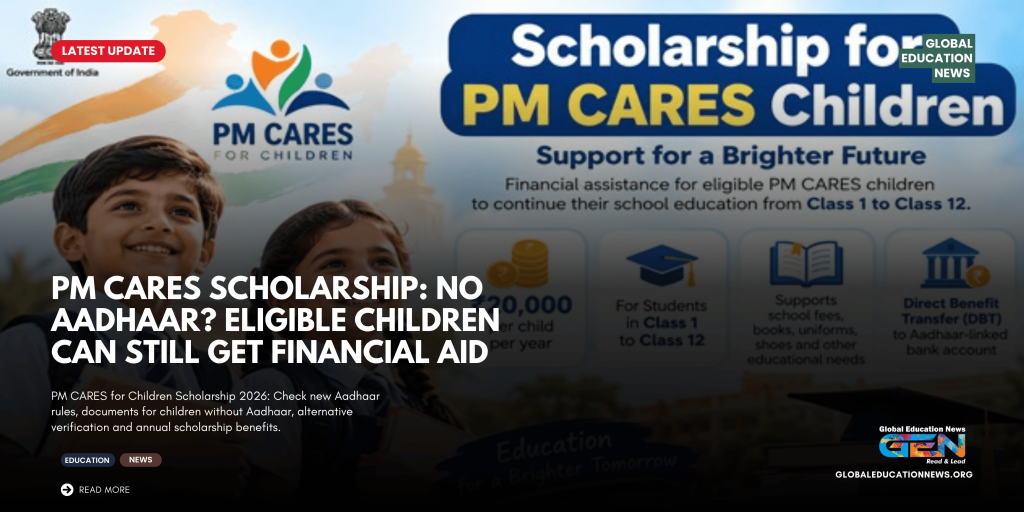
Under the published scholarship information, the annual educational assistance is ₹20,000 per child, comprising a monthly allowance of ₹1,000 and an annual academic allowance of ₹8,000. The academic allowance is intended to help with school-related expenses, including fees, books, uniforms, shoes and other educational requirements.
Eligibility for the scheme is subject to the applicable conditions and verification process. Aadhaar verification rules should not be confused with the separate criteria used to establish whether a child qualifies for assistance.
How Can Families Check PM CARES for Children Scholarship Information?
Parents, guardians and beneficiaries should use the official scheme portal to review scholarship information and available assistance.
- Visit the official PM CARES for Children website.
- Open the scholarship or relevant assistance section.
- Review the latest scheme instructions and document requirements.
- Check whether Aadhaar authentication or an enrolment acknowledgement is required in the beneficiary’s case.
- If authentication fails or Aadhaar has not been assigned, ask the relevant scheme authority about the prescribed alternative verification process.
- Keep copies of the documents submitted and any acknowledgement received.
Families should use official contact details published on the scheme website for questions about eligibility, document verification or technical problems.
PM CARES for Children Scholarship: Frequently Asked Questions
1. Is Aadhaar mandatory for the PM CARES for Children Scholarship in 2026?
Beneficiaries are required to complete Aadhaar authentication or provide proof of possession of an Aadhaar number. However, eligible children must not be denied assistance solely because they lack an Aadhaar number or cannot complete authentication, provided their identity is verified through the prescribed alternative process.
2. Can a child without an Aadhaar number receive scholarship assistance?
Yes. The notification provides an alternative verification procedure for eligible children who have not been assigned an Aadhaar number.
3. Which documents can a child below 18 use if Aadhaar is unavailable?
The prescribed process includes an Aadhaar enrolment acknowledgement containing the Enrolment ID and proof of age, such as a birth certificate, Indian passport or recognised board’s Class 10 or Class 12 certificate or marks statement. Other documents may be required to establish the relationship with a parent or legal guardian.
4. What should a beneficiary do if Aadhaar authentication fails?
The beneficiary or guardian should follow the alternative verification procedure. Other permitted authentication methods, including another biometric method or OTP-based authentication, may be offered wherever feasible and admissible.
5. Which classes are covered by the scholarship?
The Special Scholarship Scheme provides educational assistance for eligible children continuing their studies from Class 1 to Class 12.
6. How much scholarship assistance is provided annually?
The published scholarship information lists ₹20,000 per child per year, comprising a monthly allowance of ₹1,000 and an annual academic allowance of ₹8,000. Beneficiaries should confirm the applicable conditions and current instructions through the official scheme portal.
7. Where can families find official information about the scheme?
Families can visit pmcaresforchildren.in for scheme information, scholarship details and assistance-related guidance.
What This Means for Students and Parents
The new Aadhaar provisions make identity verification an important part of accessing PM CARES for Children scholarship benefits. At the same time, the alternative verification process protects eligible children from losing assistance solely because they lack an Aadhaar number or face authentication difficulties.
Parents and legal guardians should check the required documents, complete Aadhaar enrolment where necessary and contact the relevant authorities if verification problems arise. For students, understanding these requirements can help families avoid unnecessary delays in accessing educational support.
Global Education News will continue to report important scholarship rules, student benefits and education policy updates that matter to families across India.