October 6, 2026 | Stockholm | World News:
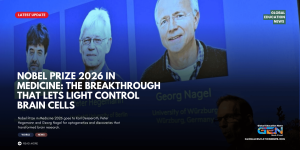
The 2026 Nobel Prize in Physiology or Medicine has been awarded to Karl Deisseroth, Peter Hegemann and Georg Nagel for discoveries that led to optogenetics, a breakthrough technique that allows scientists to control the activity of nerve cells using light. The Nobel Assembly at Karolinska Institutet announced the award on October 5, recognising research that has transformed how scientists study the brain.
At the heart of the discovery is a deceptively simple idea: if scientists can switch specific neurons on or off with light, they can observe what those cells actually do.
That capability has opened a new era in neuroscience, helping researchers investigate how neural circuits influence memories, emotions, behaviour and other brain functions.
Who won the Nobel Prize in Medicine 2026?
The 2026 Nobel Prize in Physiology or Medicine is being shared by three scientists:
| Laureate | Institution/association | Contribution |
|---|---|---|
| Karl Deisseroth | Stanford University / Howard Hughes Medical Institute | Developed optogenetic methods for controlling neurons with light |
| Peter Hegemann | Humboldt University of Berlin | Discovered light-sensitive proteins involved in algal movement |
| Georg Nagel | University of Würzburg | Helped identify and establish the function of channelrhodopsin |
The three researchers’ work came together to create a powerful method for investigating the brain with unprecedented precision.
What is optogenetics?
Optogenetics combines optics, the science of light, with genetics.
In simple terms, scientists introduce genes for light-sensitive proteins into selected cells. When those cells are exposed to a particular wavelength of light, the proteins can influence the cells’ electrical activity.
In neurons, this allows researchers to switch particular groups of nerve cells on or off and then observe what happens.
The Nobel Committee describes optogenetics as a method that can reveal how nerve cells shape memories, feelings and behaviour in a living brain.
How did a green alga lead to a Nobel Prize?
The story began not with the human brain, but with a microscopic organism.
Peter Hegemann was interested in Chlamydomonas, a single-celled green alga that moves towards light. Hegemann and Georg Nagel investigated how the organism could respond so rapidly to illumination.
Their research led to the discovery of channelrhodopsin, a light-sensitive protein that functions as an ion channel.
When exposed to light, the channel opens and allows charged particles to move across the cell membrane, generating an electrical signal.
This discovery provided the biological component needed for a much bigger idea.
How did scientists turn light into a brain-cell switch?
Karl Deisseroth and colleagues realised that light-sensitive proteins could potentially be used to control nerve cells.
They introduced the gene for channelrhodopsin into neurons. By shining light on those cells, researchers could trigger neural activity with extremely precise timing.
Deisseroth’s work eventually demonstrated that the method could be used in living animals, transforming optogenetics from an intriguing biological discovery into a major neuroscience research tool.
This was crucial because neurons communicate extremely quickly.
Traditional methods could affect many nearby cells at once. Optogenetics offered scientists a way to target particular cells or circuits and manipulate them with millisecond-level precision.
Why is the Nobel-winning discovery important?
For decades, scientists could observe relationships between different areas of the brain, but establishing exactly which neurons caused a particular behaviour was much harder.
Optogenetics changed that equation.
Researchers can now ask much more precise questions:
- Which neurons are involved in forming a memory?
- Which neural circuits influence a particular behaviour?
- What happens when a specific group of neurons is activated?
- What happens when those neurons are switched off?
- How do different brain circuits communicate?
This has helped neuroscience move from simply mapping the brain toward experimentally testing how particular neural circuits function.
Can optogenetics help treat diseases?
The technology is primarily a research tool, rather than a routine treatment.
However, its potential medical applications are attracting significant attention.
Researchers are investigating whether optogenetic approaches could eventually help address neurological and sensory disorders. One area already being explored clinically is vision restoration for people with certain forms of retinal degeneration, including retinitis pigmentosa.
This distinction matters: Nobel-winning research can create the foundation for future therapies without meaning that a treatment is already available to patients.
What does the 2026 Nobel Prize mean for neuroscience?
The award recognises a major shift in how scientists investigate the brain.
Instead of treating the brain as a system that can only be observed from the outside, optogenetics gives researchers a way to intervene in individual neural circuits and then study the consequences.
That ability has helped researchers investigate the biological mechanisms behind memory, emotion and behaviour and has become a widely used technique in neuroscience laboratories.
The broader lesson is equally important for students: a discovery that begins with a basic question about how an alga responds to light can eventually transform an entirely different field of science.
Nobel Prize in Medicine 2026: Key Facts for Students
| Question | Answer |
|---|---|
| Award | Nobel Prize in Physiology or Medicine 2026 |
| Winners | Karl Deisseroth, Peter Hegemann, Georg Nagel |
| Field | Neuroscience / optogenetics |
| Recognised work | Light-gated ion channels and optogenetics |
| Key protein | Channelrhodopsin |
| Original biological model | Single-celled green alga |
| Main breakthrough | Using light to control nerve-cell activity |
| Major application | Studying neural circuits, memory, behaviour and brain function |
| Prize amount | 12 million Swedish kronor, shared by the three laureates |
| Announcement date | October 5, 2026 |
The Nobel Prize amount for the 2026 award is 12 million Swedish kronor, divided equally among the three laureates.
FAQ: Nobel Prize in Medicine 2026 and Optogenetics
Who won the Nobel Prize in Medicine 2026?
Karl Deisseroth, Peter Hegemann and Georg Nagel jointly won the 2026 Nobel Prize in Physiology or Medicine for discoveries concerning light-gated ion channels and optogenetics.
What is optogenetics?
Optogenetics is a technique that uses light-sensitive proteins and genetic methods to control the activity of specific cells, particularly neurons.
What is channelrhodopsin?
Channelrhodopsin is a light-sensitive protein discovered in a single-celled alga. It became a key component of optogenetics because light can activate the protein and influence electrical activity in cells.
Why did optogenetics win the Nobel Prize?
The technique gives scientists an unusually precise way to control individual nerve cells and neural circuits, allowing them to investigate how the brain produces memories, emotions and behaviour.
Is optogenetics already a common medical treatment?
No. It is primarily a neuroscience research technique. Researchers are investigating potential clinical applications, including approaches to restore vision in certain forms of retinal disease.
How can optogenetics help scientists understand the brain?
By switching selected neurons on or off and observing the resulting effects, researchers can establish stronger links between particular neural circuits and functions such as memory, behaviour and sensory processing.
Why this Nobel Prize matters beyond the laboratory
The 2026 Nobel Prize in Physiology or Medicine is a reminder that some of the biggest scientific breakthroughs begin with basic curiosity.
A question about how a microscopic alga responds to light eventually contributed to a technology capable of controlling nerve-cell activity with remarkable precision.
For students interested in biology, neuroscience, genetics, medicine, biotechnology and artificial intelligence, optogenetics also demonstrates how discoveries across different disciplines can combine to create an entirely new research field.
The Nobel recognition of Deisseroth, Hegemann and Nagel places that scientific journey among the defining advances in modern neuroscience.
Global Education News will continue tracking the science, education and research breakthroughs shaping what students need to know about the future of knowledge and technology.