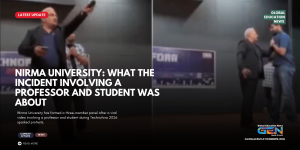
AHMEDABAD, GUJARAT — A viral video from Nirma University has triggered a campus controversy after a professor was seen grabbing a student’s collar during a student event, prompting protests by the Akhil Bharatiya Vidyarthi Parishad (ABVP) and the formation of a three-member university inquiry panel.
The incident occurred during Technofora, an event organised by students of the university’s Electronics and Instrumentation department. The confrontation reportedly followed a student’s remark during a stand-up comedy programme. The video circulating online appears to show Professor H K Patel, head of the department, calling the student onto the stage before grabbing his collar and warning him against insulting faculty members.
Nirma University Vice-Chancellor Dr RN Patel said the university has constituted a committee of three senior directors to examine the incident. The panel is expected to submit its findings within three to four days, after which the university will decide on further action under its rules.
Nirma University Professor-Student Incident: What Happened?
The episode unfolded during Technofora 2026, a three-day student event held at Nirma University last week.
According to reports and the video circulating on social media, a stand-up comedy performance was underway when Professor H K Patel was addressing the gathering. A student in the audience reportedly made a remark using a line associated with the Bollywood film Golmaal 3.
The professor then called the student onto the stage.
The video appears to show a heated exchange followed by the professor holding the student’s collar. The professor can also be heard warning the student against insulting faculty members.
The footage, however, captures only part of the episode. Reports do not establish the complete exchange that preceded the confrontation or provide an independently verified account of every statement made during it.
That distinction is significant as the university begins its inquiry.
ABVP Protest Brings the Nirma University Row Into Focus
The video quickly moved beyond social media and into campus activism.
ABVP activists protested at Nirma University, demanding action against the professor. According to ABVP’s city general secretary Priyam Bhatia, the student was allegedly threatened with academic consequences. The organisation said the incident raised concerns about how students are treated during campus interactions.
The protest has added pressure on the university to establish what happened and whether any disciplinary rules were breached.
The university, however, has not announced a final finding.
Instead, it has chosen an inquiry process before deciding on further action.
Nirma University Forms Three-Member Inquiry Committee
The university’s response is now centred on the three-member panel.
Vice-Chancellor Dr RN Patel said university officials spoke to both the professor and the student after the incident. According to the Vice-Chancellor, the professor apologised, while the student also acknowledged his mistake and apologised for his comment. The university also said it had spoken with the parents concerned.
The committee will now examine the episode and submit its report.
The university has indicated that any further action will follow its internal rules and the committee’s findings.
This makes the inquiry the next significant development in the case rather than the viral video itself.
Why the Viral Nirma University Video Has Sparked Debate
The episode has generated a wider discussion about the boundaries of student conduct and faculty authority at college events.
Other reports have highlighted a slightly different aspect of the controversy. The Indian Express reported that NSUI had warned of a possible protest and said it had sought an apology and an impartial inquiry.
That coverage also noted that the event included a comedy segment and that the confrontation followed an interruption from the audience.
Meanwhile, other reports have focused on the video itself and the subsequent reaction on social media.
Across the coverage, one point remains clear: the viral footage shows a confrontation, but the full context surrounding it is still being examined by the university.
Technofora 2026: The Event Where the Incident Took Place
Technofora was not simply a classroom gathering.
The annual student event associated with Nirma University’s Electronics and Instrumentation programme featured technical activities alongside cultural programming, including a stand-up comedy performance. India Today reported that the 2026 edition was held from September 18 to 20 and attracted more than 800 participants.
It was during this larger student gathering that the professor-student confrontation occurred.
The setting matters because the incident took place before a wider student audience rather than during a private interaction.
What the University Will Examine
The three-member committee’s findings could clarify several questions surrounding the controversy:
The sequence of events
The panel is expected to establish what happened immediately before the professor called the student to the stage and how the confrontation unfolded.
The conduct of both sides
The inquiry can examine the student’s reported remark as well as the professor’s response, rather than relying solely on a short social-media clip.
Alleged academic threats
ABVP has alleged that the student was threatened with academic consequences. Those allegations have become part of the wider controversy and would need to be assessed through the university’s inquiry.
Further university action
The committee’s report will determine what, if any, action the university takes under its rules.
Viral Video vs Full Inquiry: Why Context Matters
The speed with which the footage spread online has placed the incident under intense public attention. But a short video and a formal inquiry serve different purposes.
The video provides a visible record of part of the interaction. The university committee has the task of establishing the broader sequence of events, hearing the accounts of those involved and determining whether institutional rules were violated.
That is why the next development will likely come from the committee rather than from further social-media debate.
For students, faculty and university administrators, the episode has also revived a familiar campus question: where should the line be drawn between informal student behaviour, faculty authority and institutional discipline?
At Nirma University, the answer will now depend on the findings of the three-member panel.