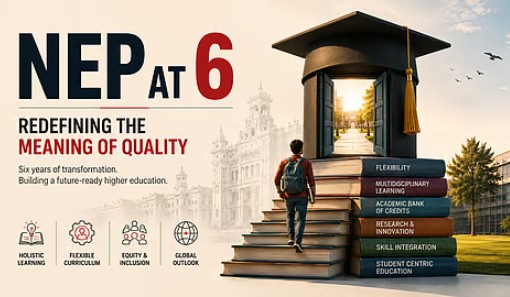
The National Education Policy (NEP) 2020, now six years old, has been hailed as one of the most ambitious reforms in India’s education sector. While the arrival of foreign universities in India has captured headlines, the deeper challenge lies in ensuring that internationalisation reaches every Indian campus. The policy’s success will be measured not by the number of foreign names on Indian soil, but by whether every student receives globally benchmarked education.
🌍 Foreign Universities: Symbolic but Limited
- The University Grants Commission (UGC) has approved five foreign universities to set up campuses in India.
- These institutions bring prestige and visibility, but they will serve only a tiny fraction of India’s 4.5 crore higher education students.
- NEP’s vision is broader: it seeks systemic transformation, not just symbolic partnerships.
📈 Internationalisation at Home: The Real Test
Internationalisation must be embedded across Indian universities, not confined to elite institutions. Key strategies include:
- Curriculum Reform: Adoption of globally benchmarked curricula, peer-reviewed syllabi, and interdisciplinary learning.
- Faculty Mobility: Encouraging visiting scholars, faculty exchanges, and joint teaching programs.
- Collaborative Research: Establishing joint centres for global challenges such as climate change, AI, and healthcare.
- Student Opportunities: Expanding international internships, joint degrees, and industry collaborations.
📊 Student Mobility Trends
- Outbound Indian students dropped from 9.08 lakh in 2023 to 6 lakh in 2025, due to rising costs and visa restrictions abroad.
- This decline highlights the need for world-class education at home, ensuring students don’t miss out on global exposure.
- Internationalisation at home can democratise access, making global education affordable and inclusive.
🔑 India as a Global Knowledge Hub
- Hosting international students enriches classrooms, strengthens cultural exchange, and boosts India’s soft power.
- India’s diverse student population and growing research ecosystem can position it as a net exporter of knowledge.
- Leveraging the Indian diaspora and global partnerships will be crucial in building credibility.
📌 Comparison: Foreign Campuses vs. Internationalisation at Home
| Aspect | Foreign University Campuses | Internationalisation at Home |
|---|---|---|
| Reach | Limited to a few thousand students | Benefits 4.5 crore students |
| Symbolism | High visibility, global branding | Deep systemic transformation |
| Cost | Expensive, selective access | Affordable, inclusive access |
| Sustainability | Dependent on foreign institutions | Driven by Indian universities |
| NEP Alignment | Partial | Full alignment with NEP 2020 goals |
🚀 The Road Ahead
- By 2035, India aims to achieve a 50% Gross Enrolment Ratio (GER), requiring millions of new opportunities.
- Internationalisation must scale across all institutions, not just elite ones.
- The next six years should focus on:
- Faculty and student exchanges
- Joint research centres
- Curriculum innovation
- Attracting international students
✅ Conclusion
The success of NEP 2020 will not be judged by the number of foreign campuses in India, but by whether every student—whether in Delhi, Patna, or Coimbatore—receives an education that is globally competitive, future-ready, and proudly rooted in India’s intellectual heritage.