The Supreme Court has declined requests to reconstitute the five-member high-powered committee examining allegations of police excesses against student protesters during recent NEET UG-related demonstrations in Delhi.
A bench headed by Chief Justice of India Surya Kant, along with Justices Joymalya Bagchi and V Mohana, made it clear that the court would not begin with an assumption that the committee was biased. The panel, headed by former Supreme Court judge Justice R. Subhash Reddy, will continue its work under the supervision of the apex court.
The decision keeps the focus on the committee’s original mandate: examining allegations of excessive force against protesters as well as claims of violence against police and security personnel.
Why was the committee challenged?
During the hearing, lawyers representing petitioners raised concerns about the composition of the panel. One of the objections related to a former Director General of Police from a northeastern state who is a member of the committee.
The petitioners argued that the member could have a potential conflict of interest because of his alleged proximity to a senior functionary who could potentially come under scrutiny.
The Supreme Court, however, rejected the suggestion that the panel should be treated as biased from the outset. The bench indicated that it could consider specific reservations about an individual member but would not accept a presumption that a committee constituted by the court was inherently compromised.
The court’s position effectively means that the committee will proceed with its existing composition while remaining answerable to the Supreme Court.
What will the five-member panel examine?
The committee was constituted earlier to conduct a broad examination of events surrounding the student protests in Delhi.
Its responsibilities include looking into allegations of excessive police force and violence against protesters, including claims involving the deployment of pellet guns. At the same time, it has also been asked to examine allegations that protesters used force or violence against police personnel and other security officials.
The panel comprises:
- Former Supreme Court judge Justice R. Subhash Reddy, who is heading the committee
- Former Punjab and Haryana High Court Chief Justice Ravi Shankar Jha
- Former Delhi High Court judge Justice Shalinder Kaur
- Former CBI director Rishi Kumar Shukla
- Retired Meghalaya DGP L. R. Bishnoi
The court has said that the diversity of professional experience within the committee was among the factors considered while selecting its members.
Public submissions to be part of the process
The Supreme Court has also indicated that the committee’s work will include an opportunity for members of the public to place their views and supporting material before it.
People who wish to participate will be able to submit relevant information, documents or evidence. The material will then be placed before the committee for consideration.
This approach could allow the inquiry to consider accounts from different sides rather than relying solely on material presented by the parties involved in the court proceedings.
The court has also emphasised that the committee will function under its supervision, giving the proceedings a direct judicial oversight mechanism.
Protests that brought the issue before the court
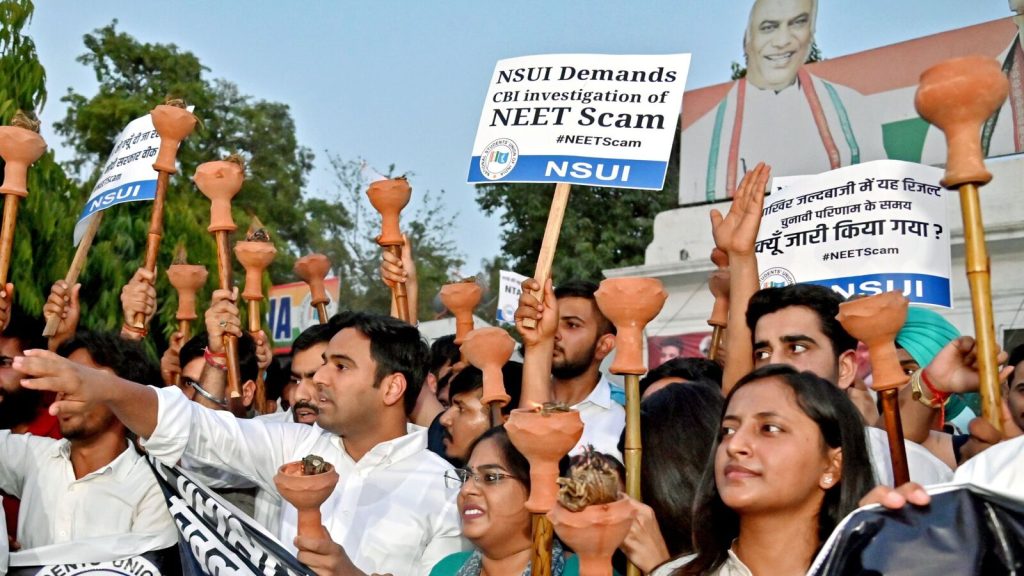
The dispute stems from a series of student-led demonstrations in Delhi that began at Jantar Mantar in June 2026 and subsequently spread to other locations.
The agitation was linked to concerns surrounding the NEET UG examination system and demands raised by protesters, including a call for the resignation of the Union Education Minister.
A major confrontation occurred during a march towards Parliament on July 20, when protesters and security personnel clashed. Police used measures including lathis and tear gas to disperse the crowd attempting to proceed towards Parliament.
The protests continued until July 25, when the agitation was called off following developments that included the resignation of Education Minister Dharmendra Pradhan and acceptance of other demands raised by the protesters.
A wider question about student protests
The Supreme Court’s decision has implications beyond the immediate NEET UG protest case.
At its heart is a question about how allegations involving both protesters and law-enforcement agencies should be independently examined when public demonstrations become confrontational.
The court’s decision to retain the panel while inviting evidence from members of the public suggests an emphasis on an evidence-based inquiry rather than replacing the committee because of allegations made against one of its members.
For students and education stakeholders, the issue is particularly significant because competitive examinations such as NEET UG affect millions of young people and have increasingly become the centre of debates around examination transparency, institutional accountability and student grievances.
Another development involving a student protester
The hearing also saw an update concerning a notice issued to a student who had participated in the protests.
The court was informed that an executive magistrate in Greater Noida who issued a show-cause notice to the student over participation in the protest had been suspended. The development came amid the Supreme Court’s scrutiny of how authorities handled individuals involved in the demonstrations.
The episode adds another layer to the larger debate over how student protests should be handled by administrative and law-enforcement authorities.
What happens next?
The immediate outcome is clear: the high-powered committee will continue with its existing members.
Rather than reconstituting the panel, the Supreme Court has chosen to retain direct oversight of its functioning and allow individuals with relevant information to approach the committee.
The eventual findings could help establish a clearer account of what happened during the protests, including allegations concerning the conduct of both police personnel and protesters.
For the wider NEET UG ecosystem, the proceedings will be closely watched. The controversy has already placed examination governance, student grievances and institutional accountability under intense public scrutiny. The committee’s eventual assessment could therefore become an important reference point in the continuing debate over how India’s high-stakes entrance examinations—and the protests surrounding them—are managed.