Date: November 12, 2026
Place: New Delhi
Education News: NEET UG 2026, MBBS Admission, NMC Advisory
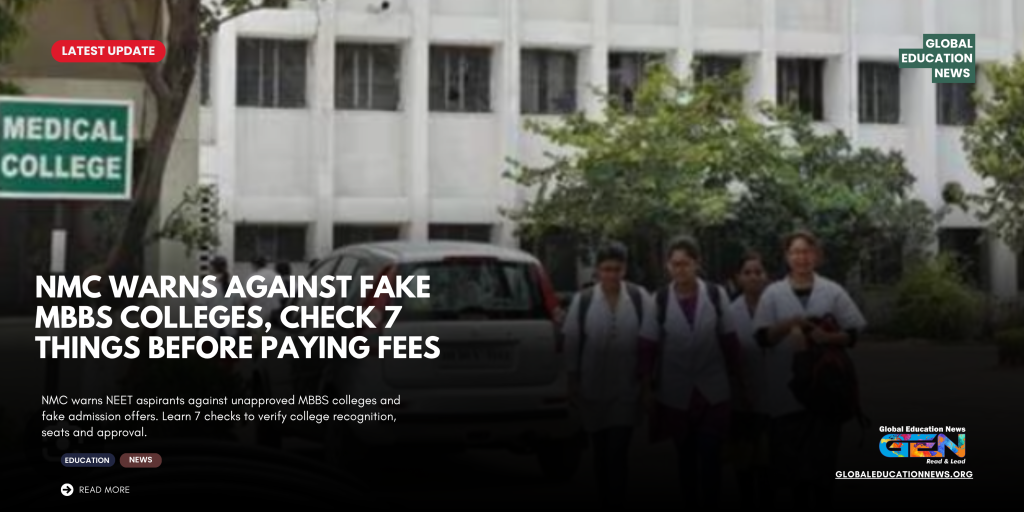
New Delhi, Education news: The National Medical Commission (NMC) has issued an important warning to NEET aspirants, students and parents against misleading MBBS admission offers and medical institutions operating without the required regulatory approval. The medical education regulator has advised candidates to verify a college’s authenticity, recognition status, approved MBBS seats and admission permission for the relevant academic year before accepting an offer or making any payment.
The advisory, issued in November 2026, follows a direction from the Supreme Court in the case Ayesha Jain v. Amity University, Noida and Others. The court asked regulatory authorities to caution students and parents against unauthorised educational institutions. The matter came into focus following a reported incident involving a purported fake medical college operating from a farmhouse and claiming to offer various courses.
The NMC has clarified that a college’s previous approval or presence on an official list does not automatically establish its permission to admit students in a subsequent academic year. Candidates must independently verify the institution’s current regulatory status through official records.
NMC Warning on Fake MBBS Colleges 2026: Key Highlights
| Particulars | Details |
|---|---|
| Regulatory authority | National Medical Commission |
| Advisory issued | November 2026 |
| Concern | Unapproved medical colleges and misleading admission offers |
| Students affected | NEET aspirants, MBBS applicants and parents |
| Main verification authority | NMC and Medical Assessment and Rating Board |
| Admission process | Official MCC or State/UT counselling, wherever applicable |
| Important requirement | Verify approval for the relevant academic year |
| Official website | nmc.org.in |
Why Has NMC Warned NEET Aspirants Against Fake Medical Colleges?
The warning addresses the risk of students being misled by institutions that claim to offer MBBS or other medical courses without obtaining the necessary statutory recognition or permission.
Medical education is regulated because students must receive appropriate academic instruction, clinical training and practical exposure before qualifying as medical professionals. An institution cannot establish its legal authority to offer an MBBS course merely by operating from a building, maintaining a website or advertising admission opportunities.
The NMC has highlighted several possible warning signs, including:
- Advertisements claiming guaranteed MBBS admission outside the prescribed process.
- Institutions making claims about recognition without verifiable regulatory documents.
- Admission offers circulated through unauthorised agents or intermediaries.
- Documents claiming to be Letters of Permission that cannot be authenticated.
- Claims about hospital facilities and clinical training that cannot be independently verified.
- Requests to transfer admission fees to personal bank accounts.
Students should not treat promotional material or verbal assurances as proof of approval.
Seven Things Students Must Verify Before Taking MBBS Admission
The NMC advisory highlights several checks that students and parents should complete before accepting an admission offer.
1. Check Whether the Medical College Is Listed by NMC
Candidates should first verify whether the institution appears on the official list of medical colleges published by the National Medical Commission.
However, appearing on the list is only one part of the verification process. Students must also establish whether the college has permission to admit students for the academic year in which they are applying.
2. Verify MBBS Seat Approval for 2026–27
One of the most important points in the advisory is the distinction between a college’s existence and its permission to admit a particular batch.
A medical college may have operated in an earlier academic session, but this does not automatically mean it can admit new students every year.
Candidates should check:
- Whether the college has permission for the relevant academic year.
- Whether the MBBS course is authorised.
- The approved annual intake.
- Whether the offered seat falls within the sanctioned intake.
The approved seat count should be checked through official NMC and Medical Assessment and Rating Board (MARB) records.
3. Do Not Trust Admission Brochures or Social Media Advertisements Alone
The NMC has warned against relying exclusively on college websites, prospectuses, advertisements, social media posts and approval documents shared by institutions or their representatives.
A document that looks official may still require authentication.
If a student has doubts about a college’s recognition or a Letter of Permission, the details should be verified directly with the competent regulatory authority.
4. Use Official MBBS Counselling Channels
Candidates should follow the prescribed counselling process instead of accepting unofficial admission arrangements.
For applicable MBBS admissions, students should use the official Medical Counselling Committee (MCC) process or the relevant State or Union Territory counselling authority.
The counselling authority, college and allotted seat details should be checked against official records.
5. Verify the College’s Hospital and Clinical Training Facilities
Medical education requires more than classrooms and academic buildings. Students need appropriate clinical exposure and training facilities as part of their education.
The NMC has advised candidates to exercise caution when institutions make extraordinary claims about hospital infrastructure, clinical training or admission opportunities that appear inconsistent with the institution’s actual facilities.
A website, building or advertisement alone does not prove that a college is legally authorised to provide medical education.
6. Avoid Payments to Unauthorised Agents
Students and parents should be particularly careful when someone promises an MBBS seat in exchange for a payment outside the official admission process.
The NMC has warned against making admission-related payments to:
- Unauthorised admission agents.
- Personal bank accounts.
- Unverified intermediaries.
- Individuals promising guaranteed seats through unofficial arrangements.
Candidates should verify the fee instructions and payment details through the authorised institution and counselling authority.
7. Check Which Regulatory Authority Approves the Course
Another important clarification concerns institutions offering different healthcare and professional programmes.
Approval to conduct one course does not automatically authorise an institution to offer MBBS.
For example, pharmacy, nursing, Ayurveda and allied healthcare programmes fall under different statutory or competent regulatory authorities. Students must check the recognition requirements of the authority responsible for their particular course.
NMC vs MARB: What Should MBBS Applicants Know?
Students may come across two important regulatory terms while checking medical college approval: NMC and MARB.
| Authority | Role in verification |
|---|---|
| National Medical Commission (NMC) | India’s statutory regulator for medical education and medical practice |
| Medical Assessment and Rating Board (MARB) | Handles regulatory assessment and permissions relating to medical institutions, courses and seats |
For admission verification, students should consult the relevant official records rather than relying on information circulated by private agents or unofficial websites.
How Can Students Verify an MBBS College Before Admission?
Candidates can use the following verification process before making a financial commitment.
Step 1: Visit the official NMC website: https://www.nmc.org.in/
Step 2: Open the section containing the list of colleges teaching MBBS.
Step 3: Search for the medical college by its official name.
Step 4: Check the institution’s course and regulatory permission details.
Step 5: Verify the approved MBBS intake and admission permission for the relevant academic year through NMC/MARB records.
Step 6: Check the college and seat allotment through the applicable official counselling authority.
Step 7: Confirm the payment instructions directly with the authorised institution or counselling authority before transferring money.
If any information is unclear or inconsistent, candidates should seek clarification from the competent authority before proceeding.
What Should Students Do If They Suspect a Fake Medical College?
The NMC has encouraged students and parents to report suspected fake medical colleges, unauthorised MBBS courses, forged approval letters and fraudulent admission offers.
Complaints may be brought to the attention of:
- The National Medical Commission through its official website and communication channels.
- The concerned State or Union Territory Department of Medical Education.
- The competent regulatory authority.
- Local police, where appropriate.
Students should preserve relevant advertisements, payment receipts, correspondence, website details and copies of documents that may support a complaint.
Why Is This Warning Important for NEET UG 2026 Candidates?
For NEET aspirants, choosing a medical college is a major academic and financial decision. Admission verification is important because a misleading offer can result in financial losses and serious disruption to a student’s education.
The warning also highlights an important difference between qualifying for NEET and obtaining a valid MBBS admission. NEET qualification alone does not establish that an institution or seat is authorised.
Candidates must complete the prescribed counselling and verify the college’s regulatory permission before accepting admission.
Frequently Asked Questions
1. Why has NMC issued a warning to MBBS students in 2026?
The NMC has cautioned students and parents against unapproved medical colleges, misleading advertisements, forged approval documents and unauthorised MBBS admission offers.
2. How can I check whether a medical college is approved by NMC?
Visit the official NMC website at https://www.nmc.org.in/ and check the list of medical colleges teaching MBBS. Also verify the institution’s permission and approved seat intake for the relevant academic year.
3. Is a college’s previous approval enough for MBBS admission?
No. Previous approval or inclusion in an official list does not automatically establish permission to admit a new batch. Candidates must check the regulatory status for the relevant academic year.
4. What is MARB in medical education?
The Medical Assessment and Rating Board is a board under the NMC framework that handles regulatory assessment and permissions relating to medical institutions, courses and seats.
5. Can students take MBBS admission through private agents?
Students should follow the prescribed official counselling process and avoid admission-related payments to unauthorised agents, personal bank accounts or unverified intermediaries.
6. Does approval for nursing or pharmacy mean a college can offer MBBS?
No. Different courses are regulated by different competent authorities. Approval for one programme does not automatically authorise an institution to offer MBBS.
7. Where should students report fake medical colleges?
Suspected fake colleges, forged approval documents and fraudulent admission offers can be reported to the NMC, the concerned State or UT medical education department, the competent regulatory authority and local police, as appropriate.
8. Does qualifying NEET guarantee a valid MBBS seat?
No. Candidates must follow the prescribed counselling process and verify that the institution and seat have the required regulatory permission.
Conclusion: Verify Before Paying for an MBBS Seat
The NMC’s latest advisory is an important reminder that students must verify medical college recognition, approved intake and admission permissions before accepting an MBBS offer. A college’s website, advertisement or previous approval should never be treated as sufficient proof of its authority to admit a new batch.
For NEET aspirants and parents, the safest approach is to rely on official NMC records and authorised counselling channels, authenticate admission documents and avoid payments to unverified intermediaries.
For more updates on NEET UG, medical admissions, higher education regulations and student alerts, stay connected with Global Education News.