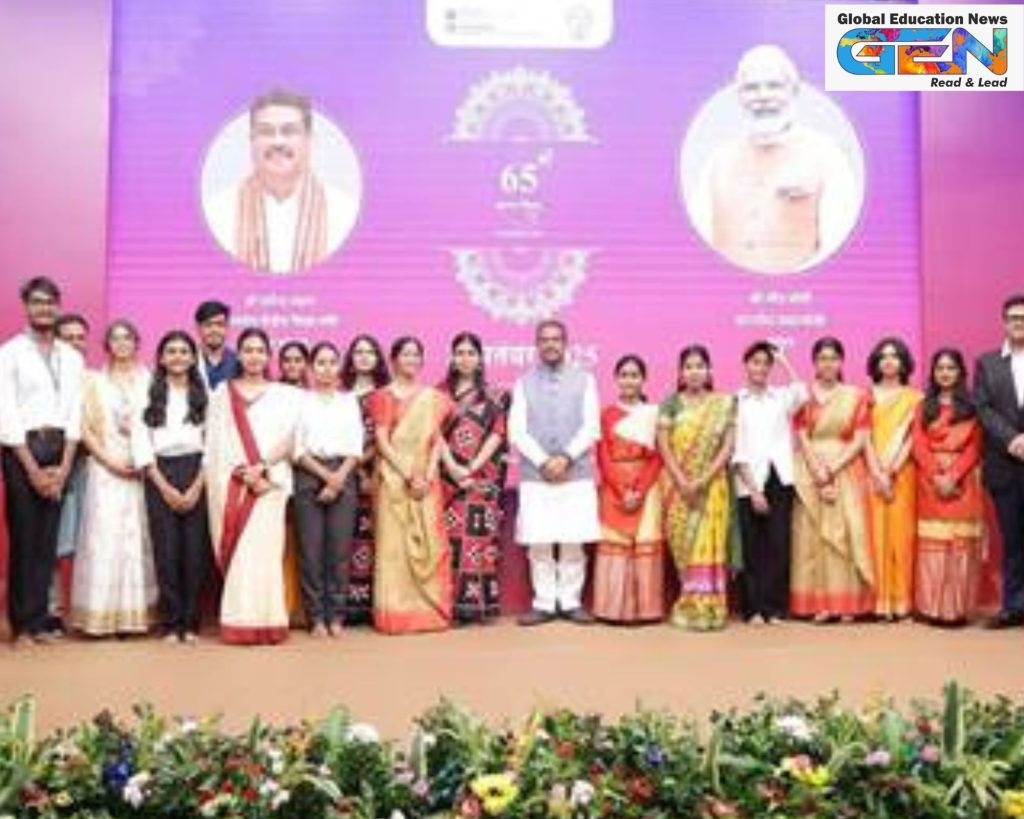
On September 1, 2025, the National Council of Educational Research and Training (NCERT) marked its 65th Foundation Day with a transformative lineup of initiatives aimed at revolutionizing India’s education landscape. Held at its New Delhi headquarters, the event, graced by Union Education Minister Dharmendra Pradhan, showcased NCERT’s commitment to digital and inclusive learning, aligning with the National Education Policy (NEP) 2020. From launching a dedicated TV channel for young learners to unveiling advanced digital platforms, NCERT is paving the way for a future-ready education system.
Key Points:
- NCERT celebrated 65 years of shaping India’s educational framework.
- The event featured prominent dignitaries, including Sanjay Kumar (Secretary, DoSE&L), former ISRO Chairman Sreedhara Panicker Somanath, and Chamu Krishna Shastry (Chairman, Bharatiya Bhasha Samiti).
- Initiatives focused on digital innovation, inclusivity, and regional heritage, reinforcing NEP 2020’s vision.
Bal Vatika TV: Empowering Early Learners
A standout announcement was the launch of Bal Vatika – PM eVidya DTH Channel No. 35, designed to boost foundational literacy and numeracy for children aged 3–6 years. This engaging audio-visual platform targets teachers, Anganwadi workers, parents, and young learners, offering content that makes early education interactive and accessible.
Key Points:
- Targets foundational skills for preschoolers, aligning with the National Curriculum Framework for Foundational Stage (NCF-FS 2022).
- Provides resources for parents and educators to support early childhood education.
- Available on DTH Channel No. 35, ensuring wide reach across India.
DIKSHA 2.0: A Leap in Digital Learning
The upgraded DIKSHA 2.0 platform was unveiled as a game-changer for digital education. Built to be device-responsive and multilingual, it offers a suite of AI-powered tools to personalize learning and empower educators. With features like adaptive assessments and real-time feedback, DIKSHA 2.0 is set to transform how students and teachers engage with education.
Key Points:
- Supports 12 Indian languages with tools like Read Aloud, Closed Captioning, and text translation.
- Offers structured lessons and adaptive assessments for personalized learning.
- Aligns with NEP 2020’s focus on technology-driven education.
Inclusive Education: PRASHAST 2.0 and Kitab Ek Padhe Anek
NCERT reaffirmed its commitment to inclusive education with PRASHAST 2.0, an enhanced screening tool for early identification of children with disabilities. Integrated with platforms like UDISE+, APAAR, and the Swavlamban Card, it ensures timely support for diverse learners. Additionally, Kitab Ek Padhe Anek introduces accessible textbooks based on universal design principles, making learning inclusive for all.
Key Points:
- PRASHAST 2.0 enables early intervention for children with disabilities.
- Kitab Ek Padhe Anek creates textbooks tailored for diverse learning needs.
- Both initiatives support NEP 2020’s goal of equitable education.
Celebrating Regional Heritage and Vocational Education
NCERT paid tribute to regional contributions with the release of Utkal Jananinkara Sujogya Santana, a book honoring 100 eminent personalities from Odisha who shaped the state’s development and India’s freedom movement. Additionally, the PSSCIVE Handbook for Key Functionaries on Vocational Education was launched to strengthen vocational learning, a key pillar of NEP 2020.
Key Points:
- The Odisha book celebrates cultural and historical contributions.
- The vocational education handbook equips educators to implement skill-based learning.
- Both initiatives highlight NCERT’s role in fostering regional pride and practical education.
Infrastructure and Innovation: VR Labs and PM eVidya App
NCERT introduced Virtual Reality (VR) labs at four demonstration schools in Ajmer, Bhopal, Bhubaneswar, and Mysuru, offering immersive learning experiences. The PM eVidya mobile app was also launched as a centralized gateway for digital learning, enhancing accessibility for students and teachers nationwide.
Key Points:
- VR labs provide cutting-edge, experiential learning for students.
- The PM eVidya app streamlines access to digital educational resources.
- These innovations align with NCERT’s tech-driven reform agenda.
Multilingual Education: New Language Primers
To promote linguistic diversity, NCERT released primers in Hindi, Sanskrit, Ho-Hindi, and Koya languages. These resources support NEP 2020’s emphasis on multilingual education, ensuring students can learn in their mother tongues while embracing India’s rich linguistic heritage.
Key Points:
- Primers cater to regional languages, fostering inclusive learning.
- Aligns with NEP 2020’s focus on mother-tongue-based education.
- Enhances accessibility for students from diverse linguistic backgrounds.
NCERT’s Vision for a Viksit Bharat
Union Education Minister Dharmendra Pradhan described NCERT as a “Gyan-Kumbh” (fountain of knowledge), urging it to lead tech-driven, reform-oriented education. With initiatives like the National Curriculum Framework for School Education (NCF-SE 2023) and NCF-FS 2022, NCERT is driving a paradigm shift toward competency-based, inclusive learning to build a Samridhh Bharat by 2047.
Key Points:
- NCERT is pivotal in realizing NEP 2020’s vision for a prosperous India.
- Focuses on creative and critical thinking over rote learning.
- Initiatives like DIKSHA 2.0 and Bal Vatika TV position NCERT as a global education leader.