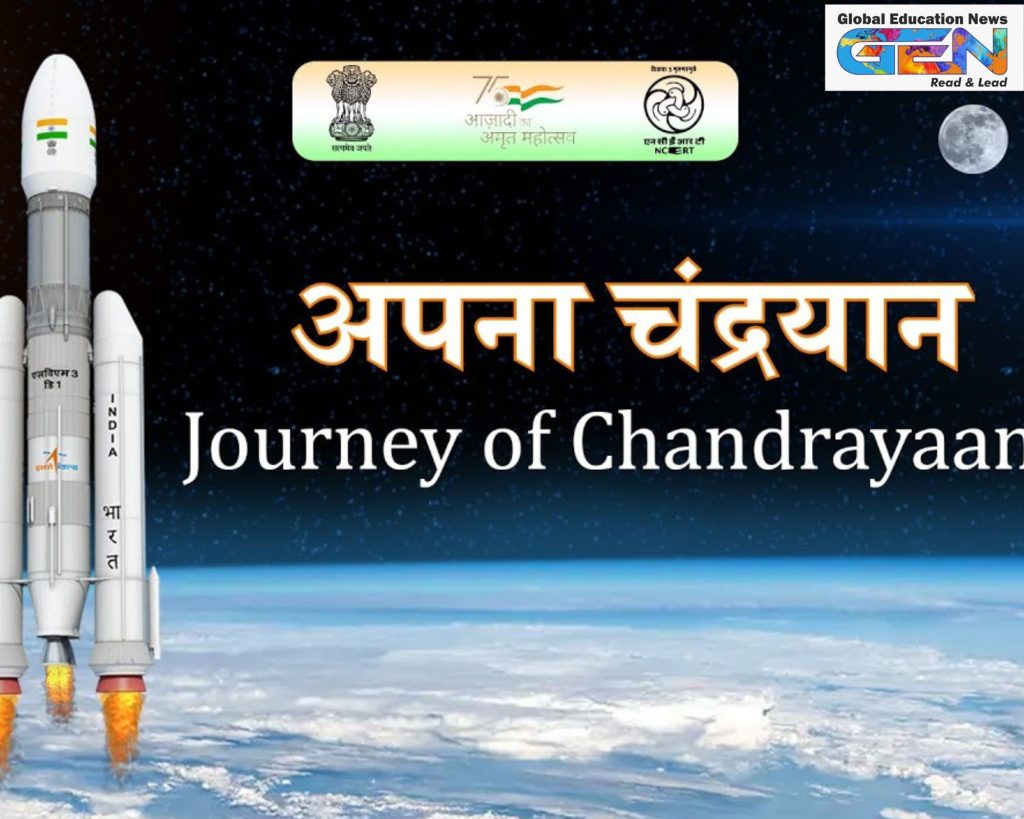
On August 24, 2025, the National Council of Educational Research and Training (NCERT) launched two special modules titled “India: A Rising Space Power” for middle-stage (Classes 6–8) and secondary-stage (Classes 9–12) students. These modules, aligned with the National Education Policy (NEP) 2020, chronicle the evolution of India’s space program from the Indian National Committee for Space Research (INCOSPAR), established in 1962 under Vikram Sarabhai, to the Indian Space Research Organisation (ISRO), now a global leader among spacefaring nations. The modules aim to inspire over 25 crore students with India’s scientific achievements.
Key Points:
- Two modules for middle and secondary students.
- Highlights INCOSPAR to ISRO transformation.
- Impacts 25 crore students under NEP 2020.
From Bicycles to Lunar Landings
The modules vividly describe India’s early space efforts, noting that in the 1960s, the first rocket components were transported on bicycles and bullock carts to avoid electromagnetic interference from motorized vehicles, which could disrupt delicate equipment. This ingenuity at Thumba Equatorial Rocket Launching Station laid the foundation for ISRO’s success. Key milestones include:
- Chandrayaan-1 (2008): Discovered water molecules on the Moon.
- Mangalyaan (2013): Made India the first Asian nation to reach Mars and the first globally to succeed on its maiden attempt.
- Chandrayaan-2 (2019): Its orbiter continues to provide critical lunar data.
- Aditya-L1 (2023): India’s first solar observatory at Lagrange Point-1, studying the Sun’s outer atmosphere and solar storms.
- Chandrayaan-3 (2023): Achieved India’s first soft lunar landing, celebrated on National Space Day.
Key Points:
- Bicycles and bullock carts used for early rocket transport.
- Chandrayaan-1, Mangalyaan, and Aditya-L1 among landmark missions.
- Chandrayaan-3 marked by National Space Day.
Honoring India’s Astronauts
The modules pay tribute to India’s astronauts:
- Squadron Leader Rakesh Sharma: First Indian in space in 1984, aboard a Soviet mission.
- Group Captain Shubhanshu Shukla: First Indian to stay at the International Space Station in June 2025, marking a milestone in India’s human spaceflight program.
A quote from Prime Minister Narendra Modi emphasizes the relevance of space technology: “Space may seem distant, but is an integral part of our daily life. It drives our modern communication and connects even the remotest family to the ordinary. India’s space programme is a perfect example of our vision of Scale, Speed and Skill.”
Key Points:
- Honors Rakesh Sharma (1984) and Shubhanshu Shukla (2025).
- PM Modi’s quote highlights space’s role in daily life.
- Showcases India’s human spaceflight milestones.
Future Horizons: NISAR and Beyond
The modules highlight the upcoming NASA-ISRO Synthetic Aperture Radar (NISAR) satellite, set to launch in March 2026. NISAR will provide high-resolution data on Earth’s ecosystems, ice cover, and natural disasters, surveying the planet every 12 days. This collaboration underscores India’s growing role in global space research, complementing ISRO’s Bharatiya Antariksh Station (BAS) plans for 2028–2035 and the Gaganyaan mission in December 2025.
Key Points:
- NISAR to launch in March 2026 for Earth monitoring.
- Supports ecosystems and disaster management data.
- Aligns with BAS and Gaganyaan missions.
Context and Educational Impact
The modules align with NEP 2020’s emphasis on experiential learning and STEM education, complementing initiatives like the UGC’s draft curriculum (introducing Kala Ganpana and Bharatiya Bijganit) and CBSE’s new regional offices for enhanced governance. They aim to inspire students to pursue STEM careers, with ISRO’s achievements like Chandrayaan-3 and Aditya-L1 showcasing India’s contributions to the $1 trillion global space economy. Challenges, such as infrastructure gaps (e.g., Rajasthan’s 86,934 unsafe classrooms) and 45% rural internet penetration, may limit access, but NCERT’s KATBOOK digital platform could bridge this gap.
Key Points:
- Supports NEP 2020 for STEM and experiential learning.
- Complements UGC curriculum and CBSE expansion.
- Faces infrastructure and digital access challenges.