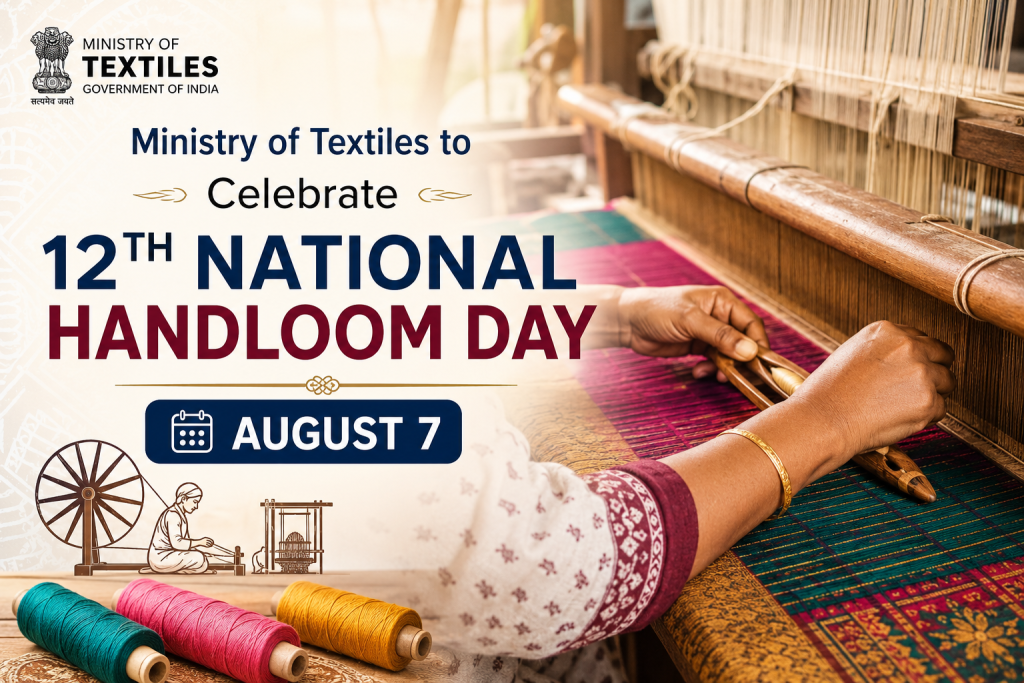
Every year on August 7, India celebrates National Handloom Day to honour the country’s centuries-old weaving traditions and recognise the invaluable contribution of millions of handloom weavers and artisans. The observance commemorates the Swadeshi Movement of 1905, which encouraged the use of indigenous products and became a defining moment in India’s journey towards self-reliance.
The 2026 edition, themed through the government’s message “Celebrating Weavers, Renewing Traditions, Expanding Horizons,” reflects a sector that is preserving its cultural roots while embracing design innovation, digital commerce, sustainable fashion, and international markets.
Today, India’s handloom industry is not merely a traditional craft—it is an important source of rural employment, women-led entrepreneurship, cultural identity, and sustainable economic growth.
————————————————–
Why National Handloom Day is Celebrated
National Handloom Day was instituted by the Government of India in 2015 to commemorate the launch of the Swadeshi Movement on August 7, 1905.
The day serves multiple objectives:
- Honouring India’s weaving community.
- Preserving centuries-old textile traditions.
- Promoting indigenous products.
- Supporting sustainable livelihoods.
- Encouraging consumers to choose handloom products.
- Strengthening the vision of Vocal for Local and Atmanirbhar Bharat.
————————————————–
India’s Handloom Legacy: A Living Cultural Heritage
India possesses one of the world’s oldest and most diverse weaving traditions. Archaeological evidence traces textile production back to the Indus Valley Civilisation, while references to spinning and weaving appear in ancient Indian literature including the Rigveda, Ramayana, and Mahabharata.
Every region of India has developed unique weaving techniques and distinctive textiles, such as:
- Banarasi Silk
- Kanchipuram Silk
- Pochampally Ikat
- Chanderi
- Maheshwari
- Muga Silk
- Jamdani
- Patola
- Sambalpuri
- Kota Doria
- Bhagalpuri Silk
- Paithani
These handwoven textiles represent not only artistic excellence but also the cultural identity of their regions.
————————————————–
Over 35 Lakh Weavers Keep India’s Tradition Alive
According to official data, India’s handloom sector supports 35.22 lakh weavers and allied workers, with over 72% being women. This makes handloom one of the country’s largest cottage industries and a vital source of employment in rural and semi-urban areas.
The sector contributes significantly by:
- Generating rural employment.
- Preserving traditional skills.
- Empowering women artisans.
- Supporting small-scale entrepreneurship.
- Promoting inclusive economic development.
————————————————–
Government Initiatives Strengthening the Handloom Sector
Over the years, several initiatives have been introduced to modernise the handloom industry while protecting its traditional character.
National Handloom Development Programme (NHDP)
Supports infrastructure development, skill upgradation, design innovation and market access for weavers.
India Handloom Brand
Promotes authentic, high-quality handloom products through quality certification.
Handloom Mark
Ensures that consumers receive genuine handwoven products and protects artisans against imitation goods.
Raw Material Supply Scheme
Provides quality yarn and raw materials to weavers at affordable prices.
Marketing and Digital Promotion
The government is expanding participation in:
- National exhibitions
- International trade fairs
- E-commerce platforms
- Digital marketplaces
- Export promotion initiatives
These measures are helping artisans access wider domestic and global markets.
————————————————–
Handlooms in the Digital Era
Traditional weaving is increasingly being complemented by modern technology.
Today, artisans are leveraging:
- Online marketplaces.
- Social media marketing.
- Digital payments.
- Designer collaborations.
- Virtual exhibitions.
- Global e-commerce platforms.
Digital transformation has enabled weavers to reach customers far beyond their local markets while preserving the authenticity of handcrafted products.
————————————————–
Sustainability Makes Handlooms More Relevant Than Ever
As consumers become more environmentally conscious, handloom textiles are gaining renewed popularity.
Handloom production offers several sustainability advantages:
- Low carbon footprint.
- Minimal electricity consumption.
- Eco-friendly production processes.
- Use of natural fibres.
- Reduced industrial pollution.
- Support for slow and ethical fashion.
Unlike mass-produced textiles, handwoven fabrics combine craftsmanship with environmental responsibility, making them increasingly attractive to global consumers.
————————————————–
National Handloom Awards Celebrate Excellence
As part of the 12th National Handloom Day celebrations, the President of India presented the Sant Kabir Handloom Awards and National Handloom Awards 2025 to outstanding weavers and master artisans. These honours recognise exceptional craftsmanship, innovation and lifelong contributions to India’s handloom sector.
————————————————–
Challenges Facing the Handloom Industry
Despite its rich legacy, the sector continues to face several challenges:
- Competition from power looms and machine-made textiles.
- Rising raw material costs.
- Limited access to finance.
- Marketing constraints.
- Imitation products.
- Changing consumer preferences.
- Need for greater digital literacy.
Addressing these issues remains essential for ensuring the long-term sustainability of India’s weaving communities.
————————————————–
Why Supporting Handlooms Matters
Choosing handloom products creates benefits that extend beyond fashion.
Every purchase helps:
- Preserve traditional craftsmanship.
- Generate rural employment.
- Empower women weavers.
- Protect India’s cultural heritage.
- Encourage sustainable consumption.
- Strengthen local economies.
By supporting handloom artisans, consumers become active participants in preserving one of India’s most treasured cultural traditions.