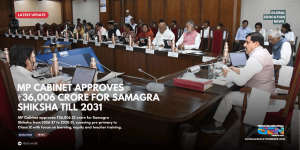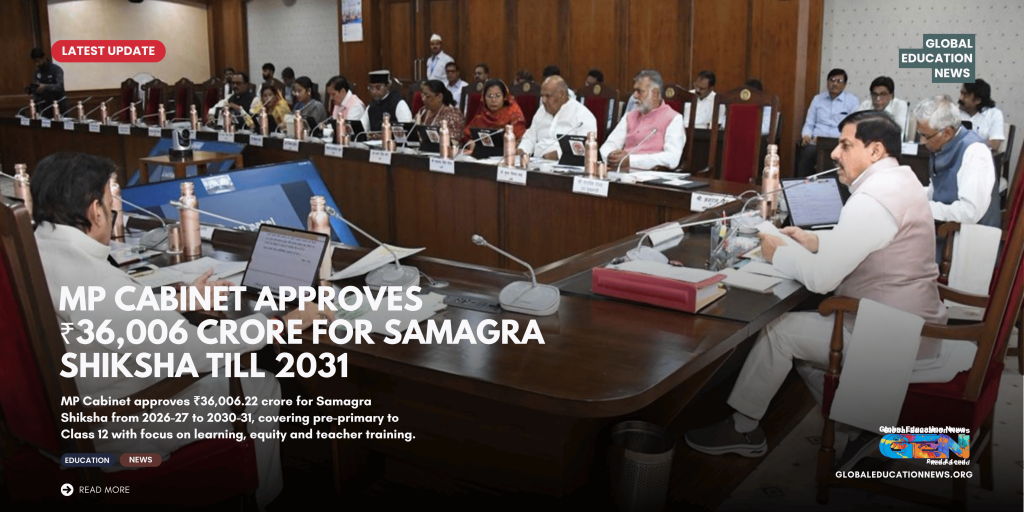
Madhya Pradesh — Madhya Pradesh has cleared a ₹36,006.22-crore education package for the continuation of the Samagra Shiksha programme from 2026-27 to 2030-31, extending one of the state’s central school-education programmes for another five years.
The decision was taken at a Cabinet meeting chaired by Chief Minister Mohan Yadav on September 15, where the state government approved proposals worth more than ₹42,490 crore across education, transport, irrigation, horticulture and welfare sectors.
For schools, the significance of the decision lies not only in the size of the allocation but in the breadth of the programme. Samagra Shiksha covers children from the pre-primary stage through Class 12 and is intended to address access, learning quality, equity, inclusion, vocational education and teacher preparation.
₹36,006 Crore Samagra Shiksha Plan Covers 2026-27 to 2030-31
The Cabinet has approved ₹36,006.22 crore for the continuation of the Centre-sponsored Samagra Shiksha scheme for five financial years, beginning 2026-27 and running through 2030-31.
The programme covers students in the 4-to-18 age group, bringing early education, school education and higher secondary education under a common framework.
Its stated objectives include:
- Improving the quality of school education
- Raising student learning outcomes
- Expanding equitable access to education
- Reducing social and gender disparities
- Strengthening inclusion at different stages of schooling
- Promoting vocational education alongside academic learning
- Supporting implementation of the Right to Education Act, 2009
- Strengthening teacher education and training institutions
The five-year approval effectively gives Madhya Pradesh a longer planning horizon for these interventions instead of treating school education initiatives as isolated annual programmes.
What the Samagra Shiksha Funding Means for MP Schools
The programme reaches much further than classroom construction or school infrastructure.
Its framework includes efforts to improve learning outcomes, expand access and make the school system more responsive to children from different social and economic backgrounds.
For younger students, the pre-primary component brings early learning into the broader school-education framework. At the other end of the spectrum, the programme extends through Class 12, linking foundational schooling with secondary and higher-secondary education.
That continuity matters because education gaps rarely begin in a single academic year. They accumulate.
A child who struggles with foundational learning in the early grades can face increasingly difficult barriers later. The programme’s emphasis on learning outcomes therefore places academic achievement alongside access as a central objective.
Teacher Training Gets a Key Role
A significant part of the programme’s architecture concerns the people who deliver education every day: teachers.
The Cabinet decision includes strengthening institutions such as SCERT, State Institutes of Education and District Institutes of Education and Training (DIETs) as nodal agencies for teacher training.
That focus is important because additional infrastructure alone cannot guarantee better classroom outcomes.
Teacher preparation, professional development and institutional support determine how effectively curriculum reforms and new teaching methods reach students.
The emphasis also aligns the programme with the broader objective of improving the quality of school education rather than measuring progress only by enrolment.
Vocational Education Included Alongside Schooling
Another feature of the five-year plan is its emphasis on vocational education.
The Samagra Shiksha framework seeks to bring vocational learning alongside mainstream school education, giving students exposure to skills and career-oriented learning before they leave the school system.
This approach broadens the definition of school success. Academic progression remains central, but students can also gain exposure to practical skills that may connect classroom learning with future employment or further training.
For Madhya Pradesh, the challenge will be translating that policy objective into meaningful programmes across schools rather than limiting vocational education to a formal curriculum component.
Equity and Inclusion at the Centre of the Programme
The Cabinet’s approval also puts equity and inclusion among the core objectives of the Samagra Shiksha programme.
The scheme aims to reduce social and gender disparities and ensure that students have access to minimum educational provisions regardless of their background.
That makes the programme relevant beyond government schools’ financial requirements. It is also intended to address differences in educational opportunity.
For families, the practical impact will ultimately depend on how effectively the funding translates into functioning schools, trained teachers, improved learning environments and sustained support for students who face barriers to education.
MP Cabinet Clears More Than ₹42,490 Crore in Proposals
The Samagra Shiksha allocation was the largest education-related decision within a broader package exceeding ₹42,490 crore approved by the Madhya Pradesh Cabinet.
The Cabinet also sanctioned:
- ₹1,166.60 crore for continuation of 11 Transport Department schemes through 2030-31.
- ₹491 crore for eight horticulture and food-processing schemes.
- More than ₹2,607 crore for three irrigation projects in Ujjain, Singrauli and Ashoknagar.
- ₹2,220.62 crore as an interest-free loan to MARKFED for repayment of an outstanding foodgrain credit-limit loan.
The education allocation, however, stands out because of its direct reach into the state’s school system and its coverage across the full pre-primary-to-Class-12 spectrum.
The Real Test Begins After the Budget Approval
A five-year allocation of this scale gives Madhya Pradesh substantial financial space to pursue its school-education objectives. But the size of the approval is only the first measure of its impact.
The more consequential questions will emerge inside classrooms: whether teacher training improves instruction, whether learning outcomes rise, whether disadvantaged students receive sustained support and whether vocational education becomes a meaningful part of schooling.
The ₹36,006.22-crore Samagra Shiksha approval gives the state a five-year window to pursue those goals.
For millions of children moving through Madhya Pradesh’s schools during that period, the success of the programme will ultimately be measured not in the Cabinet’s balance sheet, but in what changes at school level — from the quality of teaching to the opportunities available after Class 12.