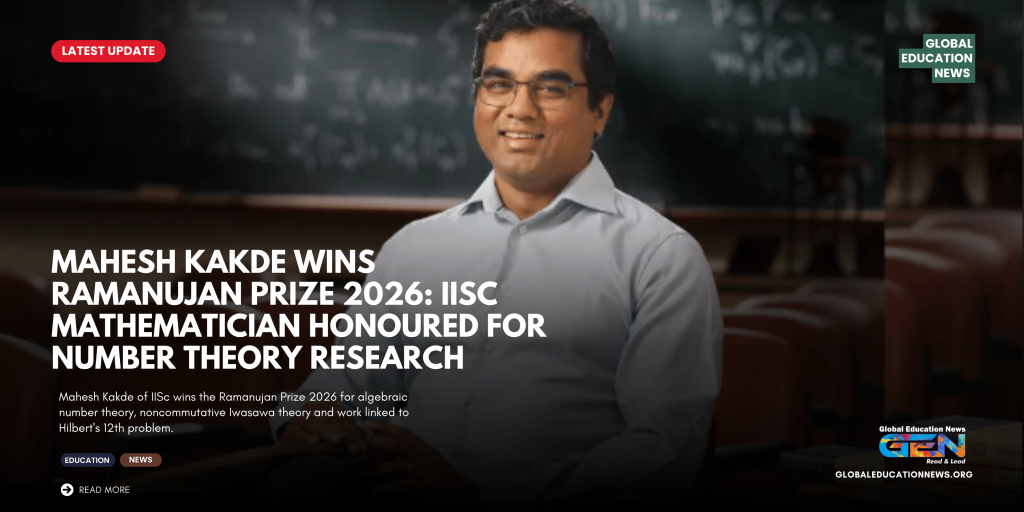
October 8, 2026 | Bengaluru | Education News: Indian mathematician and Indian Institute of Science (IISc) professor Mahesh Kakde has won the 2026 Ramanujan Prize for Young Mathematicians from Developing Countries for his significant contributions to algebraic number theory. His work in noncommutative Iwasawa theory and the Gross-Stark and Brumer-Stark conjectures has earned international recognition, with implications for one of David Hilbert’s famous mathematical problems.
The prize is jointly administered by the Abdus Salam International Centre for Theoretical Physics (ICTP) and the International Mathematical Union (IMU). The 2026 award was officially announced by ICTP on September 30, while IISc highlighted Kakde’s achievement on October 7.
Who is Mahesh Kakde?
Mahesh Kakde is a professor in the Department of Mathematics at IISc Bengaluru whose research focuses primarily on algebraic number theory.
He completed his Bachelor of Mathematics at the Indian Statistical Institute in Bengaluru and later pursued a Master of Mathematics and PhD in pure mathematics at the University of Cambridge. He completed his doctoral degree in 2008.
Following his PhD, Kakde worked as a mathematics instructor at Princeton University and later held research and academic positions at University College London and King’s College London. He joined IISc as a professor in 2019.
Why did Mahesh Kakde win the Ramanujan Prize 2026?
The 2026 Ramanujan Prize recognises Kakde’s fundamental results in noncommutative Iwasawa theory and his work on the Gross-Stark and Brumer-Stark conjectures.
These areas belong to advanced number theory and investigate deep relationships between numbers, algebraic structures and mathematical fields.
Kakde’s research is significant because it addresses difficult questions about how arithmetic properties behave within increasingly complex mathematical structures. His work also has implications for Hilbert’s 12th problem, one of the 23 famous problems identified by German mathematician David Hilbert in 1900.
What is algebraic number theory?
Algebraic number theory combines number theory with concepts from abstract algebra to study integers and their generalisations.
Instead of examining numbers only through elementary arithmetic, researchers use structures such as fields and groups to investigate deeper properties and relationships.
Kakde’s research lies at the advanced end of this field, particularly in areas involving Iwasawa theory and major conjectures concerning arithmetic structures.
What is the Ramanujan Prize?
The Ramanujan Prize for Young Mathematicians from Developing Countries has been awarded annually since 2005.
It is jointly administered by ICTP and IMU and recognises researchers from developing countries who have made outstanding contributions to mathematical sciences while working under challenging circumstances.
A recipient must be under 45 years of age on December 31 of the award year. The prize carries a US$10,000 cash award.
The award is named after Indian mathematical legend Srinivasa Ramanujan, whose extraordinary contributions to number theory continue to influence mathematics worldwide.
Ramanujan Prize 2026: Key facts
| Detail | Information |
|---|---|
| Award | Ramanujan Prize 2026 |
| Winner | Prof. Mahesh Kakde |
| Institution | Indian Institute of Science, Bengaluru |
| Field | Algebraic number theory |
| Recognised research | Noncommutative Iwasawa theory; Gross-Stark and Brumer-Stark conjectures |
| Major implication | Hilbert’s 12th problem |
| Awarding bodies | ICTP and IMU |
| Prize amount | US$10,000 |
| Award announcement | September 30, 2026 |
| IISc announcement | October 7, 2026 |
Source: ICTP and IISc.
How does Kakde’s research connect to Hilbert’s 12th problem?
Hilbert’s 12th problem is one of the landmark problems presented by David Hilbert in 1900. It concerns the possibility of explicitly describing certain mathematical fields and their special numbers using appropriate analytic and algebraic structures.
Kakde’s research on the Gross-Stark and Brumer-Stark conjectures has implications for this broader mathematical landscape. The connection demonstrates why his work is considered significant beyond a single specialised area of number theory.
Mahesh Kakde’s academic achievements
The Ramanujan Prize adds to a growing list of national and international recognition for Kakde.
He received the Infosys Prize in Mathematical Sciences in 2022 and was an invited speaker at the International Congress of Mathematicians, alongside mathematician Samit Dasgupta.
In 2023, he was also named to the Asian Scientist 100 list recognising leading researchers, academics and innovators across Asia.
Why Mahesh Kakde’s Ramanujan Prize matters for Indian mathematics
Kakde’s recognition puts advanced mathematical research being conducted in India in the international spotlight.
For students and young researchers, the award also highlights the importance of fundamental research in areas that may not have immediate commercial applications but can shape mathematics for decades.
The achievement is particularly significant for India’s research ecosystem because it comes from a scholar working at IISc while contributing to highly specialised areas of modern number theory.
Frequently Asked Questions
Who won the Ramanujan Prize 2026?
Professor Mahesh Kakde of the Indian Institute of Science, Bengaluru, won the 2026 Ramanujan Prize for his contributions to algebraic number theory.
What did Mahesh Kakde win the Ramanujan Prize for?
He was recognised for fundamental results in noncommutative Iwasawa theory and outstanding work on the Gross-Stark and Brumer-Stark conjectures.
How much money does the Ramanujan Prize carry?
The Ramanujan Prize carries a US$10,000 cash award.
Where does Mahesh Kakde work?
Mahesh Kakde is a professor at the Indian Institute of Science (IISc), Bengaluru. He joined IISc as a professor in 2019.
What is Mahesh Kakde’s area of research?
His primary field is algebraic number theory, with major research contributions in noncommutative Iwasawa theory and the Gross-Stark and Brumer-Stark conjectures.
What is the Ramanujan Prize?
The Ramanujan Prize is an annual international award for young mathematicians from developing countries who have made outstanding contributions to mathematical sciences. It has been awarded since 2005 and is jointly administered by ICTP and IMU.
Global Education News
Mahesh Kakde’s Ramanujan Prize 2026 is a notable recognition of India’s contribution to advanced mathematical research. His work demonstrates how fundamental research in number theory continues to produce internationally significant mathematical insights, while also highlighting the research strength of institutions such as IISc.
Global Education News will continue tracking major developments in Indian higher education, research, science and academic achievements.