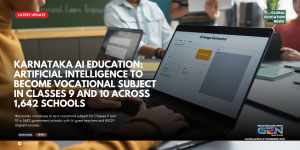
KARNATAKA — Artificial intelligence is moving from the technology sector into Karnataka’s government classrooms.
Starting with the 2026–27 academic year, Karnataka will offer Artificial Intelligence (AI) as a vocational subject for students in Classes 9 and 10 across 1,642 government high schools. The programme, being implemented through Samagra Shikshana Karnataka (SSK), is aligned with the National Skills Qualifications Framework (NSQF) and is designed to expose secondary-school students to emerging technology and workplace-oriented skills.
Under the arrangement, students can choose the AI skill subject in place of the existing third-language option under the state’s applicable vocational education framework. The decision places AI education, employability and future-ready skills at the centre of a significant curriculum change in Karnataka’s government schools.
The move also opens a new question for the education system: how should schools balance emerging technological skills with established academic and language education?
Karnataka AI education rollout covers 1,642 government schools
The scale of the programme is one of its most notable features.
The 1,642 government high schools covered by the initiative comprise three groups:
- 1,180 newly approved government high schools
- 381 schools already covered under NSQF
- 81 existing single-sector schools
In the 81 single-sector schools, vocational subjects including Beauty and Wellness, Retail and Apparel are being replaced by AI under the new arrangement.
The programme received approval from the Project Approval Board and is being implemented through Samagra Shikshana Karnataka.
For students, the change means that artificial intelligence is no longer being treated solely as an advanced subject associated with engineering colleges or specialised technology courses. It is being introduced as part of vocational learning at the secondary-school stage.
AI subject aims to build 21st-century skills
The government’s stated objective goes beyond teaching students about a particular technology.
The AI vocational programme is intended to develop problem-solving, critical thinking, technical knowledge and employability skills.
That distinction matters.
Artificial intelligence is evolving rapidly, and the skills students need may change long before they enter the workforce. A school-level course therefore has the potential to introduce students to the concepts and ways of thinking behind emerging technologies rather than simply training them for one specific job.
The NSQF framework also gives the programme a vocational orientation, connecting school education with skills that can potentially be developed further at later stages of education.
AI learning can continue beyond Class 10
Officials have indicated that students who pursue the NSQF-aligned AI course can continue with AI-related skill education at the Pre-University level.
That creates a possible progression from secondary-school exposure to more specialised skill development instead of treating the Class 9–10 course as an isolated experiment.
For students interested in computing, technology and emerging digital careers, such continuity could make the vocational option more meaningful.
Karnataka to appoint AI guest teachers in participating schools
Introducing AI into 1,642 schools also requires a new teaching workforce.
SSK has directed participating schools to appoint one AI guest teacher for the 2026–27 academic year. The reported monthly honorarium is ₹20,000. Recruitment is to be overseen by a selection committee headed by the School Development and Monitoring Committee (SDMC).
The eligibility requirements are aimed at candidates with a technology background. Qualifications include degrees or diplomas in areas such as Computer Applications, Computer Science and Information Technology, along with relevant experience requirements. Candidates are also expected to have proficiency in the local language and English.
The staffing model reflects the practical challenge of introducing a specialised subject quickly: schools need teachers who can bring technical knowledge into classrooms without waiting for a completely new permanent cadre to be created.
Third-language option becomes a key point of debate
The introduction of AI has also triggered discussion because of its relationship with the third-language option.
Under the existing NSQF framework, students can take a vocational subject instead of a third language in the relevant classes. The Karnataka government’s latest move therefore gives students in participating schools an additional choice between a language route and a skill-based AI option.
The Karnataka State High School Hindi Teachers’ Association has opposed the move, calling for the existing three-language approach to be retained and raising concerns about teacher redeployment.
The government, however, has said that the AI programme is being introduced as an NSQF-aligned vocational or skill subject, rather than as a blanket removal of language education.
Officials have also said concerns over transferring existing teachers were addressed, with assurances that teachers would not be transferred as part of the AI rollout.
What the Karnataka AI move means for government-school students
The significance of the programme extends beyond the 1,642 schools listed for the first rollout.
For years, discussions about AI in education have often focused on universities, engineering institutions and private schools. Karnataka’s initiative brings the conversation much closer to the secondary-school classroom.
A student entering Class 9 could now encounter AI not simply as a topic mentioned in a computer lesson, but as a structured vocational subject connected to a national skills framework.
That shift reflects a broader change in how education systems are responding to the technology economy.
From digital literacy to AI literacy
Basic digital literacy is increasingly becoming a foundation rather than an endpoint. Schools are now confronting a more complicated question: how early should students begin understanding artificial intelligence, and what should that education actually include?
Karnataka’s approach answers the first question decisively by bringing AI into Classes 9 and 10.
The quality of implementation will depend on what happens inside the classroom — the curriculum, teacher preparation, practical learning opportunities and the ability of schools to make AI accessible to students with different levels of prior exposure to technology.
The presence of an AI course alone cannot guarantee those outcomes.
Karnataka’s AI school programme arrives as AI education expands
Karnataka’s move comes as AI education is also becoming more visible elsewhere in India’s school system.
The CBSE 2026–27 secondary curriculum, for example, includes Computational Thinking and AI modules at the secondary level, reflecting the broader national movement towards introducing emerging technology concepts earlier in schooling.
Karnataka’s initiative differs in its vocational framing and its scale within the government-school system. Rather than limiting AI to an optional technology topic, the state is positioning it within the NSQF-based skill education structure.
That makes the programme both an education reform and a test of how vocational learning can adapt to rapidly changing technology.
A new test for AI education in Karnataka
The decision to introduce AI across 1,642 government high schools is ambitious in scale. But its real impact will ultimately be measured inside classrooms.
Students will need more than exposure to the phrase “artificial intelligence”. They will need teachers who can explain complex concepts clearly, practical learning that connects technology to everyday problems, and an educational structure that allows them to build skills progressively.
For Karnataka, the 2026–27 academic year will therefore be an important test of whether AI can become a meaningful part of vocational education — and whether government schools can give students an early, structured pathway into one of the fastest-changing areas of the modern economy.