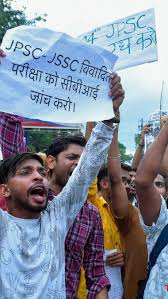
The standoff between the Jharkhand government and protesting students over alleged irregularities in recruitment examinations continued on Saturday, August 8, after a second round of talks ended without a concrete resolution.
The latest meeting, held between government representatives and a delegation of protesting students in Ranchi, saw both sides reiterate their positions. While the government maintained that it was willing to consider the concerns raised by aspirants and work towards greater transparency in recruitment examinations, the protesting students remained firm on their demand for concrete action.
The government has now opened an email-based feedback mechanism, inviting students, aspirants and other stakeholders to send suggestions on examination reforms.
The development comes as the student agitation enters its 15th day, keeping the controversy surrounding the JPSC-JSSC recruitment examinations firmly in the spotlight.
Second Round of Talks Ends Without a Breakthrough
The second round of discussions took place at the State Guest House in Morabadi, Ranchi.
An eight-member delegation associated with the JPSC-JSSC Abhyarthi Nyay Manch met four ministers representing the state government. The delegation raised demands concerning the recruitment examination process, including concerns related to the JPSC and JSSC examinations as well as teacher recruitment examinations.
The government side included ministers Sudivya Kumar Sonu, Chamra Linda, Deepika Singh Pandey and Sanjay Yadav.
Although the students said their concerns had been heard, no final decision was announced after the meeting.
The students indicated that they would wait for the government to communicate its position before deciding whether to withdraw their ongoing agitation.
Government Opens Email Channel for Student Suggestions
One of the key developments after Saturday’s meeting was the government’s decision to seek wider feedback from students and examination aspirants.
Minister Sudivya Kumar Sonu appealed to students and candidates to submit their suggestions and concerns through the dedicated email address jpsc.jssc.feedback@gmail.com. The government said the feedback could be considered while developing a broader policy for examination reforms.
The move indicates that the government is attempting to broaden the consultation beyond the organisations currently leading the protest.
According to the government’s position, discussions will not be restricted to one student organisation and other groups and stakeholders may also be brought into the dialogue process.
What the feedback initiative could mean
The email-based consultation could allow aspirants to raise concerns relating to:
- Recruitment examination transparency
- Examination administration
- Alleged irregularities
- Question-paper security
- Conduct of examinations
- Recruitment timelines
- Grievance redressal
- Proposed reforms to the JPSC-JSSC system
However, the effectiveness of the initiative will depend on whether student representatives consider the government’s response sufficiently concrete.
Students Continue to Demand Concrete Action
For the protesting students, the central issue remains unresolved.
Student representatives said that their demands had been presented before the government and that the matters would now be taken up with Chief Minister Hemant Soren.
They have maintained that the agitation will continue until a concrete decision is taken. The students have also indicated that they are not prepared to call off the movement merely on the basis of discussions or assurances.
This position has kept the possibility of further demonstrations alive.
August 10 Assembly Protest Remains a Key Flashpoint
The continuing deadlock has also heightened attention around the protesters’ proposed Assembly gherao on August 10.
The students have maintained their intention to proceed with the programme unless their demands are addressed.
With the second round of talks also failing to produce an immediate agreement, the planned protest could become an important test of whether further negotiations can prevent the agitation from escalating.
How the Jharkhand Recruitment Exam Row Reached This Point
The current protest has developed around allegations of irregularities in recruitment examinations conducted through the state’s recruitment system, including examinations associated with JPSC and JSSC.
The agitation has brought together competitive-exam aspirants demanding greater transparency, accountability and reforms in the recruitment process.
Before the latest round of talks, the government had already opened a dialogue with representatives of protesting students.
The first formal round of discussions on Friday also ended without a final settlement, making Saturday’s second meeting another attempt to break the deadlock.
The government has also pointed to investigative action already initiated over the alleged irregularities, including a CID probe and arrests, while insisting that it is committed to addressing concerns regarding the examination system.
Why JPSC-JSSC Examination Reforms Matter to Aspirants
Recruitment examinations are particularly sensitive because thousands of candidates invest years preparing for government jobs.
Any allegation of an examination irregularity can therefore affect more than a single test. It can create uncertainty over:
- Whether an examination result can be trusted
- Whether candidates have received equal opportunities
- How quickly recruitment will be completed
- Whether examinations will be cancelled or repeated
- How grievances will be investigated
- What safeguards will be introduced in future examinations
For aspirants, predictability and transparency are as important as the examination itself.
A credible recruitment system requires clear procedures, secure examination mechanisms, timely investigations and transparent communication with candidates.
Government’s Challenge: From Dialogue to Action
The latest development puts the Jharkhand government in a difficult position.
Opening a feedback channel allows the administration to gather views from a wider group of students and stakeholders. However, the continuing protest suggests that many aspirants are seeking decisions on specific demands rather than consultation alone.
This creates a crucial distinction between dialogue and resolution.
The government has demonstrated its willingness to engage with student representatives. The next challenge will be converting those discussions into clearly communicated decisions and, where appropriate, institutional reforms.
Students’ Challenge: Maintaining the Movement While Negotiations Continue
The protesting students also face a difficult choice.
On one hand, continued agitation keeps pressure on the government and highlights their demands. On the other, negotiations offer an opportunity to seek solutions through formal dialogue.
The second round of talks indicates that both sides remain engaged, but the absence of a settlement means the protest is unlikely to disappear immediately.
The coming days could therefore determine whether the government-student dialogue develops into a structured negotiation or whether the agitation intensifies further.
What Happens Next?
The immediate focus is likely to remain on three developments:
1. Government’s response to student demands
Students are waiting for the government to communicate what action it proposes on the issues raised during the talks.
2. Feedback from aspirants and stakeholders
The newly opened email channel could generate a wider pool of suggestions on JPSC-JSSC examination reforms and recruitment procedures.
3. August 10 protest programme
The proposed Assembly gherao remains a major point of attention as the student movement enters its third week.