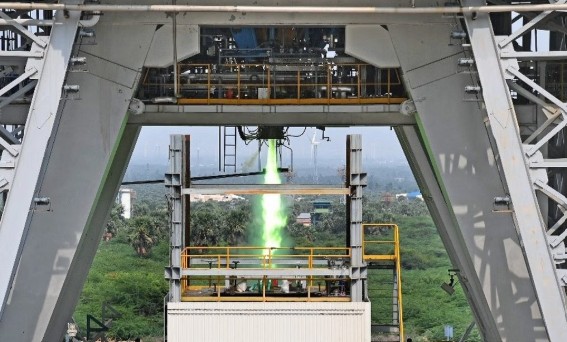
The Indian Space Research Organisation (ISRO) has successfully completed a crucial hot test of its Semi-Cryogenic Engine Power Head Test Article (PHTA), bringing the country significantly closer to deploying a more powerful launch vehicle for future space missions.
Conducted on 24 June 2026 at the ISRO Propulsion Complex (IPRC) in Mahendragiri, Tamil Nadu, the test achieved a thrust level of 175 tonnes, approximately 88% of the engine’s rated capacity. It was the eighth hot test in the ongoing development programme and represents one of the most important milestones in India’s efforts to build advanced indigenous rocket propulsion systems. The successful test demonstrated stable engine performance at higher thrust levels and moved the programme closer to full-capacity operation.
What Was Tested?
The latest trial focused on the Power Head Test Article (PHTA)—a critical subsystem of the semi-cryogenic engine that includes nearly all engine components except the thrust chamber.
During the hot test, engineers evaluated:
• Engine ignition sequence
Ensuring smooth and reliable start-up after pre-burner ignition.
• Stable high-thrust operation
The engine maintained steady performance at 175 tonnes of thrust without abnormal fluctuations.
• Turbopump performance
The test confirmed stable operation of the main turbopumps, delivering outlet pressures of approximately 400 and 500 bar, essential for efficient fuel delivery.
• System reliability
All critical parameters remained within expected limits, providing confidence for the upcoming full-thrust demonstration.
Understanding Semi-Cryogenic Rocket Engines
Rocket propulsion systems are generally classified according to the propellants they use.
A semi-cryogenic engine combines:
- Liquid Oxygen (LOX) as the oxidizer.
- Refined Kerosene (Isrosene/RP-1 class fuel) as the fuel.
Unlike traditional cryogenic engines that use liquid hydrogen, semi-cryogenic propulsion offers higher fuel density, easier handling, lower costs, and improved operational efficiency while still delivering high performance.
Why is This Engine Important?
The engine being developed—known as the SE2000—will power the new SC120 Semi-Cryogenic Propulsion Stage.
This stage will replace the existing L110 liquid core stage of India’s Launch Vehicle Mark-3 (LVM3), the country’s heaviest operational launch vehicle.
The upgrade is expected to transform the capabilities of the rocket by allowing it to carry substantially heavier payloads into orbit.
How the New Engine Improves LVM3
| Current L110 Stage | New SC120 Stage |
|---|---|
| Existing liquid core stage | Semi-cryogenic propulsion stage |
| Lower payload capability | Significantly higher payload capacity |
| Conventional propulsion | High-efficiency semi-cryogenic propulsion |
| Older engine technology | Advanced SE2000 engine |
| Greater operational complexity | Improved efficiency and performance |
The enhancement will make India’s launch vehicles more competitive in the rapidly expanding global satellite launch market.
Advantages of Semi-Cryogenic Propulsion
Compared with conventional propulsion technologies, semi-cryogenic engines provide several important advantages.
Higher Payload Capacity
Greater thrust allows rockets to carry heavier satellites and scientific payloads.
Better Fuel Efficiency
The combination of liquid oxygen and kerosene provides excellent thrust while maintaining operational simplicity.
Lower Launch Costs
Denser fuel requires smaller tanks and simplifies vehicle design, reducing manufacturing and operational expenses.
Improved Reliability
Semi-cryogenic engines offer stable combustion and better long-term operational performance.
Environmentally Safer Operations
The use of cleaner, non-toxic propellants improves handling safety compared with some older propulsion systems.
Years of Progressive Development
The latest achievement is the outcome of several years of systematic testing.
ISRO has gradually increased the engine’s operating capability through multiple hot tests.
Development Timeline
- 2024: Successful ignition tests of the pre-burner system.
- 2025: Hot tests conducted at approximately 47% and 60% thrust levels.
- June 2026: First successful operation at 175 tonnes (88%) thrust.
- Next Phase: Full-capacity demonstration at 200 tonnes (100%) thrust.
Impact on India’s Future Space Missions
The successful development of the semi-cryogenic engine will support several strategic objectives.
Heavy Communication Satellites
India will be able to launch larger communication satellites using indigenous launch vehicles.
Deep Space Exploration
Future lunar, planetary and interplanetary missions will benefit from increased lifting capability.
Human Spaceflight Programme
More powerful launch systems will complement future human spaceflight and advanced exploration missions.
Commercial Launch Market
Higher payload capability will strengthen India’s competitiveness in the international commercial launch industry.
A Step Towards Complete Technological Self-Reliance
The semi-cryogenic engine represents one of India’s most ambitious indigenous propulsion programmes.
Developed largely with domestic expertise and technology, the project supports the nation’s long-term vision of reducing dependence on foreign propulsion systems while strengthening India’s leadership in advanced aerospace engineering.
The successful test also demonstrates the growing maturity of India’s rocket engine development ecosystem, from design and manufacturing to testing and validation.
Challenges Ahead
Despite the successful demonstration, several milestones remain before operational deployment.
These include:
- Full-thrust qualification testing.
- Integration with the SC120 propulsion stage.
- Flight qualification on LVM3.
- Extensive reliability verification.
- Mission certification for operational launches.
Each phase will ensure the engine meets the stringent safety and performance standards required for future launch missions.
The Road Ahead
With the latest hot test successfully completed, ISRO is preparing for the final stages of engine qualification. Once fully certified, the semi-cryogenic propulsion stage is expected to become a cornerstone of India’s next generation of launch vehicles.
Its integration with an upgraded cryogenic upper stage will significantly improve the LVM3’s payload capability, enabling more ambitious scientific missions, larger commercial satellite launches, and future deep-space exploration.