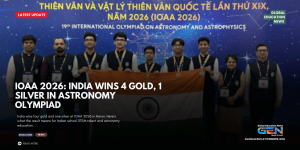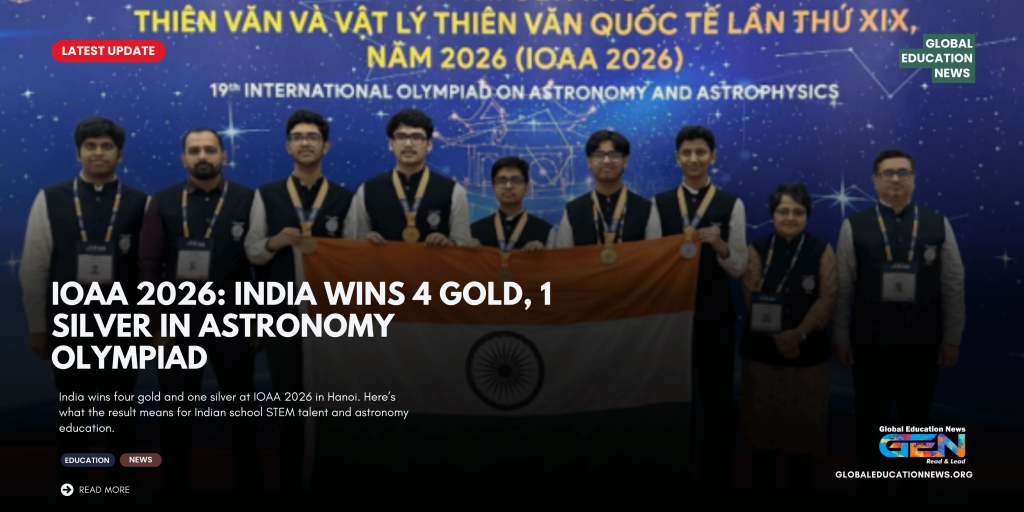
October 6, 2026 | Hanoi, Vietnam | Education News: India has delivered a standout performance at the International Olympiad on Astronomy and Astrophysics (IOAA) 2026, with its five-member school student team winning four gold medals and one silver medal in Hanoi, Vietnam.
The result gives India a near-perfect medal haul at one of the world’s leading international science competitions for school students and puts the spotlight on the country’s young talent in astronomy, astrophysics, mathematics and advanced scientific problem-solving.
The performance also adds another significant achievement to India’s record in international STEM Olympiads, where students compete against some of the strongest school-level science talent from around the world.
IOAA 2026: What Did India Achieve in Hanoi?
India’s five-member contingent secured four gold medals and one silver medal, meaning every member of the team returned with an individual medal.
| IOAA 2026 India Result | Achievement |
|---|---|
| Indian team size | 5 students |
| Gold medals | 4 |
| Silver medals | 1 |
| Total medals | 5 |
| Host city | Hanoi |
| Host country | Vietnam |
| Competition | International Olympiad on Astronomy and Astrophysics |
| Level | School students |
| Broad fields | Astronomy and astrophysics |
The result is particularly notable because the competition tests students well beyond conventional school examinations. Participants are expected to apply concepts from physics and mathematics to demanding astronomy and astrophysics problems.
What Is the International Olympiad on Astronomy and Astrophysics?
The International Olympiad on Astronomy and Astrophysics, commonly known as IOAA, is an international science competition for secondary-school students.
It brings together high-achieving students from participating countries to compete in astronomy and astrophysics. The competition tests both theoretical understanding and practical scientific skills.
IOAA problems can require students to combine:
- Physics
- Mathematics
- Astronomy
- Astrophysics
- Data interpretation
- Scientific observation
- Problem-solving
For school students, the Olympiad provides an international platform to demonstrate scientific reasoning beyond the standard classroom curriculum.
Why Is India’s Four-Gold Performance at IOAA 2026 Significant?
The biggest headline from Hanoi is the four-gold, one-silver result.
With five students in the Indian contingent, every team member secured a medal. Four students reached the gold-medal category, while the fifth won silver.
That makes the 2026 performance particularly significant for India’s school-level STEM ecosystem because astronomy and astrophysics require students to combine multiple disciplines rather than rely on memorisation alone.
The achievement also demonstrates the level of preparation required for students to compete internationally in advanced scientific subjects.
How Does IOAA Help Identify India’s Future STEM Talent?
International Olympiads can act as an early platform for identifying students with exceptional aptitude in scientific reasoning.
Students who perform strongly in astronomy and astrophysics competitions can potentially pursue higher education and research in fields such as:
- Astrophysics
- Astronomy
- Space science
- Physics
- Mathematics
- Cosmology
- Planetary science
- Aerospace and space technology
- Computational science
The value of such competitions therefore extends beyond medals. They can expose students to scientific problem-solving at an international level at an early stage of their academic journey.
What Does India’s IOAA 2026 Result Mean for School Students?
For Indian school students, the result provides a visible example of how specialised science competitions can become part of a broader academic pathway.
Astronomy is particularly interdisciplinary. Students need a strong foundation in physics and mathematics while also developing the ability to interpret unfamiliar scientific situations.
Preparation for Olympiad-level competitions can therefore encourage students to move beyond textbook exercises and develop deeper conceptual understanding.
The achievement may also encourage greater interest in STEM Olympiads, astronomy clubs, science competitions and research-oriented learning.
Why Are Astronomy Olympiads Important for India’s STEM Ecosystem?
India’s ambitions in space science, astronomy, advanced technology and scientific research require a long-term pipeline of skilled students.
School-level competitions such as IOAA can contribute to that pipeline by identifying students with strong aptitude before they enter university.
The pathway can broadly develop from:
School science → Olympiad training → Advanced STEM study → University research → Scientific careers
However, winning an Olympiad medal does not automatically determine a student’s future career. The larger benefit is the exposure to challenging scientific problems and international academic standards.
How Does the IOAA Result Strengthen India’s International STEM Profile?
The four-gold, one-silver result adds to India’s visibility in international academic competitions.
Success at global Olympiads provides evidence that Indian school students can compete at a high level in specialised scientific disciplines.
It also creates opportunities to highlight the importance of:
- Strong science foundations in schools
- Advanced mathematics and physics learning
- Mentoring and Olympiad preparation
- Scientific curiosity
- Research-oriented education
- International academic collaboration
For policymakers and educators, such achievements can also serve as a reminder that identifying talented students early is only the first step. Sustained mentoring and access to research opportunities are equally important.
What Can Students Learn From India’s IOAA 2026 Success?
The achievement offers several lessons for students interested in science.
Strong fundamentals matter
Advanced astronomy builds on concepts from physics and mathematics. A strong understanding of fundamentals is essential before attempting Olympiad-level problems.
Problem-solving is more important than memorisation
International science competitions often require students to apply familiar concepts to unfamiliar situations.
Interdisciplinary learning creates an advantage
Astronomy connects physics, mathematics, computation and observation. Students can benefit from learning across subject boundaries.
Competitions can open research pathways
Olympiad participation can introduce students to advanced scientific communities and motivate them to explore research-oriented higher education.
India at IOAA 2026: Key Facts
| Fact | Details |
|---|---|
| Event | IOAA 2026 |
| Indian contingent | Five students |
| Gold medals | Four |
| Silver medals | One |
| Total medals | Five |
| Location | Hanoi, Vietnam |
| Academic area | Astronomy and Astrophysics |
| Student level | School education |
| Significance | Major international STEM achievement |
IOAA 2026 FAQs
How many medals did India win at IOAA 2026?
India won five medals at IOAA 2026—four gold medals and one silver medal.
How many students were in India’s IOAA 2026 team?
India’s IOAA 2026 contingent consisted of five students.
Where was IOAA 2026 held?
The International Olympiad on Astronomy and Astrophysics 2026 was held in Hanoi, Vietnam.
What is IOAA?
IOAA stands for the International Olympiad on Astronomy and Astrophysics, an international academic competition for school students focused on astronomy and astrophysics.
What subjects are useful for IOAA preparation?
Students preparing for advanced astronomy competitions generally need strong foundations in physics and mathematics, along with astronomy concepts, analytical reasoning and scientific problem-solving.
Why is India’s IOAA 2026 result important?
The result highlights the strength of India’s school-level astronomy and STEM talent, with all five members of the Indian team winning medals and four securing gold.
Can IOAA help students pursue astronomy careers?
Participation can provide valuable exposure to advanced astronomy and scientific problem-solving. Students interested in the field can subsequently pursue higher education in astronomy, astrophysics, physics, space science and related disciplines.
India’s Four Golds Put School STEM Talent in the Spotlight
India’s four gold and one silver medal haul at IOAA 2026 is more than a medal tally. It highlights the ability of Indian school students to compete in a demanding international scientific discipline and brings renewed attention to astronomy as a pathway into advanced STEM education and research.
The next challenge is to build on such achievements by giving talented students sustained access to mentors, laboratories, research opportunities and international scientific exposure.
For India’s education system, the Hanoi result is another reminder that the country’s future scientific strength begins much earlier than university laboratories—with curious school students willing to solve problems that go well beyond the textbook.
Global Education News will continue tracking India’s performance in international Olympiads, STEM competitions and emerging pathways connecting school education with global research opportunities.