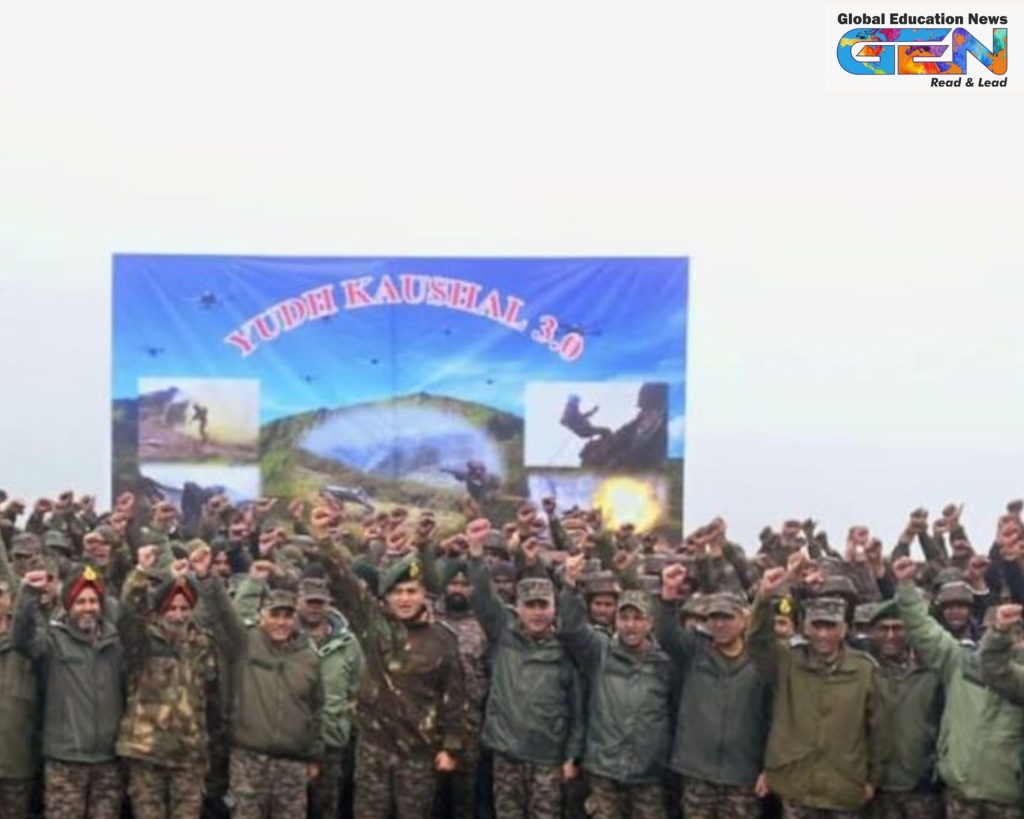
In a display of military prowess and technological innovation, the Indian Army successfully conducted Exercise Yudh Kaushal 3.0 in the rugged, high-altitude Kameng region of Arunachal Pradesh in August 2025. This large-scale multi-domain drill, observed by Lt Gen Gambhir Singh, GOC of Gajraj Corps, showcased the Army’s operational readiness, integration of advanced technologies, and collaboration with India’s burgeoning defense industry. Running parallel, the Achook Prahar exercise with the Indo-Tibetan Border Police (ITBP) further underscored India’s commitment to securing its sensitive eastern borders. Aligned with the Atmanirbhar Bharat vision, these exercises highlight India’s leap toward self-reliant, technology-driven warfare. Here’s an in-depth look at Yudh Kaushal 3.0, its significance, and its role in shaping India’s defense future.
Yudh Kaushal 3.0: A Multi-Domain Showcase
Held in the challenging terrain of the eastern Himalayas, Yudh Kaushal 3.0 tested the Indian Army’s ability to operate in extreme climates and high-altitude environments, critical for defending India’s borders with China. The exercise emphasized multi-domain operations, integrating land, air, and cyber capabilities to prepare for modern warfare challenges.
- Drone Surveillance and Strikes: The drill featured unmanned systems for real-time target acquisition and precision strikes, enhancing situational awareness in complex terrains.
- Advanced Weaponry: Precision-guided munitions and high-altitude combat systems demonstrated the Army’s capability to deliver accurate, lethal strikes.
- ASHNI Platoons Debut: The introduction of ASHNI platoons, blending next-generation technology with traditional tactics, marked a milestone in hybrid warfare readiness.
- Air-Littoral Dominance: Synchronized maneuvers showcased air-ground coordination, ensuring dominance in contested environments.
- Sustained Operations: As per Lt Col Mahendra Rawat, the exercise validated the Army’s ability to conduct prolonged operations in multi-domain settings, preparing for future threats.
Atmanirbhar Bharat: Indigenous Innovation Takes Center Stage
A hallmark of Yudh Kaushal 3.0 was its focus on indigenous defense technologies, reflecting India’s Decade of Transformation under the Atmanirbhar Bharat initiative. The exercise highlighted the growing synergy between the Indian Army and domestic defense industries, reducing reliance on foreign imports.
- Unmanned Systems: Indigenous drones, developed by firms like Bharat Dynamics Limited and startups under the iDEX initiative, were deployed for surveillance and strike roles.
- AI-Enabled Operations: Artificial intelligence-driven decision-making tools enhanced battlefield efficiency, showcasing India’s advancements in smart warfare.
- Precision Weaponry: Locally developed munitions, including Smart Anti-Airfield Weapons, proved effective in high-altitude combat scenarios.
- Industry Collaboration: Partnerships with private players like Tata Advanced Systems and Larsen & Toubro demonstrated the rapid integration of homegrown technology into military operations.
Achook Prahar: Strengthening Border Security with ITBP
From August 25–28, 2025, the Spear Corps conducted Exercise Achook Prahar alongside the ITBP in Arunachal Pradesh, focusing on joint operations along India’s sensitive border with China. This four-day drill reinforced inter-agency coordination critical for national security.
- Joint Firepower Coordination: The exercise simulated battlefield conditions, testing synchronized firepower and tactical responses to border threats.
- High-Altitude Readiness: Conducted in Arunachal’s rugged terrain, it validated the Army and ITBP’s preparedness for high-altitude warfare.
- Inter-Agency Synergy: The collaboration strengthened operational frameworks, ensuring seamless coordination between military and paramilitary forces in sensitive areas.
Strategic Context: Arunachal’s Geopolitical Importance
Arunachal Pradesh, bordering China’s Tibet Autonomous Region, is a strategically vital region, with tensions lingering since the 1962 Sino-Indian War and recent LAC skirmishes. Yudh Kaushal 3.0 and Achook Prahar underscore India’s proactive stance in bolstering defenses along the Line of Actual Control (LAC), especially after the 2020 Galwan Valley clashes and the 2022 Yangtse clash in Arunachal.
- Enhanced Deterrence: The exercises signal India’s readiness to counter potential threats, with over 50,000 troops deployed in the eastern sector.
- Infrastructure Push: Recent developments, like the Sela Tunnel and upgraded airfields, complement the Army’s operational capabilities in Arunachal.
- Global Messaging: The drills reinforce India’s strategic autonomy, balancing relations with China (post the August 2025 SCO Summit) while asserting military strength.
Challenges and Future Outlook
While Yudh Kaushal 3.0 marks significant progress, challenges remain in scaling indigenous defense production and integrating advanced technologies.
- Supply Chain Gaps: Delays in component supplies for drones and AI systems, often reliant on foreign vendors, highlight the need for a robust domestic ecosystem.
- Training Needs: Integrating AI and unmanned systems requires extensive training for troops, a focus area for the Army’s Integrated Battle Groups.
- Sustained Investment: Continued funding for initiatives like iDEX and DRDO collaborations is crucial to maintain India’s technological edge.