CURRENT AFFAIRS
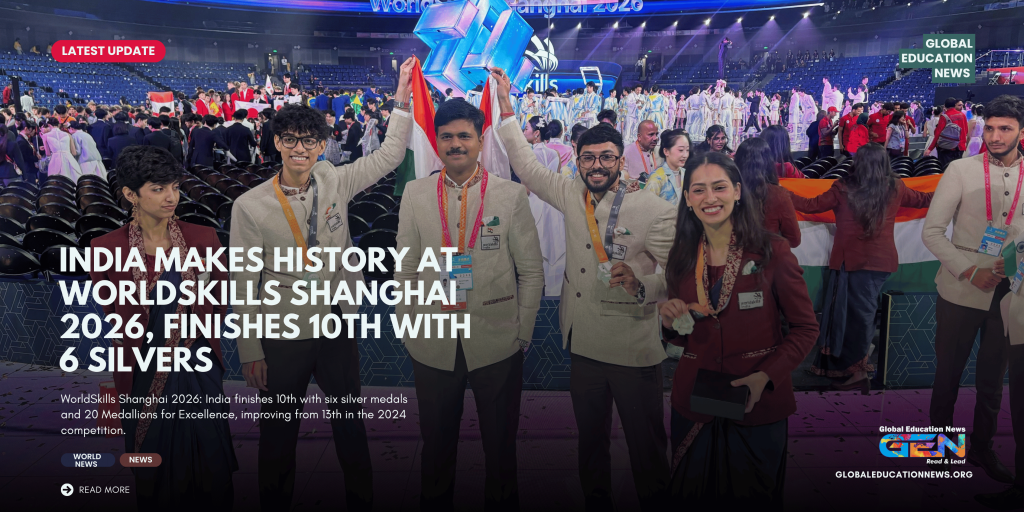
SHANGHAI, CHINA , India has finished 10th at WorldSkills Shanghai 2026, securing six silver medals and 20 Medallions for Excellence in one of the world’s biggest international showcases of vocational and technical talent. The result moves India up from 13th at WorldSkills Lyon 2024 and marks a significant shift in the country’s performance on the global skills stage.
The Indian contingent included 70 competitors across 63 skills, the country’s largest-ever participation at the WorldSkills Competition. The 48th edition brought together about 1,400 young competitors from nearly 70 countries and regions, competing across 64 skills in Shanghai.
Six Indian competitors won silver medals: Smriti Nambiar in Bakery, Mohammed Salam in Dental Prosthetics, Kovid Ajay Gangrade in Digital Interactive Media Design, Parth Vohra in Industrial Design Technology, Mehrunissa Begum in Logistics and Freight Forwarding, and Saniya Joshi in Retail Sales. Nambiar was also named India’s Best of Nation.
But the medal tally tells only part of the story.
India’s WorldSkills Shanghai 2026 Result Goes Beyond Six Silver Medals
India’s 10th-place finish reflects a broader expansion in the types of skills in which Indian competitors are reaching international standards.
The 20 Medallions for Excellence were spread across fields including intelligent security technology, mechatronics, mobile applications development, electrical installations, autonomous mobile robotics, fashion technology, health and social care, graphic design technology and automobile technology.
That breadth matters because WorldSkills is designed to test practical ability against international occupational standards rather than simply classroom knowledge.
WorldSkills says Medals for Excellence recognise competitors who achieve world-class standards in their respective skills, even when they do not finish on the medal podium.
For India, the distinction suggests that the country’s progress cannot be measured only by the six silver medals.
The Six Silver Medal Winners
| Competitor | Skill | Result |
|---|---|---|
| Smriti Nambiar | Bakery | Silver |
| Mohammed Salam | Dental Prosthetics | Silver |
| Kovid Ajay Gangrade | Digital Interactive Media Design | Silver |
| Parth Vohra | Industrial Design Technology | Silver |
| Mehrunissa Begum | Logistics and Freight Forwarding | Silver |
| Saniya Joshi | Retail Sales | Silver |
Nambiar’s victory also gave India its Best of Nation recognition at Shanghai 2026.
From 13th in Lyon to 10th in Shanghai
The latest result represents a clear improvement over India’s previous WorldSkills campaign.
At WorldSkills Lyon 2024, India finished 13th with four bronze medals and 12 Medallions for Excellence. In Shanghai, the country moved into the global top 10 while replacing those bronze medals with six silvers.
The longer trajectory is even more striking.
India finished 39th at WorldSkills London in 2011, followed by 33rd in Leipzig in 2013, 29th in São Paulo in 2015, 19th in Abu Dhabi in 2017 and 13th in Lyon in 2024. The Shanghai result marks the first time India has entered the top 10, according to recent reporting on the country’s WorldSkills performance.
The progression points to a sustained effort to build internationally competitive vocational skills rather than a one-off medal haul.
New-Age Skills Are Changing India’s WorldSkills Profile
One of the less obvious stories from WorldSkills Shanghai 2026 was India’s participation in emerging skill categories.
The Indian team made its debut in 11 new skills, including Dental Prosthetics, Intelligent Security Technology, Landscape Gardening, Optoelectronic Technology, Retail Sales, Unmanned Aerial Systems, Software Testing, Heavy Vehicle Technology and Aircraft Maintenance.
That represents a departure from the narrow perception of vocational training as being limited to conventional industrial trades.
Digital design, robotics, logistics, security technology, aircraft maintenance and software testing now sit alongside traditional technical disciplines. The WorldSkills results show how closely skills competitions are tracking changes in the modern workplace.
Women Feature Across India’s Skills Campaign
The Shanghai campaign also highlighted the participation of Indian women across technical, creative and service-oriented disciplines.
Indian women competed in areas including Logistics and Freight Forwarding, Fashion Technology, Chemical Laboratory Technology, Health and Social Care and hospitality-related skills.
The hospitality contingent offered one particularly visible example. Five Indian finalists represented the country in Bakery, Cooking, Hotel Reception, Pâtisserie & Confectionery and Restaurant Service, and all five were women. Smriti Nambiar’s silver medal in Bakery became the standout result from that group.
The participation matters beyond the competition itself: it places women in front of an international audience across occupations that combine technical precision, creativity, technology and customer-facing expertise.
What the WorldSkills Result Means for India’s Skills Push
The WorldSkills Competition is often described as an international benchmark for vocational excellence. Its format requires competitors to demonstrate practical skills under demanding conditions, with results measured against occupational standards.
For India, the Shanghai performance therefore provides a snapshot of where its skilled youth can compete globally.
The National Skill Development Corporation coordinated India’s participation under the Ministry of Skill Development and Entrepreneurship, working with industry partners, Sector Skill Councils, training institutions and technical experts.
That network is significant because international competition requires more than selecting talented competitors. It involves specialised training, equipment, mentoring, industry exposure and months of preparation.
The Government’s account of the Shanghai campaign highlights that preparation and international benchmarking were central to the team’s performance.
Why the Shanghai Result Matters for Students and Employers
The most consequential part of the result may not be the ranking itself.
India’s performance comes at a time when education and employment are increasingly converging around practical skills, technology and industry readiness. A young person entering the workforce today may need a combination of technical knowledge, digital capability, problem-solving and hands-on competence.
WorldSkills provides one highly visible international test of that combination.
The appearance of skills such as digital interactive media design, logistics and freight forwarding, autonomous mobile robotics, software testing and intelligent security technology also reflects how quickly the definition of a “skilled job” is changing.
For employers, the competition offers a pool of young talent trained to international standards. For students, it provides another route to demonstrate expertise beyond conventional academic credentials.
India’s Skills Story Is Moving Into the Global Top 10
India leaves Shanghai with six silver medals and 20 Medallions for Excellence.
But the bigger number is 10th.
After years of moving up the WorldSkills rankings, India has now entered the global top 10 for the first time. Its 70 competitors competed across 63 skills, including a growing number of technology-driven and emerging occupations.
The next challenge will be harder: turning international competition success into a wider skills ecosystem in which high-quality vocational education, industry training and globally benchmarked expertise become accessible to far more young Indians.
Shanghai has shown what the country’s strongest young competitors can do.
The question now is how widely that capability can spread.