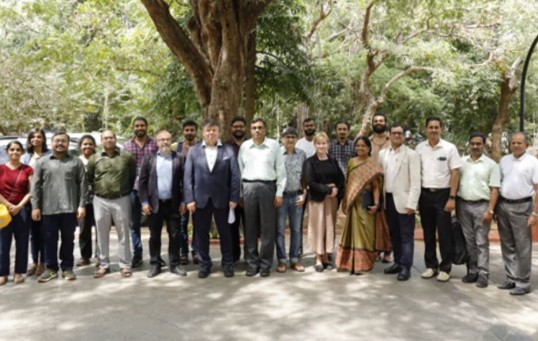
In a significant global academic collaboration, the Indian Institute of Technology Madras has partnered with the Finnish Meteorological Institute to establish the VAYYU Research Centre—a virtual hub dedicated to climate science, atmospheric research, and air quality modelling.
This initiative is more than a research partnership—it represents a strategic convergence of technology, environmental science, and global education, with implications for both scientific advancement and student opportunities.
1. What is VAYYU? Understanding the Research Centre
The VAYYU (Virtual Research Centre) focuses on three critical domains:
Core Research Areas
- Aerosol–meteorology interactions
- Himalayan atmosphere–cryosphere dynamics
- Urban air quality and pollution modelling
The centre aims to combine advanced simulations with real-world atmospheric observations to understand how aerosols impact climate systems, including monsoons, glacier melt, and air pollution.
2. Why This Collaboration Matters
Strategic Importance
- Strengthens Indo-Finnish scientific cooperation
- Aligns with India’s climate and sustainability goals
- Supports global climate change research and policy development
By integrating IIT Madras’s engineering expertise with Finland’s strengths in weather prediction and atmospheric science, the initiative aims to deliver high-impact climate solutions.
3. Research Focus: Tackling Real-World Climate Challenges
The VAYYU centre is designed to address some of the most pressing environmental issues.
Key Scientific Objectives
- Study aerosol impact on monsoon patterns and hydro-climate
- Analyse Himalayan glacier melt and snow dynamics
- Improve urban air quality forecasting in Indian cities
- Develop climate-risk assessment models
These efforts are crucial for understanding extreme weather events, water security, and pollution control in India and beyond.
4. Built on Strong Research Foundations
The initiative builds on two major international projects:
Existing Collaborative Projects
- CryoSCOPE Project
- Focus: Glacier melt and Himalayan climate systems
- Includes a monitoring supersite in Kargil
- CO-ENHANCIN Project
- Focus: Urban air quality and atmospheric observations
- Led to the creation of a high-tech observatory in Chennai
These projects provide data infrastructure, funding, and scientific groundwork for VAYYU’s expansion.
5. Opportunities for Students and Researchers
One of the most impactful aspects of VAYYU is its focus on academic and career development.
Key Opportunities
- Student and faculty exchange programmes
- Joint PhD supervision and interdisciplinary research
- Summer internships and winter schools
- Access to advanced supercomputing facilities
This creates a global learning ecosystem, especially beneficial for students preparing for competitive exams like JEE Advanced 2026 and aspiring to enter cutting-edge research fields.
6. Role of Technology and Innovation
VAYYU leverages advanced tools and technologies:
Technological Integration
- High-resolution climate modelling systems
- AI and machine learning for atmospheric analysis
- Advanced instruments like lidar, radar, and aerosol analysers
Such integration ensures data-driven insights and predictive accuracy in climate science.
7. Policy and Global Impact
Broader Implications
- Supports evidence-based environmental policymaking
- Enhances climate resilience strategies
- Contributes to Sustainable Development Goals (SDGs)
- Strengthens India’s position in global climate research
The collaboration is also seen as a milestone in science diplomacy, connecting nations through shared environmental goals.
8. Critical Analysis: A Forward-Looking Initiative
Strengths
- Combines global expertise with local challenges
- Focuses on interdisciplinary and applied research
- Offers strong academic and career pathways
Challenges
- Requires sustained funding and global cooperation
- Dependence on high-end infrastructure and data systems
- Translating research into policy-level impact